For about six years of my life I was late on purpose, and I thought it made me interesting. So when someone asks me how to stop being late, they are asking a reformed offender.
I learnt it from the man I shared a flat with in my twenties. He was late for everything, and everyone waited: waiters, his brother, me in my coat by the front door with my handbag already on my arm, listening to him look for a cufflink. To a girl who had no say over anything, being waited for looked like power. So when I finally had places of my own to go, I copied him. Ten minutes. Fifteen. I believed I was making an entrance. What I was actually making was a small withdrawal from everyone else's evening, and calling it style.
Here is the answer I wish someone had given me at twenty-six. Stop planning the moment you arrive and start planning the moment you are standing at your own door with your coat on. Build the day backwards from that minute, leave a margin you intend to spend, and start nothing new in the quarter of an hour before it. Lateness is almost never decided on the road. It is decided in the hour before you leave, usually over something that didn't matter.
What chronic lateness tells the people who are waiting
There is a house rule I wrote with that younger version of myself in mind:
"Lateness is theft wearing perfume."
Theft, because the minutes were theirs. They got dressed for a certain time, they turned down something else, they paid for the parking. Perfume, because the chronically late are nearly always charming about it. They arrive in a gust of apology and anecdote, and the anecdote is often very good, and everyone laughs, and the minutes are still gone.
I learnt what it looks like from the other side of a counter. After I left him, with a good deal less charm than I'd arrived with, I took a job behind the reception counter of a hotel whose lobby clock ran two minutes fast. It was brass, it hung above the pigeonholes where we kept the keys, everyone who worked there knew about it, and nobody fixed it. One morning a man in a grey overcoat came down at 8:52 and sat in the lobby with a folded newspaper he didn't read. He had a nine o'clock with someone. At 9:24 she came through the revolving door, laughing, unwinding a scarf.
"You won't believe the traffic," she said.
"I believe it," he said. "I've been watching it from the window since a quarter to."
He was perfectly pleasant for the next hour. I have no idea how their business turned out. I do know he had booked the room for two nights and checked out after one, and when I handed him the bill he looked at the brass clock and said, to nobody in particular, "Fast, isn't it." I still think of it whenever somebody blames the traffic. He wasn't angry. He had simply adjusted his opinion of her by twenty-four minutes, and he was a man who did his sums.
That is what being late tells people, whatever your reason. It tells them where they rank. You may not mean it. They will hear it anyway.
Why chronically late people are rarely selfish
I want to be fair here, because the people I have known who ran late were, most of them, warm and generous and overcommitted. Selfish people are often perfectly punctual. They simply don't care what happens to you after they arrive.
What I noticed, in myself and in the lobby, was a handful of habits rather than a character.
The first is optimism about duration. You remember the fastest version of every trip. The Sunday morning when the lights were all green becomes, in your head, how long it takes. It has taken that long once.
The second is the last small task. There is always one more thing that seems to fit before you go: an email, the dishwasher, a quick reply to your sister. Each one takes four minutes, and you do three of them.
The third is harder to admit, and I'll admit it first. Many late people are uncomfortable arriving first. Standing alone in a restaurant doorway, or sitting at a table for two with nobody opposite, feels exposed, as though everyone can see you were eager. So some quiet part of you arranges never to be the one who waits. I did exactly this for years and told myself it was sophistication. It was nerves in a good coat.
None of these make you a bad person. All of them can be fixed with arithmetic and a book.
How to stop being late: plan the door, not the arrival
Here is the method, and it is less glamorous than you'd like.
Choose your door time. This is the minute you will be standing at your own front door, keys in hand, coat on, ready. Not the minute you'll arrive. The arrival is the result; the door time is the decision. Write it down, or set an alarm with a label that says where you are going, so that at 7:15 your phone says "Door. Dinner with Anna" rather than a noise you will snooze.
Time the real route once. The next time you make a trip you make often, look at the clock when you leave and when you get there, and write both down. Do this for the usual five or six: work, your mother's house, the station, the good restaurant, the school. Most people are shocked. The walk to the station that "takes ten minutes" takes seventeen, with the crossing and the stairs. You have been late by seven minutes every day for years and blaming the trains.
Add a margin, and then give the margin a job. This is the part that cured me. A margin you intend to waste feels like losing, and you will quietly cut it. A margin with a purpose feels like a gift. I always carry something to do with the ten spare minutes: a thank-you card to write, a book I'm halfway through, a list for the week. Now arriving early is where I get my reading done, and I resent it far less than I resented the waiting I used to cause.
Start nothing new in the last fifteen minutes before your door time. Finish what's in your hands. Do not open the email, do not begin the phone call, do not decide this is a good moment to water the plants. That quarter of an hour is for shoes, keys, one look in the mirror, and out.
Lay tomorrow out tonight. Clothes on the chair, bag packed, the thing you need to bring by the door where you'll trip over it. A morning with no decisions in it runs on time by itself.
The hour before is where you lose it
Another house rule: "The first hour sets the price of the whole day." I've found it's also true of the hour before anything that matters. If that hour is calm, you arrive calm. If it is spent hunting for a phone charger, you arrive having already lost an argument with yourself. Late is a decision you made an hour ago. The clock only reports it.
Being on time is therefore not about the last dash. It is about what you allow into the preceding hour. When I have somewhere important to be at eleven, I don't take calls after ten. I don't try to squeeze in a small errand on the way, because the small errand is always the one with a queue. I dress early. I sit down for five minutes with my coat on the back of the chair. Then I go.
If that sounds rigid, try it once and notice how you feel when you walk in. Most people have never arrived anywhere unhurried, and it changes the first ten minutes of every conversation. You are listening, instead of catching your breath. Nobody walks in well while they're still out of breath, and the ten seconds at the door that make a confident entrance are wasted on someone who has just taken the stairs two at a time.
What to say when you are going to be late anyway
You will be, sometimes. Trains break. Children are sick on the stairs. What counts is how you carry it.
Send word before the agreed time, never after. A message at 7:58 for an eight o'clock is courtesy. A message at 8:09 is a confession. Give a number, apologise once, and release them from waiting:
"I'm running twelve minutes behind, I'm so sorry. Please order a drink on me and I'll be with you at ten past."
What you never send is the saga: the nightmare day, the phone that died, the traffic that nobody could have predicted. Nobody at the table needs the reasons. The reasons are the perfume.
When you arrive, don't apologise a second time. Sit down, look at them properly and say, "Thank you for waiting." It turns the whole thing from your failure into their kindness, which is where it belongs. Then give them your whole attention until the bill comes, and let the matter drop. If you keep returning to it, you make them spend the dinner reassuring you, and now you've taken their minutes twice.
If you are the one kept waiting, by the way, be gracious about it. Order the drink. Read your book. Say "Not at all" and mean it. People remember who made them feel forgiven.
Arriving early without hovering in the doorway
Punctuality has one small trap, and the very organised fall into it. Being early is lovely. Being at someone's front door twenty minutes early while they are still in a towel is not.
Early is for you. On time is for them. So arrive in the area early, and at the door on time. Walk round the block. Sit in the car with your book. Have a coffee at the counter of the café on the corner. For a dinner at someone's home, ring the bell at the stated hour or a few minutes after, never before. For a meeting, a restaurant or a train, be there with ten minutes in hand and use them.
And learn to enjoy being the first one at the table. Order a glass of water, put your phone away, and look around the room. You get to choose the seat facing the door. You watch everyone else arrive in a rush. It is one of the few free luxuries left, and the late never get to have it.
The same courtesy runs the other way at the end of the night. An evening has a door at both ends, and knowing when to leave a party is only punctuality in reverse.
What punctuality does to a reputation over years
Here is the part nobody tells you. Being on time is barely noticed on any single day. Nobody thanks you for it. The man in the grey overcoat got no applause for being at the lobby at 8:52.
But over a year, over ten years, it becomes what people say about you when you aren't there. "She's always on time." It sounds like nothing. In practice it means you can be trusted with the start of things: the first meeting, the early flight, the hard conversation. It is one of the plain habits that make people take you seriously before you've opened your mouth, and respect earned without a word is mostly built from habits exactly this dull. You are not asking for respect. You are simply never the reason anyone waited.
And it does something to you, privately. Every time you arrive when you said you would, you have kept a small promise. Do that for enough years and you start to believe your own word, which is rarer than you'd think.
The diary, and the one I wrote you
My grandmother kept a diary all through her years as a dressmaker, and she wrote in it the way she sewed, small and exact. On one page, between a note about a bodice and a complaint about the price of thread, there is this:
"Mrs. H. was never late for a fitting. She said a woman who keeps a seamstress waiting will keep a husband waiting, and a bank."
I'd read that line a dozen times before it landed. It landed in my mid-thirties, on the morning a client I badly wanted had paid for her coffee and gone by the time I came through the café door, eleven minutes late, with a very good story about a bus. The waiter handed me her card. On the back she'd written, "Another time, perhaps." There wasn't one. I have not been late for anything that mattered since, and it had nothing to do with becoming a better person overnight. I finally understood that time was the first thing people would judge me by, long before they had any idea what I could do.
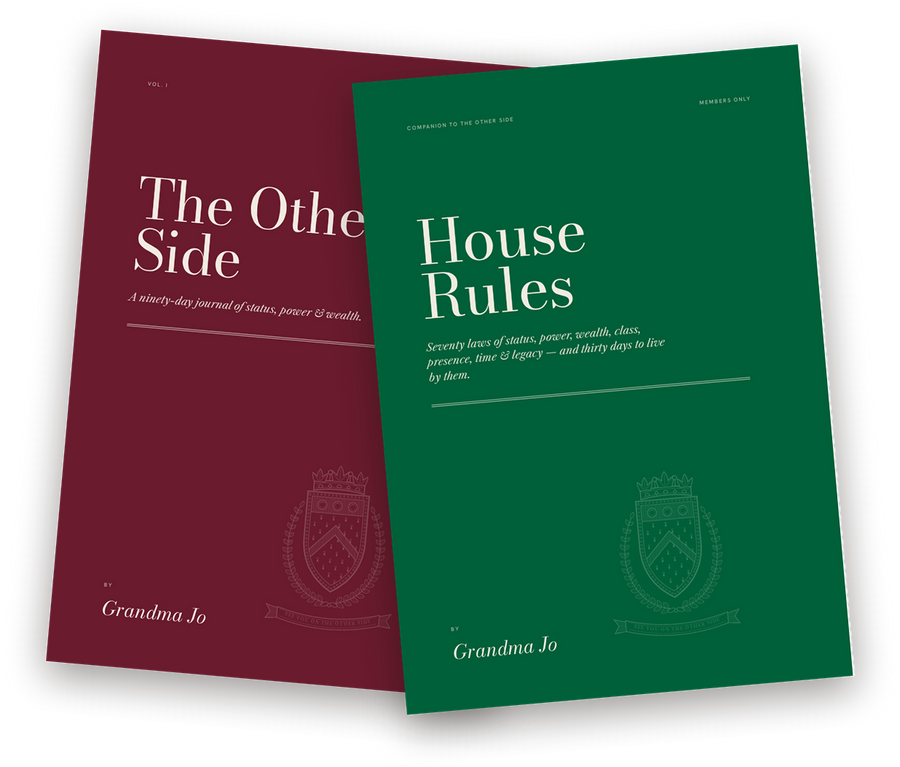
She left me a diary. I have written you one. The Other Side runs for ninety days, and one of the last things it asks of you each evening is a line called Tomorrow: the one thing that has to happen the next day. Many evenings mine simply says the door time. "Out at 8:40. Coat on the chair." It's a small line, and it has kept more appointments for me than any alarm. Order The Full House tonight and you can write tomorrow's door time before you go to bed.
I'll stop there. I'm meeting my granddaughter at four, and she has taken to arriving at twenty to, purely to catch me out.