Write it by hand, send it within two days, and put one detail in it that only you could have noticed. That is how to write a thank you note, and it is very nearly all there is to it. The rest of this piece is for the moment your pen hovers over the card and you find yourself writing "Thank you so much for everything" because nothing else will come.
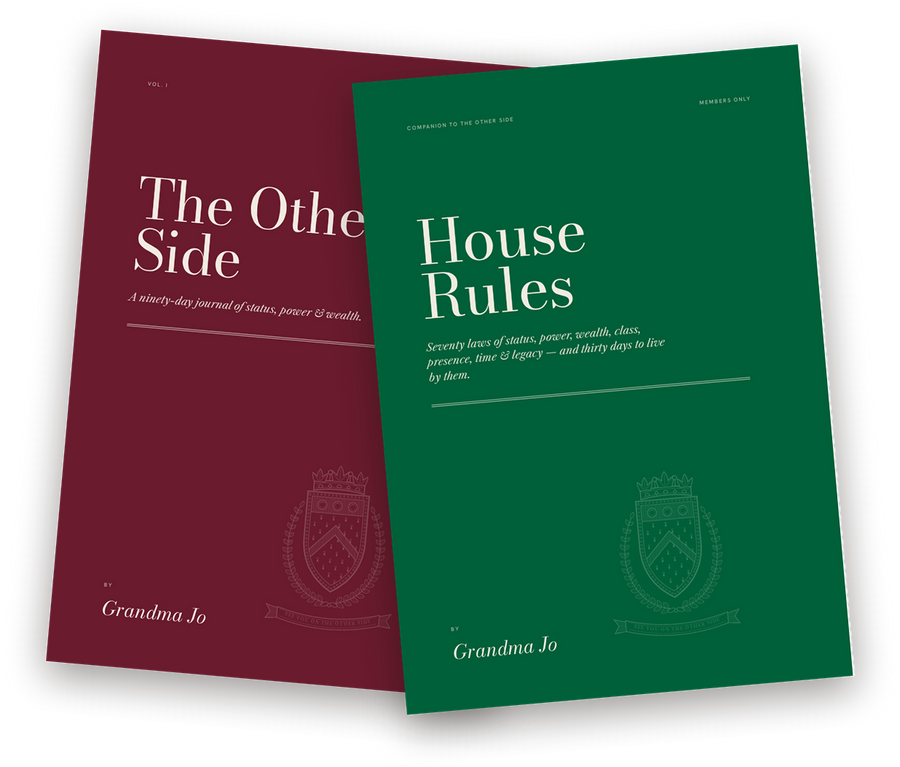
House Rule 34 is printed in House Rules exactly like this, and I'll quote it because I believe every word of it:
"Thank-you notes. By hand. Always. It's the cheapest luxury in the world."
In the top drawer of my desk there is a card the size of a playing card, cream, a little foxed at one corner. It came from the first woman who ever gave my small firm real work. Three lines in blue-black ink: "Thank you for Tuesday. You were the only one who asked about my deadline before my budget. I shan't forget it." I have moved house four times since. I've given away furniture, letters from men and a very good fur coat I no longer agreed with. The card stays.
I tell you that so you understand what you're making when you sit down with a pen. It isn't a chore you're ticking off. You are making something another person may keep in a drawer for thirty years, and it takes about four minutes.
Why a handwritten thank-you note still does what a message can't
A message lands in the same place as the gas bill, the group chat about the school fête, a reminder from the dentist and a man trying to sell you a warranty. It's read in the queue at the chemist and gone by the time the queue moves. A card arrives on its own. Someone has to open it with their hands. It sits on the hall table or the mantelpiece for a week, and every time they walk past it they remember that you thought of them twice: once when they did the kind thing, and again when you sat down to say so.
That second thought is the entire value. A handwritten thank-you note is effort that can't be produced in bulk, which is why it reads as expensive. Of all the small signals that make a person look expensive, it has the lowest price and the longest life. A card, a stamp, four minutes, and it looks like a fortune.
I'm not saying messages are forbidden. If a friend drives you to the airport at five in the morning, text her from the gate. Then write the card when you're home. The message is the receipt. The note is the thanks.
How to write a thank-you note without a template
Everyone wants a formula, and the internet will give you one: greeting, thanks for the specific gift, how you'll use it, a nod to the future, thanks again, sign-off. It's perfectly sensible and it produces notes that read like a form from the council. People can smell a template the way they can smell a room that's been sprayed instead of aired.
My grandmother made dresses for women who received a great many letters. She wrote this in her diary, in the small slanted hand I know better than my own:
Mrs H. keeps every letter she is sent in a hatbox under the bed. She told me she reads each one twice, once for what it says and once for who took the trouble. The ones she keeps are the ones that noticed something.
Noticed something. That's the method, if you insist on having one. Before you write a word, ask yourself what you saw that nobody else will bother to mention. That she'd put the good glasses out on a Tuesday. That he stayed after the meeting to walk you to the lift. The one question in the interview that made you stop and think. Write that down in plain words and the rest of the note grows around it.
So: say who it's to. Say the thing you noticed. Say what it did to you, in one sentence. Stop. If something natural follows ("I'll bring the lemon cake next time"), add it. If nothing does, don't invent it. Warmth doesn't need a structure; it needs a detail.
Here is where I got it wrong for years. When I first started writing notes properly, in my early thirties, I thought they had to be impressive. I drafted them on scrap paper. I used "delightful" and "wonderful" in the same sentence. I wrote long notes, which meant I wrote fewer of them, and I sent them late, because a long note needs a free evening and I never had one. A woman whose dinner I'd been to, kind and extremely dry, said to me a month afterwards: "Jo, your letter was lovely. It came after I'd forgotten the dinner, so it was rather like being thanked for somebody else's party." I have never forgotten it. Short and on time beats beautiful and late, every single time.
Thank-you note examples for the occasions that trip people up
None of these is for copying word for word. They're here so you can see the shape: short, specific, finished. Change every noun.
After a dinner
Dear Helen, Thank you for Saturday. I keep thinking about your father telling the story of the ferry while your mother pretended she didn't know the ending. I haven't laughed like that at a table in months. With love, Jo
After an interview
Dear Mr Okafor, Thank you for this morning. Your question about what I'd stop doing in my first month has stayed with me all afternoon, and I'd enjoy answering it properly if we speak again. With thanks, Anna Reid
Keep this one plain. It isn't a second cover letter and it mustn't read like pleading. You are thanking a person for their time and showing that you listened. That's all it has to do.
For a gift you didn't love
Dear Aunt Mary, Thank you for the scarf, and for remembering how cold I get waiting on the platform in January. It was so like you to think of that. Much love, Sophie
You thank the thought, which is always real, and you never lie about the object. Nobody needs to know it's orange.
For money
Never write the amount. The house rule about never naming what a thing cost holds just as firmly when the money was somebody else's kindness; a figure on the card turns a gift into a receipt. Say what it's going towards, if you know, and what the gesture meant.
Dear Grandpa, Thank you for the birthday card and what was tucked inside it. It's going towards the pottery course I told you about at Easter, and the first bowl that doesn't collapse is yours. Love, Ben
To someone who helped when things were bad
Dear Ruth, I don't think I said it properly at the time. You left soup on the Thursday and didn't stay to talk, which was exactly right. I still have your pan. It's clean, and I'll bring it back when I'm ready to see people. With so much love, Clare
These notes can wait longer than any other kind. A card three months after a funeral is still received as a kindness, and nobody is counting.
To someone who can never return the favour
Dear Mr Patel, Thank you for keeping my parcel back on Friday when my train was late. It was my granddaughter's birthday present, and she never knew how close it came. Kind regards, Josephine
This is the note people skip, and it does more than all the others. Mr Patel can't promote you, introduce you or invite you anywhere, which is exactly why the card matters. It is the only test of class that counts, taken in ink, with a stamp on it.
To someone who said no
Dear Catherine, Thank you for seeing me, and for being so clear. I would rather have a straight no from you than a maybe from anyone else. I hope our paths cross again. Best wishes, Daniel
Almost nobody writes this one, which is precisely why the person who does is remembered when the next thing comes up.
The mistakes that make a note forgettable
I read other people's notes whenever I'm allowed, which is more often than you'd think; people show you the ones that moved them and quietly bin the rest. The forgettable ones fail in the same handful of ways.
They're about the writer. "I'm so sorry this is late, things have been mad, work's been a nightmare, anyway…" Three lines about your week before you've mentioned their kindness. Over-explaining yourself is a costly habit anywhere, and nowhere does it cost more than on a card with room for sixty words.
They're vague. "Thank you for everything, it was lovely." Lovely is the word we use when we weren't paying attention.
They gush. Exclamation marks in threes, "amazing", "incredible", a row of little hearts. Excitement on paper reads as effort to seem excited. Warm and composed goes further, and lasts longer in a drawer.
They lunge at the future. "We must do it again soon, let's put a date in, I'll call you." If you mean it, call. If you don't, a note that closes cleanly is kinder than a promise you'll spend six months dodging.
And they're typed. I'm sorry, but a printed card with a typed message and a signature in pen is a letter from a company.
How to thank someone when you've left it far too long
Everyone has one. The wedding present from two summers ago. The man who introduced you to the woman who gave you the job. The longer it sits, the bigger the note seems to need to be, and the bigger it gets, the less likely you are to write it. It's the same trap I fell into with my long drafts.
Break it tonight with a short one. One line of acknowledgement, and then straight on to the thanks:
Dear Tom, This is shamefully late and no less meant. Your introduction to Sarah changed the whole of my last year, and I think of you every time I walk into that building. Thank you. Mark
"Shamefully late and no less meant." That's the only apology it needs. Say sorry once and get on with the thanks; a paragraph of grovelling only hands them a second thing to forgive. People don't count the days nearly as closely as you fear. They notice whether it came.
Paper, pen and the four minutes you think you don't have
Now the practical part, because good intentions die in the hunt for a stamp. Keep a box. Plain cards, cream or white, with envelopes that fit; a book of stamps; an address book that's up to date; a pen you enjoy. Mine live in the left-hand drawer, and I restock when there are five cards left, the way you'd buy milk before the last of it.
Write the note the same day or the next. Not at the weekend in a batch: batches read like batches. Think of the one thing you noticed, write it, address the envelope, stamp it and leave it by the front door so you have to step over it on the way out. The whole business is shorter than the time you spent deciding what to wear to the dinner.
Your handwriting doesn't matter. My grandmother's was beautiful. My grandson's looks as though a spider fell in the inkwell and walked home, and his cards, addressed to GRANDMA JO in capitals, are the ones on my fridge. Write slowly and it will be legible. That's all anyone asks of it.
I hear the same three objections whenever I bring this up, so let's have them out. "I haven't the time." You have four minutes; you've spent longer than that reading this far. "Isn't stationery a bit of a woman's thing?" The most devastating note I ever saw was written by a retired naval officer to a young waiter who'd found his reading glasses under a banquette, in a hand like barbed wire. I saw it years later, framed beside the till. Nothing in rule 34 asks who is holding the pen. And the honest one: "I'll start, and I won't keep it up."
That last one I take seriously, because it was true of me for years. Good intentions about cards live in your head, and your head is busy. What made it stick was moving the intention onto paper the night before. Each evening in The Other Side has a short line called Tomorrow, and on most nights mine now holds a name: the neighbour who took in a parcel, the young man who sent me his reading list. The name goes down at bedtime, the card goes in the post by lunch, and that small hinge between one day and the next does what willpower never did for me. The Full House has ninety evenings of that line. Skip a week and the cards are still owed, which is the right way to see it: no fresh start, no sackcloth, just the next card.
Gratitude you only feel is a private matter. Put it on paper in your own hand, while it's still warm, and it becomes something another person can keep.