"You walk in like you've come to read the meter."
Irene said it, the head housekeeper at the hotel where I was the most junior thing behind reception: a woman with starched collars and no patience before nine. I was in my twenties, newly out of a life I hadn't chosen, and I had come into the staff room sideways, handbag clutched to my stomach with both hands like a shield. She wasn't being unkind. She was being accurate, which is rarer and more useful.
So, the short version, for anyone who typed how to walk into a room confidently while standing outside a party they're already late for. Stop one step inside. Take one slow breath and let your eyes cross the whole room once. Choose where you're going. Then walk there at the pace of someone who was expected, because you were. That's all of it, and it takes about ten seconds. Everything below is those ten seconds slowed right down, the way my grandmother would have slowed them if she could have stopped a customer mid-step and chalked the hem.
She made dresses for a living and watched her customers come through the workroom door for forty years, and she kept notes on them the way other women kept recipes. One of those notes sits under everything I'm about to tell you:
"Mrs D. stops in the doorway as if the room were a coat and she has not yet decided whether to buy it."
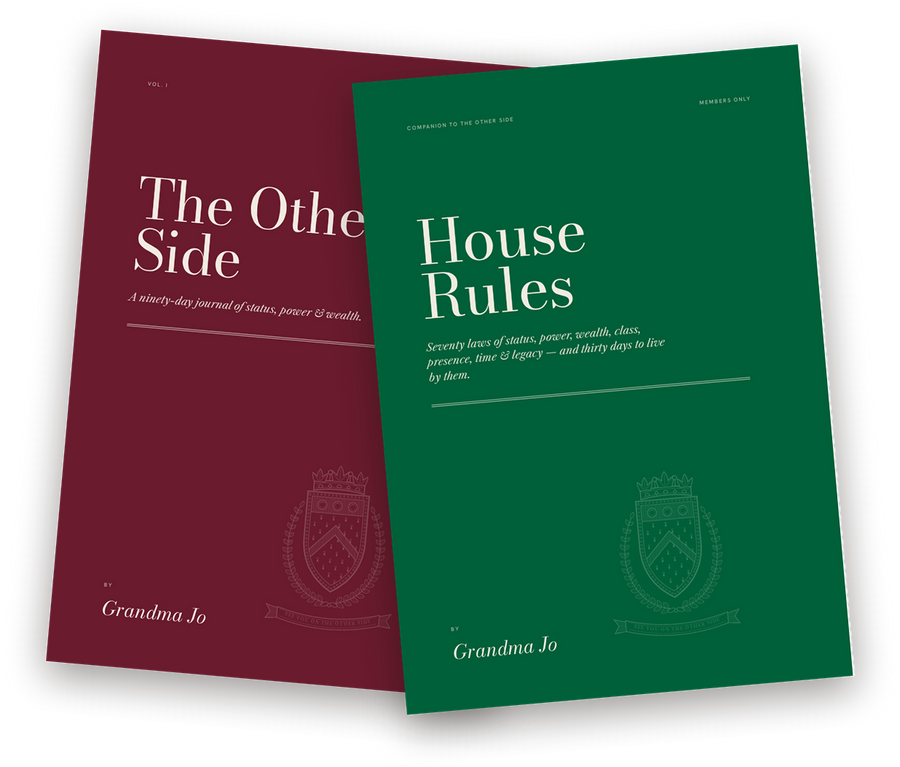
Rule 42 in House Rules is the modern version:
"Walk in as though you were expected. Because, darling, you were."
Let me walk you through a single evening. A Saturday in October, a friend's sixtieth birthday, the upstairs room of a restaurant with a narrow staircase and a door whose brass push-plate had worn pale in the middle from forty years of hands. Forty-odd people I half knew. I'll give you the clock as we go.
7.36 p.m. The pavement, where the room actually starts
Your entrance is decided about two minutes before you reach the door. The mistake most people make is to arrive still in the mood of the street: phone in hand, finishing a message, coat half-buttoned, rehearsing the apology for being late. You carry all of it up the stairs and it walks in ahead of you.
So on the pavement I do three small things. I put the phone away, properly away, in the bag and not the pocket, where my hand would keep finding it. I let my shoulders drop, since on the drive they have usually climbed to somewhere near my ears. And I decide what I'm glad about.
Not what I'm nervous about. What I'm glad about. That evening it was easy. At forty, Margaret had told me over a very bad bottle of wine that she wouldn't see fifty-five with that husband. She was turning sixty in a green silk shirt, and he was in Portugal, and everyone was happier for it, including, I'm told, Portugal.
Rule 45 is the reason for this little ritual: "Walk in hungry for approval and everyone can smell it. Walk in glad to be there and they can't look away." Gladness costs nothing and fits everyone. Nervousness, oddly, fits no one, though we all insist on wearing it.
7.39. Leave behind everything you'd hide behind
Before the door comes the cloakroom or, where there isn't one, the chair on the landing where everyone has flung their coats. Leave as much as you can there. The coat, the umbrella, the scarf you would otherwise fiddle with, the present (hand it over later or put it on the table meant for it). Confident body language begins with empty hands. The moment you're carrying things, you look like someone who has come to deliver them.
That was Irene's point about the meter. I held my handbag in front of my body with both hands, and you'll see the same gesture in any room: the drink held at the chest, the phone held like a hymn book, the folder clutched to the ribs, the evening bag gripped like a railing on a ship. It's a barricade. Everybody reads it as one, even people who couldn't tell you why they've decided you're nervous.
Put the bag on your shoulder, on the side away from where you'll shake hands. Let your arms hang. They'll feel enormous for the first few seconds. They aren't, and nobody else is looking at them.
7.41. The first second is a full stop
Now the door. You push it open (the brass, cold under your palm) and step in, one pace, and slightly to one side so you're not blocking whoever is coming up the stairs behind you. Then you stop.
This is the part people skip, because stopping feels exposed. It is exposed. That's rather the point. Someone who stops just inside a room is someone in no hurry to hide, and the room registers that without knowing it has registered anything.
I used to do the opposite, and I did it for years. I came into rooms at speed, eyes down, heading for the one fixed point I could see (usually the bar, occasionally the ladies'), as if I'd been sent to fetch something. I believed moving fast looked purposeful. It looked like flight. I learned the pause, in the end, from the other side of a reception desk, where you watch hundreds of people come through revolving doors and notice that the guests who stopped and took in the lobby before they approached were very often the ones whose names we already knew.
One breath, then. In through the nose, slowly, and out again. That's your whole first second, and a little of the second one.
Seconds two to four, or how to walk into a room confidently with only your eyes
While you're standing there, you look. Not at the floor, and not for one particular face you're desperate to find. You let your eyes travel the whole room once, left to right, at the speed you'd read a menu you're in no hurry to order from.
What are you looking for? The host, the drinks, and the person standing alone. You should be able to find all three in a single sweep. That evening: Margaret by the far window, laughing with her head back. The drinks on a long table to the left, where a boy of about twenty was opening prosecco with enormous care, as if it might go off in his hands. And by the fireplace, holding a glass of orange juice and plainly counting the minutes, a tall man in a brown cardigan whom I had never seen before.
Your face does something while your eyes travel. Let it. Keep your chin level (lifted reads as a challenge, lowered as an apology) and let a small private pleasure settle around the mouth: the look of someone who has just remembered something nice. It isn't a smile for anyone in particular. It's a smile for the room in general, which uses a different muscle and gives a different message. A smile aimed at one person asks them for something. A smile at the room asks for nothing at all.
Seconds five to seven, when you choose where you're going
If there's a secret, it's this. People who walk in like they belong always have a destination. They aren't wandering in the hope of being rescued. They've chosen.
The order I use is the host if they're free, the person on their own if the host isn't, and the drinks table if neither. Never the corner. Never the wall. Never the loo unless you need it, in which case go, come back, and do the door again. A second entrance is perfectly allowed and underrated.
Choose before your feet move. Your body gives you away if you decide mid-step. You'll see people take three paces in, stop, look about, change course and stop again, like someone who has lost their husband in a department store. Decide on the threshold, then go.
I chose Margaret. She was in the middle of a story, so I went by way of the drinks, which gave her a minute to finish, and planned the man in the cardigan for afterwards. Three stops. A small itinerary for a small room. It sounds calculated, and it is, a little, in the way that laying a table is calculated. Nobody at dinner resents the fork for being where the fork should be.
Seconds eight to ten, the walk itself
Now you walk. Pace matters more than posture, though posture matters too.
The pace is about a third slower than you'd walk to catch a train. I don't run for buses, and I'm certainly not going to cross a birthday party as if it might leave without me. Slow feet say you have time. Time is the first thing people with status have and the last thing they show off about.
For the posture, imagine someone kind has lifted the back of your collar half an inch. Shoulders down. Feet pointing where you're going rather than splayed apologetically at the corners. Hands empty and loose or, if you've collected a glass, holding it low at the waist, not up at the chest like a microphone.
And look where you're going, which sounds obvious and isn't. Most nervous people cross a room scanning the faces they pass for a welcome, table by table, like someone checking for their name on a list. Look at your destination. If someone catches your eye on the way, give them a small nod and keep moving; you'll come back to them later. Expected people don't need permission from every table they pass.
7.55. When it goes wrong, which it will
Something will go wrong at some point. It did that night. Halfway to Margaret my heel caught the edge of a rug and I did a sort of half-curtsey, half-stagger that made the boy with the prosecco look up in real alarm.
What you do in the next two seconds is more of an entrance than anything in the ten before. You don't apologise to the room. You don't laugh too loudly or glare at the floor as though it had insulted your mother. I said to the boy, "The rug and I have agreed to disagree," took a glass from him, thanked him by name (he had a badge), and carried on at exactly the pace I'd had before.
A confident entrance is rarely a perfect one. Nobody remembers how you crossed the room. Everyone remembers what you did when the room crossed you.
The other thing that goes wrong is quieter. Nobody looks up. You've done the pause and the sweep and chosen your destination, and the room carries on talking as if you'd been there all along. Good. That's the best entrance of all, because now you have the room before it has you. Take your time. Find your host. Being expected has never required applause.
8.10. The man in the brown cardigan
I'd planned him for after Margaret, and after Margaret I went to him. I stood beside him rather than in front of him, facing the room as he was, and said: "I'm Jo. I've known Margaret since she had terrible taste in men, which is to say a long time. How do you know her?"
He was her new neighbour. She'd invited him that morning over the garden fence and he had very nearly stayed at home. We talked for twenty minutes about his roses and her dog, who digs under the fence to visit the roses. Before I moved on I introduced him to two people by name, and when I looked back an hour later he'd put the orange juice down and was telling a story with both hands.
I mention him because this is the part of an entrance nobody teaches. Once you know how to walk in, you're in a position to help somebody who didn't. The person who walks in like she belongs acquires, very quickly, the power to make other people belong too, and I know of no better use for it. The woman in the grey coat who once got the last room in my hotel without raising her voice did exactly this for a flustered girl behind the desk; her story, and what she said to the night manager, is worth your time.
11.05 p.m. The other door
Entrances get all the attention, but exits are what people remember on the way home. I left a little after eleven, while the room was still warm, thanked Margaret, found my coat at the bottom of the pile and went down the narrow stairs without making a speech about it. It's the same skill run backwards (stop, look, choose, go), and leaving a party gracefully has its own set of lines for the host and the hall.
Practise the ten seconds before you need them
You can't learn any of this at the party itself. At the party you're busy. You learn it on ordinary days, walking into the kitchen, the office, the bakery, a lift full of strangers. Stop. Sweep. Choose. Go. Twenty times a day with nobody watching, until your body does it before you've thought to.
That's what the Presence week of The Other Side is built for. The morning page ends on what I call the move, a single small thing you promise to do before bed. For those seven days mine were all doors. "Pause inside the ten o'clock and find the person on their own." "Stop in the bakery doorway and look before I queue." "Leave the umbrella in the car." Written at breakfast, the sentence is waiting for you at ten o'clock with your hand on the door, which is the only moment it's any use. The first week is humbling. When Presence comes round again in the second half of the ninety days, you're no longer hoping you can do it. You have seven dated lines in your own hand saying you did.
The journal comes in The Full House, and the whole set costs less than the bottle of champagne you'd carry up those stairs for the birthday girl. The champagne is gone by midnight. The ten seconds at the door go with you into every room after it.
So. Some Saturday soon there will be a door with a brass plate worn pale in the middle, noise behind it, a heap of coats on a chair on the landing. You'll put your phone away on the stairs. You'll step in, one pace, to the side. And for one breath, before anyone has seen you, the room will be entirely yours.