There is a small gold watch in the second drawer of my dressing table that I only wear in the evening. Its face is about the size of my thumbnail, and you cannot read it from across a table, which is the point: nobody sees me check it. I turn my wrist as though I'm settling a bracelet, and I know exactly where I am in the night.
That watch is most of how to leave a party, really. I decide when my evening ends before I leave the house (not the host, not the last bottle, not the friend who insists the night is young), and when the hand gets there I find the host, say one warm sentence and go while the room is still at its best. House rule 57 says it in fewer words than I can:
"Always leave while they still want you to stay."
Everything below is how. I've written out the actual words, because knowing you ought to leave is easy. Saying so at the door, with a glass in one hand and somebody's cousin describing his kitchen extension, is where people come apart.
Why leaving early beats staying until the end
I used to believe the opposite, and I believed it for years. In the early days of my own business I was convinced the real conversations happened after midnight, when the ties came off and people said what they meant. So I stayed. At one party I stayed until the carriage clock on the host's mantelpiece said ten to two, and I can tell you precisely what happened in the final hour: a man with a very nice watch (not as nice as mine) explained the engine of his boat to me three times. By the third telling I could have serviced it myself.
Nobody remembered a word I said after eleven. Including me.
What people do remember is the outline of you. The woman who left at a quarter to eleven, laughing, coat over her arm, while the music was still good, gets filed under "wish she'd stayed." The one helping the host stack glasses at one o'clock is filed under something else. Something kind, usually. But something else.
There is a harder reason too. The last hour of a party is when people say the thing they regret, pour the drink they didn't need and make promises they won't keep on Monday. You lose nothing by missing it. You simply aren't there when the evening curdles, and your name is nowhere near it.
Decide the time before you ring the bell
Before I walk up the path, I choose an hour. For a dinner of eight, it's usually half an hour after coffee. For a drinks party, somewhere around ninety minutes after I arrive, unless I'm having the conversation of the year. For a wedding, after the speeches and the cake, and before anyone has taken off their shoes.
Choose it privately. Don't announce it on the doorstep ("I can only stay an hour!"), which makes you sound as though turning up was a favour. The time is a promise to yourself, and nobody else needs to hear it. When it arrives, look at the room once. If you're halfway through a story, or someone has just sat down beside you with a question, give it fifteen more minutes. Then go.
The watch helps. Your phone doesn't, because the moment it comes out of your bag three messages will be waiting and you'll look like someone who wants to be elsewhere, which is the reverse of the impression you're trying to leave.
What to say to the host when you leave a party
Find them. Always. Even if they're in the kitchen with their arms in the sink, even if they're mid-anecdote. Wait for a gap, touch their elbow and say one of these:
- "Thank you, this has been a lovely evening. I'm going to slip away while it's still perfect."
- "I've just had the best conversation of my month out on your terrace, and I'm leaving on it."
- "Don't move, you've got guests. I only wanted to thank you properly before I go."
That is the whole speech. One warm sentence, one specific detail if you have it (the lamb, the playlist, the friend they introduced you to), and then your coat.
Here is what not to say, and nearly everyone says it:
"I'm so sorry, I'm so tired, I've got a really early start, and there's the babysitter, and my train, and I'd stay if I could, I really would."
Five excuses where none were needed. Every extra reason sounds more like an apology, and an apology implies you've done something wrong by going home. You haven't. One reason, or none at all: both are perfectly polite. Your host has twenty other people to look after. What they need from you is warmth and brevity, not a defence prepared for a tribunal.
If they say, "Oh, already? Stay for one more," smile and hold your ground gently. "I'd love to, and I'm not going to. Thank you for having me." Then kiss them, or shake their hand, whatever your custom is, and walk towards the door as though you meant to. Don't stand in the hall for twenty minutes doing a second round. The long goodbye is just staying late in a coat.
Getting out of a conversation without leaving anyone stranded
Often the hardest part of an exit isn't the host. It's the person in front of you, who has been talking about their sourdough starter since the canapés and shows no sign of drawing breath.
Never leave someone standing alone. That's the unkind version, and people remember it for far longer than you'd guess. Hand them to someone first. "Have you met Clara? She's just back from walking half of Portugal. You two should compare blisters." Wait until they're talking. Then: "I'll leave you both to it. It was lovely to meet you."
If there's nobody to hand them to, say: "I'm going to do my goodbyes now, but I'm very glad I ended up next to you." Warm, final and true. You aren't rejecting them. You're ending your evening, and the evening was always going to end.
When someone says "just one more drink"
There's always one. Usually a friend, usually fond of you, usually two glasses further along than you are. They'll call you boring, or tell you you've changed, or physically stand between you and the door, which is charming exactly once.
Say: "Next time I'll stay for two. Tonight I'm going home while I still like everybody."
Say it smiling. It makes them laugh, it makes the point, and it contains a promise you can actually keep. If they push again, don't argue and don't explain. You don't owe the room a reason for your own bedtime. "Night, you. Text me when you're home." And go.
The Irish goodbye: rude at a dinner, kind at a crush
The Irish goodbye, slipping out without telling a soul, has a poor reputation, and at a small gathering it has earned it. At a dinner of eight your empty chair is noticed within minutes, and somebody will spend the next half hour wondering whether they upset you. Never at a dinner, then. Never at anything with a seating plan.
At a big party it can be the more considerate choice. If there are sixty people and the host is surrounded, making them break off to say goodbye to you costs them more than it gives. So slip out, and send a message the following morning rather than that night, when it would drown under the noise:
"Slipped away at eleven so I didn't steal you from your guests. Thank you for a gorgeous evening. The pear tart was the best thing I've eaten all year, and I'm still laughing about your brother and the goat."
The specific detail proves you were paying attention. The morning timing shows you thought about them after you'd gone home. That is the difference between leaving early and vanishing.
Leaving early etiquette at weddings, work parties and small dinners
Same rule, three rooms.
At a wedding, the only unforgivable early exit is one before the speeches or the cake. After that you're free. Find one of the couple, or a parent if the couple are occupied (they will be). "It was a beautiful day. Thank you for letting me be part of it. Now go and dance." Don't make the bride stop for a ten-minute farewell. She has quite enough to do.
At a work party, the aim is to be seen arriving, seen leaving, and not seen at the very end. Say goodbye to the most senior person you've spoken to and to your own team. "I'm off. Thank you for organising this, it was a good one. See you all Monday." Then leave before the karaoke. Nothing anybody has done at a work party after the karaoke has ever helped a career.
At a dinner of eight or ten, leave after coffee, never between courses, and preferably not first, because the first chair to empty can break the table's spell. If you must go early, tell the host quietly when you arrive, so there's no surprise later: "I have to leave by ten, I'm afraid, so I'm going to enjoy every minute until then." And then leave at ten. Not twenty past. If you said ten, ten is a promise.
That, near enough, is how to leave an event politely anywhere: warn if it's small, thank if it's large, and never make your departure somebody else's job.
Lines to retire on the way out
A few sentences I'd like you to stop saying at the door:
- "Sorry, I'm being so boring." You're not being boring. You're going home.
- "I have to go, I really have to, I'm so sorry." You don't have to. You're choosing to, which is better, and people can hear the difference.
- "I'd better leave before I say something I regret." Now the whole table is wondering what it was.
- "Right, I'll leave you all to it, then," announced to the entire room, standing, waiting for someone to protest. That isn't an exit. It's a request for applause.
And one I once said myself, at a birthday dinner in my thirties, to a table of people I barely knew: "Don't let me keep you." I was the one leaving. I can still see the host's face trying to work out what I meant. I didn't know either.
Seven evenings, one rule
Here is what I'd like you to try, and it costs you nothing. For the next seven evenings, practise rule 57 wherever the evening happens to be. It needn't be a party. A phone call with your sister. A drink after work. A dinner at home that has quietly run its course. A meeting that reached its decision ten minutes ago and is now going round in circles.
Leave each one while it's still good. End the call on the laugh. Go home after the second drink. Close the meeting the moment the decision is made: "I think we have it. Thank you, all." Then, before you sleep, write one line: the time you left, and how you felt walking away.
Watch for the fourth night or so. For me, that was when leaving early stopped feeling like missing out and started feeling like a choice I'd made on purpose. Those are two very different walks to the car.
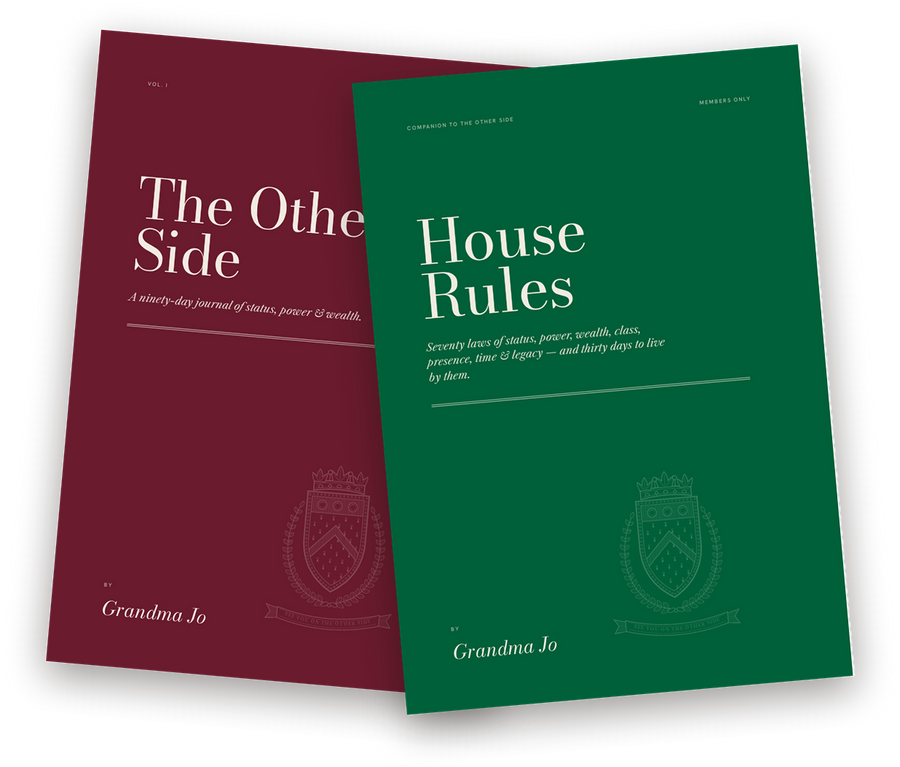
If it works for you, and I suspect it will, the other sixty-nine are waiting. They live in House Rules, ten to a chapter, and rule 57 sits in the Time chapter a few lines below the one about lateness, which is the same evening seen from the other end. Each rule comes with an exercise you can finish before your lunch goes cold: the rule itself, one sentence about your own week written as though it has already happened ("I leave the Hendersons' at half ten, laughing"), one small move, and a note of what came of it. You'll find the whole seventy, with the journal they were written to sit beside, in The Full House. Seven nights first, though. See how it feels.
My grandmother, who sewed for a living, saw a great many of her ladies' evenings from the wrong end. She did the alterations the morning after, when the gowns came back with the night still in their hems: wine at the knee, a torn flounce, once a cigarette burn on a train. She could tell you who had stayed too late without asking. She wrote one line about it, on a page whose corner has gone soft under my thumb:
"The best of them went home before the dancing turned. I never once saw one of them hurry."