At twenty to midnight on a wet Thursday in November, the lobby of the hotel where I stood behind reception had eleven people in it, and nine of them were shouting. A conference had been booked on top of a wedding. There were not enough rooms. I was twenty-four, in a navy uniform with a name badge that sat crooked however I pinned it, and I was the one standing behind the marble. I learned more that night about how to command respect than in any year that followed.
The two who were not shouting were a porter asleep on his feet by the lifts, and a woman in a grey wool coat who had come in out of the rain, laid a pair of black gloves on the far end of the counter, and simply stood there. She didn't join the queue. She didn't push in either. She didn't look at her watch. When the night manager came out of the back office, pink to the ears, he walked straight past nine raised voices and went to her first. Within four minutes she had a key.
I wanted very badly to know what she had said to him. It took me until the next morning to find out, and I'll tell you at the end.
The short answer to how to command respect, since that's what you came for, is this: be the least hurried person in the room. Stillness, a pause before you speak, a chosen place to stand, and a refusal to rush the things that deserve time. Those do more than any speech. Volume will get you attention for a minute or two. What quiet confidence gets you is slower to arrive and a great deal harder to lose.
What follows is how to do it, in the order I learned it, including the parts I got wrong in front of a great many people.
How to command respect with stillness, before you open your mouth
Movement tells people what you're feeling. Most of what we do with our hands in a tense moment is a leak: the pen clicked, the ring turned, the cuff tugged, the hair tucked behind the ear for the fourth time. Every one of those says the same thing to the people watching, which is I am waiting to be told whether I'm all right.
That night in the lobby I was leaking like a garden hose. I shuffled registration cards that didn't need shuffling. I picked up the telephone and put it down again. I believed, and I mean truly believed, that looking busy was the same thing as looking capable. The head porter, a heavy, kind man who had been carrying other people's cases for thirty years, leaned over after the woman in grey had gone up and said, very quietly, "You look like you're trying to get out of a fire, love. Nobody gives their keys to someone trying to get out of a fire."
He was right. The woman in grey had done nothing at all with her hands except put her gloves down. That one small act said: I am staying, I am in no rush, and I can wait longer than you can.
So, practically:
- Give your hands a home before you walk in. One resting over the other at your waist, or flat on the table, or loose at your sides. Decide beforehand, because you won't decide well once you're nervous.
- Plant your feet with your weight on both. People who stand on one hip look like they're about to leave, and people who look like they're about to leave are not consulted.
- Stop touching your face and your collar. You'll be amazed how often you do it once you start noticing.
- Keep the phone out of your hand. A phone is fidgeting with a screen on it.
Body language that commands respect is mostly subtraction. You're not adding a gesture. You're removing the twenty small ones that were apologising for you.
The pause: count two before you answer
When someone asks you a question in a tense room, the whole room is watching how fast you answer. Answer instantly and you look eager, or cornered. Wait a beat, and you look like a person considering it, which is what a person worth respecting does.
I count two. Not out loud, obviously. One, two, and then I speak. It feels like an age from the inside. From the outside it looks like thought.
The House Rule I keep closest for this is number eleven:
"Say less, darling. The room leans in."
The pause is also your best defence against the person who wants an answer now because they know you'd give a better one later. You're allowed to say so. My script, which I have used with builders, bankers and one very persistent head of a school board, goes like this:
"Let me think about that properly. I'll come back to you by four."
Then you come back to them by four. Not ten past. The pause only commands respect if it is followed by the thing you promised. Otherwise it's just dithering with good posture.
What goes wrong here: people discover the pause and fall in love with it. They start holding silences for effect, eyebrows arched, letting a simple question about lunch hang in the air like a courtroom drama. Don't. The pause exists so you can consider. If there's nothing to consider (tea or coffee, the Tuesday or the Wednesday) just answer, pleasantly, and move on.
Where you stand says who you think you are
The woman in grey did not stand in the queue, and she did not push to the front of it. She stood a little apart, at the quiet end of the counter, where the night manager would pass on his way out of the office. She had taken herself out of the argument without taking herself out of the room.
I've thought about that choice ever since. There is almost always a place in a room that belongs to the argument, and a place just beside it that belongs to the people who will settle it. Stand in the second one.
Some habits that follow from this:
At a meeting, don't rush for the head of the table, and don't hide at the foot. Take the side, near the middle, where you can see every face without turning your head. At a drinks party, stand where people can reach you, not in the doorway where you're in everybody's way and not wedged into the corner where you look as though you'd rather be at home. In a chair, sit back. The person perched on the front third of their seat looks ready to be dismissed.
And take up the space your body occupies, no more and no less. Spreading yourself across two chairs isn't presence, and folding yourself into half of one isn't modesty either. Both, in the end, make everybody else in the room uncomfortable.
The few things you should never rush
Most people think respect is won in the big moments. I've found it's won in the small ones that everybody else hurries through. There are a handful of things I refuse to rush, and I would suggest them to anyone:
- The end of your own sentence. Finish it, even if someone is itching to speak.
- Your coat. Put it on properly, arms in, collar straight, before you walk out of the door. Nobody commands a room while wrestling a sleeve.
- A reply to a message that has upset you. Upset gets typed. Considered gets sent the next morning.
- A decision that someone else is in a hurry for, because their hurry is not your emergency.
- Your exit. Coat on, one warm sentence, gone. The lines for slipping out of a party early work every bit as well at the end of a board meeting.
There is a House Rule for this too, and it has served me in matters far larger than buses:
"I have never run after a bus, a lover or an opportunity. Another one always comes."
You'll notice that none of this is about being slow. I move quickly. I walk fast, I decide fast when a decision is simple, and I have no patience at all for a meeting that could have been a telephone call. It's the rushing I refuse: the scramble and the visible hurry to please. Moving quickly and speaking slowly is the whole trick, if there is a trick.
When you finally speak, lower it
Respect without being loud doesn't mean respect without speaking. At some point you open your mouth, and when you do, three small things matter more than the words.
Bring the voice down at the end of a sentence. A statement that rises at the end sounds like a question asking permission. "We'll start at nine." Down. Not "We'll start at nine?" Up.
Speak a little slower than you'd like to. Nerves speed us all up, so aim for what feels slightly too slow and you'll land about right.
And keep the energy in your body, not your voice. Stand straight, eyes alive, and let the voice stay calm and low. The ones who get this backwards, with a slumped body and a shrill voice, are the ones who get talked over in meetings. The House Rule, which I've never improved on, is "Whoever raises their voice first has already lost the room." It is as true in a family kitchen as it is in a boardroom.
Respect is not coldness (the mistake quiet people make)
Here's where I have to be careful, because I've seen people read advice like this and turn into statues. They go still, they go silent, they stop smiling, and they become the guest nobody wants on their left at dinner.
The woman in grey was not cold. When she took her key from me she looked at my crooked badge, then at my face, and said, "You're doing very well. It's a horrid night." Then she went up. I can still hear the weight she put on horrid. She'd commanded the night manager's attention without a word, and she'd spent one of her few words on the girl at the desk who could do nothing whatever for her.
That's the difference between quiet confidence and a sulk. The first is calm and warm. The second is calm and punishing. People can tell which one they're looking at within about a second.
If you want a simple test: when you walk in, do people relax or stiffen? Relaxing means respect. Stiffening means you've landed on something cheaper and more brittle, which looks like power right up until the moment you leave the room.
"I'm not the type." (And the other things people tell me)
When I explain all this, I hear the same few objections, and they deserve straight answers.
I'm not the type. Neither was I. I was a nervous girl in a crooked badge, shuffling cards to look useful. Nobody is born still. Stillness is a habit, and habits are learned by repetition, not by temperament. The type you are is simply the thing you've practised most.
I don't have time for this. It takes no time at all. It's how you do the things you were already doing. You were going to stand somewhere. You were going to answer the question. You were going to put on your coat.
Is this for men too? Of course. The night manager who walked past nine shouting guests would have done exactly the same for a man in a grey coat who stood still with his gloves on the counter. And the person who taught me the most about stillness that night was the head porter, eighteen stone of him, who hadn't hurried since the coronation.
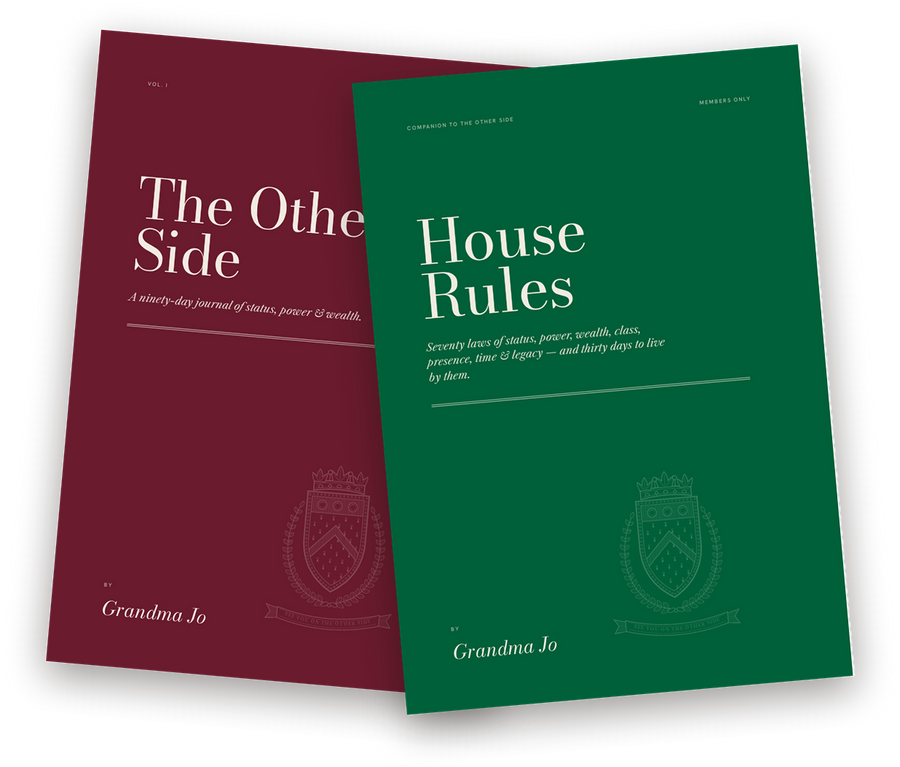
Will I stick with it? Not on willpower, no. Nobody does. What keeps a habit alive is a place where you catch yourself at it, and a plan for the day you don't. The Other Side gives you the first twice a day for ninety days, and it gives you the second in plain words: when you skip a day, you don't go back to page one and you don't write an apology to the notebook. You pick up the pen at today's date. I missed four days in my first month and felt I'd failed at stillness itself; the page told me to carry on, so I did, and the fifth day was the first time I counted two before answering my bank manager. The ten Power rules in House Rules are what you're catching yourself against, and both books come in The Full House.
How I came to write any of it is a longer tale, and a little more of it is here. The short version is that I learned it the way you will, by watching other people and by getting it wrong in public until I didn't.
Which brings me back to that lobby, and to what I promised you.
At six the next morning, over the worst coffee in the building, the night manager told me what the woman in grey had said to him: "Take your time. I'll wait in the bar."