"Go on, Jo, what did it set you back?"
He said it loudly, over the lamb, and pointed his fork at the painting behind my chair. It was the first proper dinner I had ever given in a home that was mine, and there were eight of us, and every one of them turned to look at the painting and then at me. I remember the candle wax running down onto the tablecloth because nobody was watching it anymore.
What I said comes in a moment. First, the answer you came for. The topics to avoid at dinner are three: what things cost, anybody's body, and any marriage you aren't in. One of the house rules I live by fits all of it into a single breath:
"Money, health and other people's marriages. Everything else is fair game."
That's the whole list. You'll notice politics and religion aren't on it. The old etiquette books banned those too, and I understand why, but I've sat through some wonderful arguments about both between people who liked each other and went home friends. An argument about an idea doesn't expose anyone. A question about your bank balance, your body or your bed does. Somebody at every table is in the middle of one of those three, and you won't know who.
Below are the moments when a table drifts towards the three, with the lines I use to turn it. A few came from my grandmother's diary. Most came from my own mistakes, one of which involved a glass being put down very carefully.
When someone asks what you paid
Back to the man with the fork. What I wanted to say, at the time, was the number, because I was proud of it and I'd saved for years. What I actually said was:
"Too much, and not enough. The woman who painted it lives by the sea and paints nothing but boats. Let me tell you how I found her."
Then I told the story, which was a good one, and the table went with me. The price never came up again.
The move is to answer the feeling rather than the figure, then hand the table something better. The painting has a story; the house has a garden; the watch belonged to someone's father. Talk about the thing, never its cost.
Two more that work: "More than I'd admit to my accountant. But look at the light in it." And: "Oh, I never remember numbers. I remember where I was when I saw it."
What never works is "Well, since you ask..." followed by the figure. Or its cousin, the one I hear most often: "It was an absolute steal, actually." That is still the price, dressed for dinner.
When the table starts comparing money
This one creeps in sideways. Somebody mentions house prices in their street, somebody else mentions a colleague's bonus, and within four minutes the whole table is quietly doing arithmetic about each other. The people with less go silent. The people with more get louder. Nobody enjoys it, and everybody joins in.
If it's your table, you're allowed to be a little bossy. I say: "I have a rule about house prices before pudding. Tell me instead what everyone's reading." Said with a smile, it lands as a joke and works as a rule.
If it isn't your table, go smaller. Turn to the person beside you, lower your voice slightly and ask them one real question: "Where did you grow up?" Two people talking about something human will often pull the rest of the table after them.
And one line to retire for good: "Well, we could never afford that." It sounds humble. It's actually a way of steering the whole table onto your finances, which is the thing we were trying to avoid.
When someone asks about your health, or theirs
Health is the trickiest of the three because it so often arrives as kindness. "You look so thin, have you been unwell?" The raised eyebrow at an empty wine glass, followed by a meaningful look at someone's waist. "You look tired." Every one of those is a small searchlight turned onto somebody's body in front of guests.
If the question is aimed at you, you don't owe the table your chart. Answer warmly and briefly, and pass the ball: "Very well, thank you. Now tell me about the new house." If they persist, the same sentence a second time, a little slower, is usually enough. Your digestion is not a committee report, and the habit of over-explaining is at its most tempting, and most costly, when someone has asked about your body in front of six people.
Now the gentler case. Sometimes a guest raises their own health, because it's heavy on them and they need to say it. Don't slam the door; that's cruel, and class is never cruel. Move it somewhere private instead:
"I want to hear about that properly, not over the noise. Come and find me after dinner."
Then keep the promise. Take them into the kitchen with the coffee and listen.
What you mustn't do is reach for "Oh, my aunt had exactly that, and she..." Nobody at a dinner table has ever been comforted by your aunt.
When the gossip turns to someone's marriage
Here I have a confession, and it still makes my ears warm.
Years ago, at a long table in a restaurant with red banquettes, I mentioned that a friend of mine was separating from her husband. I thought I was being sympathetic. I said, and I can still hear the exact tune of it, "Poor thing, she had no idea, apparently." A woman at the far end put her glass down very carefully. It was my friend's sister. She hadn't known either.
I apologised to her the next morning, once, properly, and to my friend the same week. They forgave me. I have never forgotten the sound of that glass.
So now I have one line, and I use it without fail: "I make a point of knowing nothing about marriages I'm not in. It's saved me more trouble than any other habit I have." Then I change the subject, usually by turning to whoever has been quietest.
If someone presses ("Oh, but you must have heard"), I smile and say, "Not a thing. Isn't that lucky?" and move on. Nobody can argue with a woman who claims to know nothing. Believe me, people have tried.
A small warning sign, while we're here. "I shouldn't say this, but..." Everything after those five words is something you shouldn't say.
When it's your own marriage (or divorce) they ask about
People ask about your own relationship as though it were the weather. "So how are things with you two?" with the eyebrows up, or "I heard you'd split" in front of the host's colleagues.
You're not obliged to open your private life because someone knocked. "We're both doing well, thank you" is complete, and true enough at a dinner. If you're separated, "It was the right decision for both of us" closes the door without slamming it. Then ask them something about their work. People rarely return to a question once they've been handed a chance to talk about themselves.
When the host is the one doing it
This is the delicate one, because it's their table and you're eating their food. I was once a guest at a long lunch in a house with green shutters where the host, a generous man in every other respect, spent the whole of the fish course explaining what each of his neighbours had paid for their houses, and which of them were about to divorce. Two birds, one course.
You can't correct your host. You can simply decline to feed the fire. Don't laugh at the story, don't add a detail, don't ask the follow-up he's hoping for. Let your face be pleasant and a little blank, the way you'd look at a weather forecast for a city you're not visiting. Then turn to the person on your other side and start something of your own: "I've been meaning to ask you about your garden all afternoon." A topic nobody picks up dies of natural causes. That lunch recovered by the cheese, and nobody was embarrassed except, very briefly, the neighbours who weren't there.
When you're the one who started it
You will slip. I did, at the restaurant with the red banquettes, and at a few tables since. Catch it quickly and say so in a single sentence, then move on without a speech:
"Actually, that isn't mine to tell. Forget I said it. Sam, how was the wedding?"
No lengthy apology across the table, which only draws more attention to the thing you're trying to bury. One clean sentence, a change of direction, and later, if it's warranted, a private word. Say sorry once, well, and let the pudding arrive.
The topics to avoid at dinner leave a great deal on the table
People sometimes think three forbidden subjects leave nothing to talk about. The opposite. Everything else is fair game, and most of it is far more interesting than anyone's mortgage. Here are the dinner conversation topics I reach for when a table goes quiet:
- "What's the best meal you've ever eaten, and who were you with?"
- "What did you want to be when you were nine?"
- "What are you learning at the moment, even badly?"
- "If you had a free Tuesday and nobody needed you, where would you go?"
- "Which book do you give people as a present?"
Notice that each one asks about something a person chose, not something that happened to them. That is the whole secret of polite dinner conversation: you give people a chance to be interesting, and you never make them feel examined. Where to seat the man with the fork is a host's problem, and it belongs with the rest of what nobody tells you about giving a dinner.
"I haven't got time to practise manners"
People say this to me, usually quite politely, and I understand it. Nobody has an hour a day to rehearse what not to say at a dinner party. You don't need one.
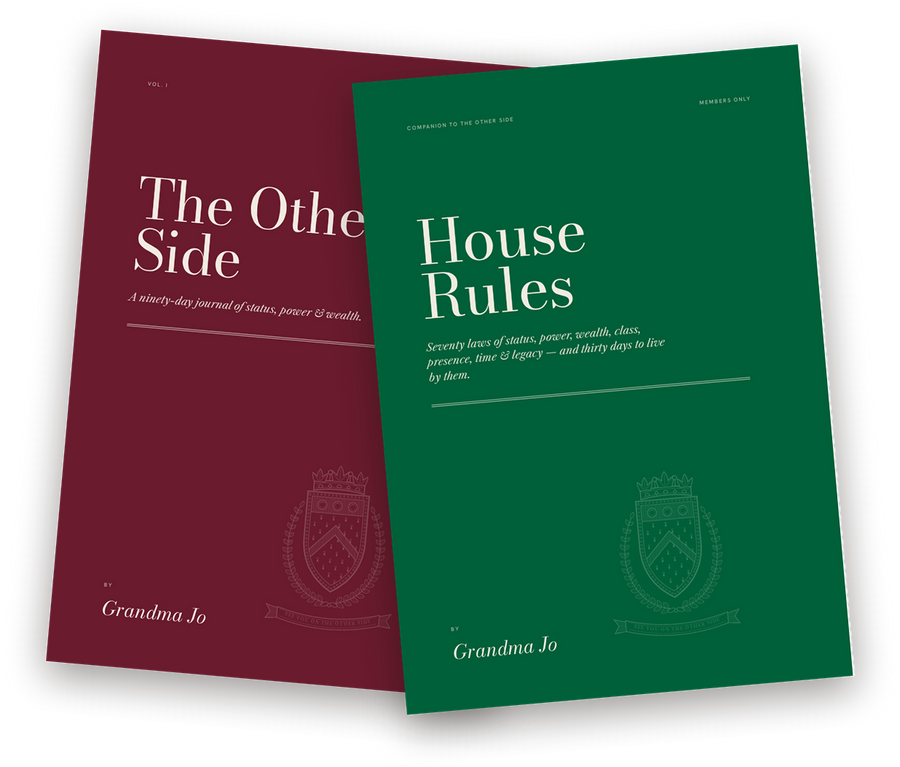
Steering a table is learned in small repetitions, the way you learn a new route home until one day you stop thinking about the turns. House Rules is built for exactly that kind of learning: a month of lunchtimes, five minutes each. On the day you reach rule 33, you copy it out. Underneath, you write a sentence that makes it yours and already true ("I know nothing about marriages I'm not in"). That afternoon you change one subject you'd normally let run. Then you note what happened when you did. Rule, script, move, receipt. It fits between one half of a sandwich and the other.
"I'm not the type who goes to dinner parties." Then you're the type who eats with colleagues, in-laws and the neighbours at a christening, and the three subjects will find you there too. "Will I keep it up?" Perhaps not every day. When you miss one, don't go back to the beginning and don't apologise to the page; carry on from the next rule. And the question I'm asked by husbands, quietly, at weddings: is this for men as well? The diary behind these rules was kept by a woman watching women. The first person I'd hand it to is the man with the fork.
Rule 33 is waiting in the Class chapter of House Rules, one of the three pieces of The Full House, whenever you'd like to begin.
What I said to the man with the fork, later
He rang me a week after that dinner, a little sheepish, and said his wife had given him a talking-to in the car. I told him I'd already forgotten it, which wasn't quite true, and invited him again. He came, and he asked the woman beside him what she'd wanted to be at nine years old, and she told him (a lighthouse keeper), and they talked until the candles went out.
I still give dinners. I still watch the table from my end of it, the way my grandmother watched women turning in front of her long mirror, and I still catch the moment a conversation starts leaning towards somebody's bank account or somebody's body or somebody's bed. Some nights I steer it well. Some nights I'm late.
When the last coat has gone and I'm stacking the plates, I only ever ask myself one thing. Did anyone leave my table feeling smaller than when they sat down?