It is twenty past eight. The soup is in its tureen with the lid on, keeping as warm as soup can, and the chair on my left is still empty. Eleven of us stand about with a second glass, making bright talk beside a table nobody may sit at. At half past, a phone buzzes in our host's apron pocket. She reads it, smiles with her mouth only, and says, "Let's start. He's on his way."
He arrives at nine, apologises three times, describes the traffic and photographs his soup. He's a lovely man. And nobody had ever explained to him the dinner party etiquette I'm about to explain to you.
It comes down to this: make the evening easier for the person who cooked it, and pleasanter for the people either side of you. Reply quickly, arrive a little after the stated time, bring something that asks nothing of your host, talk to both neighbours, keep three subjects at home, leave while the evening is still warm, and write the next day. Everything else is detail. Here is the detail.
Dinner party etiquette starts before you leave the house
1. Reply within a day, in the way you were asked
An invitation is a small act of courage. Somebody has decided they want you at their table and has risked your silence. Don't make them wait. If they wrote a card, write back. If they sent a message, a message is fine. Answer inside a day, and answer properly.
"We'd love to. Thank you for thinking of us. Is there anything you'd like us to bring, or anything you'd rather we didn't?"
That last clause is the useful one. It gives your host permission to say "please, no more wine, the cellar is a disgrace," which they would never volunteer.
2. Say what you can't eat now, once, and never again
If you don't eat meat, or shellfish, or anything else, tell your host when you accept, in one plain sentence. "I don't eat meat, but please don't cook anything special. I'll be very happy with everything else." Then drop it for good. At the table you say nothing, you eat what suits you, and you don't narrate your plate. A guest who waits until the lamb arrives to mention it has turned a kitchen problem into a public one.
3. Arrive ten to fifteen minutes after the time on the card
Never early. I learned this one badly. Years ago, at a dinner I badly wanted to be invited back to, I arrived twenty minutes before the time, thinking it would look keen and helpful. The door was opened by the hostess in a dressing gown with a towel round her head, one foot bare. I stood in her hall holding a bunch of tulips while she ran upstairs, and I could hear her husband asking, not quietly, who on earth that was. Helpful it wasn't.
A host's last quarter-hour before guests arrive is sacred. Give it to them. And if you are going to be more than fifteen minutes late, send a message before the stated time, not after it: "I'm so sorry, I've been held up and will be about twenty minutes. Please start without me." Then arrive, apologise once, and let the subject die. No traffic report.
4. What to bring to a dinner party: something that asks nothing of anyone tonight
This is the rule people get wrong most often, with the best intentions. Flowers in cellophane mean your host must stop greeting guests, find a vase, find scissors, fill the vase and find a surface. Wine handed over at the door creates a small agony: must it be opened? Is it meant for tonight? A pudding you've made means your host, who has spent two days on her own pudding, now has to serve two.
I know about the pudding because I did it. A trifle, in my good glass bowl, the size of a font. The hostess thanked me beautifully and served it alongside her tarte Tatin, and half the table felt obliged to eat both. She never said a word. Her husband, clearing plates, murmured to me that it was "very generous," and I have never heard two words carry more weight.
So bring things that keep. A bottle, handed over with "this is for you, for another evening." Good chocolates for the coffee, if you ask first. Something for their breakfast: proper marmalade, a loaf from a baker you love. Or send flowers the next morning with the note, which is the loveliest of the lot. A man once brought me a bag of lemons from his own tree, wrapped in newspaper. I thought about him every time I made a dressing for a month.
The dinner party rules at the table
5. Let yourself be seated
Wait to be told where to sit. If there are place cards, they are not suggestions, and moving yours to sit by your husband or your friend tells the host you don't trust her arithmetic. She has thought about who should meet whom. Let her be right.
A word on the old courtesies, because people ask me whether any still hold for men. Some do and some have loosened. The man who holds a chair or stands when someone arrives at the table isn't old-fashioned to me, as long as he'd do it for anyone at all, including someone's grandmother. My grandmother's rules for gentlemen were never really about being male, and every one of them works as well for women.
6. The phone stays in your coat
"Phones away. Whoever you're dining with deserves the whole of you." (House rule 47)
Not face down on the tablecloth, where it sits like a third guest waiting its turn. In a pocket or a bag, on silent. If you truly may need it, a babysitter on her own, a parent unwell, say so at the start, once: "I may need to step out for a moment later; I'm on call for my mother tonight." Everyone understands. What nobody understands is the glance downward during somebody's story. They see it. They always see it.
7. Talk to both sides
You have a neighbour on your left and one on your right, and you owe them both. Spend the first course on one and the main on the other, or follow the table's lead, but do not spend the whole evening facing the more amusing of the two while the other studies the salt cellar.
If your quieter neighbour gives you very little, ask about something they can see or touch rather than something they must justify. Not "what do you do?" but "How do you know our hosts?" or "Have you been to this part of town before?" Concrete questions are easy to answer, and once people have answered one easy thing they tend to answer a harder one.
8. Three subjects stay at home
My grandmother's version was that a lady could discuss anything at table except the three things that make people defend themselves. Mine is House rule 33: "Money, health and other people's marriages. Everything else is fair game."
That leaves you nearly everything: books, food, travel, dogs, what the table thinks of the new bridge, the best thing anyone has eaten this year. Politics you can manage if the table is kind and you are genuinely curious rather than recruiting. If someone else starts on one of the three, you don't need to lecture them. A light turn will do: "I'm hopeless on all that. Did you ever get to that island you were talking about?"
9. Praise once, specifically
Hosts don't need you to swoon over every course. They need to know you noticed. One specific compliment is worth ten general ones. "The lemon in this sauce is wonderful. What did you do?" tells the cook you were paying attention. "Mmm, amazing, everything's amazing" tells them you'd say that anywhere.
The same with what you don't like. Leave it on the plate without comment. Nobody at a good table is counting.
10. Offer to help once, then take the answer
Offer, clearly, once: "Can I carry anything?" If the answer is no, sit down and be delightful, which is the help they wanted. Following a host into the kitchen after a refusal and hovering at their elbow while they plate is not kindness. It's supervision.
And gentlemen, if you are wondering whether clearing plates is your job too: at my table it has been for forty years, and the men who did it without being asked are the ones I still invite.
Leaving, and what dinner guest etiquette asks of the morning after
11. Leave while they still want you to stay
The evening has a shape. The coffee comes, somebody pours one more glass, and then there is a moment, usually about the time the host looks at the candles, when it begins to tilt. Leave on the near side of that tilt. House rule 57 says it plainly: "Always leave while they still want you to stay."
Say it in two sentences at the door and go: "This was the best evening I've had in weeks. We'll give you your kitchen back." Don't start a new conversation in the hall with your coat on. The case for leaving a party gracefully, and a little early, is one I'll defend at any front door.
12. Write the next day
A message that night, as you get home, is gracious: "Home safe. What a lovely evening, thank you." A handwritten card within a couple of days is better. The card should say one specific thing, the lamb, the story about the lighthouse, the fact that she put you next to someone you liked very much, so it could not have been written about any other evening. That one detail is most of the knack behind a thank-you note people actually keep, and a card like that is still the best value in etiquette.
Then, some weeks later, ask them back. It doesn't have to be dinner. Lunch in a café will do, or a drink before the theatre. Hospitality is a conversation, and it's your turn to speak.
What happens when you keep these rules for long enough
None of this makes you charming by itself. What it does is take away every small reason for a host to hesitate before inviting you again, and in my experience that is how invitations start arriving more often, quietly, over years.
So let me tell you where I'd like you to be ninety nights from now. You're at a long kitchen table in somebody else's house, the candles burnt halfway down, a plate of cheese that nobody needs going round for the second time. Your phone is in your coat in the hall. You have talked properly to the woman on your left about her father's boat and to the man on your right about a book you'd both given up on in the same chapter. Your host catches your eye across the table and you can see she's glad you're there. At ten to eleven you stand, thank her in two sentences, and go, and on the way home you already know what you'll write in the card.
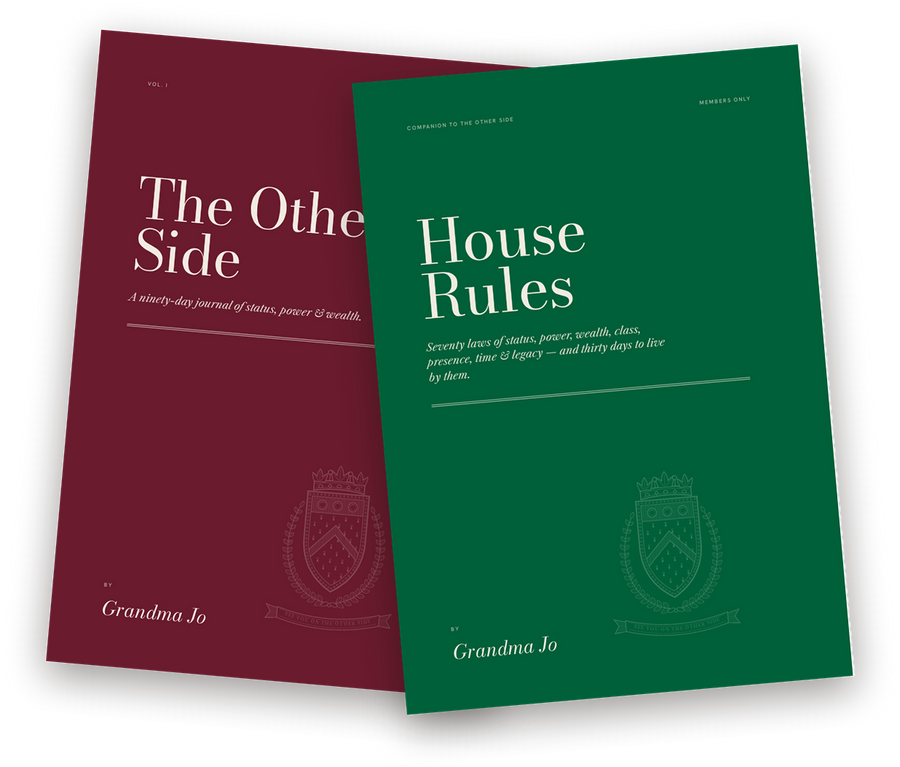
That guest is made the way anyone is made: one small rule at a time, practised until it stops needing thought, and most of the practice happens after you get home. Each night in The Other Side ends with a line called Carriage, a number out of ten for the person you were that day (after a dinner, the person you were at the table), written before you've had time to be generous with yourself about it. A six after an evening spent talking across your quiet neighbour is useful information. So is your first nine. House Rules holds the rest of the rules this piece borrows from, all seventy of them, and The Full House gives you the pair. You can start tonight, before the next invitation arrives.
As for the man with the traffic and the photograph of his soup: he was invited back, because our host is kinder than most of us. He came on time and left his phone in the hall. Somebody, somewhere, had said a word to him.
And I find myself wondering, washing the last of the glasses long after midnight, whether I ever wrote to thank the woman with the tarte Tatin for saying nothing about my trifle.