How to be classy comes down to one test, and it isn't the fork. Class is how you treat people who can do nothing for you. The cloakroom attendant, the boy who carries the luggage, the woman at the next table whose name you'll never learn, the junior on the team who can't promote you and never will. Treat them exactly as well as you treat the person who signs the cheques, and do it when nobody who matters is watching. That is the whole of it. Everything else people call class (the posture, the vowels, the good shoes, knowing which glass is for water) is decoration. Lovely decoration, some of it. I own a great deal of it. But decoration on a house with no foundations is still a house that falls down.
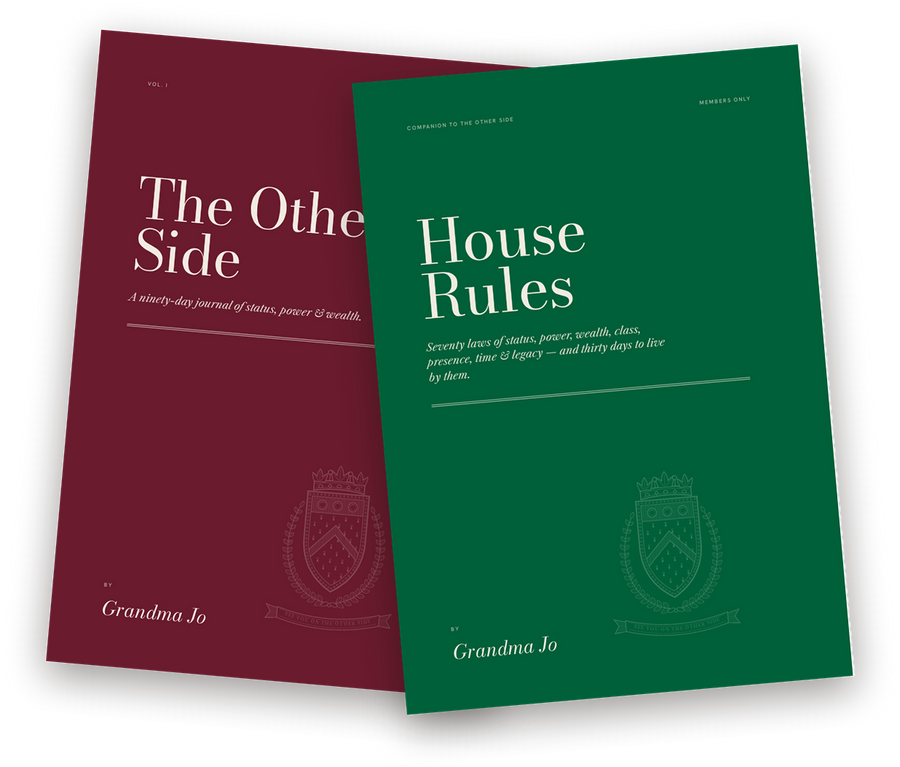
That's House Rule 31, and I put it first in the Class chapter of House Rules because every other rule in that chapter leans on it:
"Class is how you treat people who can do nothing for you."
I didn't invent it. I watched it, and before me my grandmother watched it, which is how most of the useful things in my life arrived.
The test my grandmother used without calling it one
My grandmother was a dressmaker, and for fifty years she knelt at the hems of other people's confidence with pins between her lips, listening. Nobody expects the seamstress to talk, so she watched, and at night she wrote it down at the kitchen table after the plates were cleared. The diary has moved house with me six times. Its ribbon has frayed to three threads at the end, and I still use it to keep my place.
There is a page in it I could recite with the light off:
Mrs. A. asked after my mother again, by name. She remembers everything. The new lady from the big house on the corner has not looked at me once in three fittings, and she checks every stitch twice. You can always tell who was born easy and who is still frightened.
Still frightened. That's the part I missed for years. I assumed rudeness to the help was a symptom of too much money. My grandmother knew better: it's a symptom of too little certainty. The woman who's sure of her place has nothing to prove to the seamstress, so she can afford to be kind. The woman who isn't sure uses the seamstress to prove it. Look how far below me you are, therefore look how high I've climbed.
Once you see it, you can't stop seeing it. Sharpness toward people with less power is almost always somebody announcing a doubt.
What makes someone classy, and what only looks like it
When I was twenty-six, living in Mrs Adair's back bedroom with one ring on the gas hob and a great many opinions, I decided that class was something you could learn from a book. I took one out of the library (I won't pretend to remember the title, only that it had a blue cover with a woman in gloves on the front) and practised my vowels in the mirror above the sink. Round vowels. No dropped endings. I wanted to sound like the women who came through the revolving door of the hotel and asked me, in those vowels, for their keys.
It helped a little, the way learning the words helps before you can sing the song. What it didn't do was make me classy. I know, because I remember how I spoke to the girl who cleaned the lobby at six in the morning during those same months: briskly, as though she were in my way. I had the vowels. I didn't have the thing.
So when people ask me what makes someone classy, I tell them to separate two lists. The first is things you can buy or rehearse: tailoring, table manners, a good watch worn under the cuff, a pleasant speaking voice, the right bottle. Buy them if you like. The second is things nobody can sell you: the way you look at the person pouring the water, whether you remember the name of the man who parks the cars, what you say about someone once they've left the table, how you behave when you've been kept waiting forty minutes. Only the second list is class. The first list is how class dresses when it goes out.
The first list has its uses (the tailor and the shoe trees are all in how to look expensive). But start with the second. It's the one people are quietly marking you on.
The woman at the door
Some years after the rented room, when my firm was new and very small, I was invited for the first time to a party at the house of a woman I'd admired from a distance for the best part of a decade. She was everything I'd practised my vowels for: silver-blonde, a voice like a cello, a drawing room full of books that had actually been read. If you'd offered to make me her for a year, I'd have signed without reading the terms.
She met me at her own front door, which I thought was marvellous. Behind her, a girl hired for the evening was taking coats (nineteen, perhaps, with a plaster on one thumb) and as she lifted mine from my shoulders, a glove fell out of the pocket onto the tiles. Our hostess didn't break her sentence to me. She simply turned her head a quarter-inch and said, pleasantly, "Pick that up, and do try not to be useless tonight." Then, back to me, warmly: "Now. Where were we?"
The girl picked it up. She smiled, because she had to. I smiled too, which I'm not proud of.
It was a lovely party. The food was lovely, the rooms were lovely, and she was lovely to me all evening. I went home and couldn't stop hearing that sentence. It wasn't the cruelty that stayed with me so much as the ease. She hadn't thought about it at all, and the things we say without thinking are the most accurate description of us anyone will ever get.
I realised I'd spent ten years studying the wrong things about her. The vowels, the voice, the books, the way she held a glass. The one thing that would have told me who she was had been happening at her front door all along, every time she opened it.
I stopped wanting to be her that night. It's one of the more useful things I have ever stopped wanting. And I've used the lesson since on everyone I've been tempted to admire, hire, partner or marry: don't listen to what someone says to you. Listen to what they say to the person holding the coats. What they say to you is what they want you to hear. What they say to the girl at the door is what they'll say to you on the day you can do nothing for them, and that day comes to all of us. A bad year, a lost contract, illness, age. Choose your people by the door test and on that day you'll be surrounded by ones who don't change their tone.
Signs of class you can see from across a room
You can tell a great deal from the far end of a hotel lobby with the sound off. I spent years doing exactly that from behind a reception counter, and later from better chairs. The signs of class are small, physical and remarkably consistent.
- They look up when they order. Eyes on the waiter's face, not the menu, for the second it takes to say thank you.
- They use names: the doorman's, the receptionist's, the one on the badge. House Rule 37 says it plainly: "Know the doorman's name. And use it. Doors open differently for people who remember."
- They hold the lift for someone carrying boxes, and don't glance at their watch while they do it.
- They say the same things about people behind their backs as to their faces, which in practice means they say rather little behind backs.
- When they're kept waiting, you can't tell they've been kept waiting.
Notice what isn't on the list. Nothing about price. Nothing about accent. A classy person can be wearing a supermarket jumper and still be the most expensive thing in the room, because respect arrives without being asked for once people have watched you be decent to someone else first.
How to be classy when nobody important is watching
This is where most advice on the subject goes soft. It tells you to be kind and leaves you there, as if kindness were a mood. I'd call it a set of small moves you make on purpose until they stop needing purpose.
Start with the people you already pass every day and don't see. Tomorrow, count them. The person who makes your coffee. The security guard at the office. The driver. The cleaner who comes in as you're putting your coat on. Most of us move past four or five of these people before lunch without registering a single face.
Then pick one and do the smallest possible thing properly. Learn a name and use it the next day: "Morning, Daniel. Busy one?" That's all. You don't need to ask about his children on day two. You need to become the person who knows he exists.
When something goes wrong (the order is wrong, the room isn't ready, the parcel went to the fourth floor instead of the fifth) say what you need plainly and without an edge: "I think this is the oat one, and I asked for ordinary milk. No rush at all." Complaints delivered calmly get fixed faster anyway. That isn't the reason to do it, but it doesn't hurt.
And say thank you with the whole of your attention, even when it's four words. It's astonishing how rarely people do. I've watched women in the finest coats in the city thank a waiter while reading their phones. The waiter noticed. The rest of us noticed. Nobody said anything, which is how class is judged: silently, and for a long time afterwards.
A word of warning, because I've seen this go wrong. Kindness performed for an audience is its own kind of snobbery. The man who tips with a flourish and makes a small speech about it, the woman who tells the whole table how she always chats to her cleaner: they are still using the person with less as a prop. If the kindness only happens when someone is watching, it's decoration again, just a more modern sort. Do the thing and don't mention it. If anyone ever finds out, let it be because the person you were kind to told them.
People sometimes object that doing this on purpose is calculating. Isn't class meant to be natural? Nothing is natural at the start. The women my grandmother dressed had been taught by someone, or had watched someone, or had decided one ordinary Tuesday to become the sort of person who asked after the seamstress's mother. Habits begin as decisions. Mine did. The decision is the classy part. The ease comes later, and it looks exactly as if you were born with it.
Why the other rules lean on this one
I've come to think most of the rules in the Class chapter are this one wearing different clothes. Thank-you notes by hand are rule 31 for the people who took trouble over you. Tipping like you remember the years when you couldn't is rule 31 with a wallet. Remembering birthdays and forgetting grievances is rule 31 stretched over a lifetime. Even the rules about presence, about walking into a room as though you were expected, rest on it, because a room reads you by how you treat the person at the door before it reads anything else about you.
Which is why I don't let myself off it. Each evening The Other Side opens with a line called Evidence: what happened today that proves you're becoming who you said you'd be. On the evening I signed the best contract of that year, I sat down to fill it in and couldn't. That afternoon I had been short with a young man on a switchboard who put me through to the wrong office twice, and the contract, lovely as it was, didn't prove the thing that line was asking about. I left it blank. It is the only empty Evidence line in that notebook, and I have learned more from it than from most of the full ones.
Rule 31 opens the Class chapter of House Rules; the journal is where you find out, one night at a time, whether you kept it. That pairing is the heart of The Full House. The prize was never the pages. It's becoming the person the girl taking coats remembers for the right reason.
You won't get it right every day. I still don't. What counts is the direction, and that someone is keeping score.
Every night, before the lamp goes out, I write the name of one person who could do nothing for me and what I did for them that day, and if the line is empty I know exactly where to start in the morning.
P.S. If you'd like rule 31 somewhere you'll meet it every single night, whether you've earned it that day or not, it lives in The Full House.