Her coat had been re-collared. You could see it only if you stood as close as I did, in a post office queue on a wet Tuesday many years ago: a faint pale line in the navy wool where the old fold had been, and a new collar sitting exactly where it should. Her shoes had been resoled. Her watch sat on a plain black strap. When she reached the counter, the clerk who had called the man before her "mate" called her "madam".
Start with her, if you're asking how to look expensive. Almost nothing the clerk responded to had cost much money. He was reading fit, care, grooming, stillness and silence, and he read them in about the time it takes to say good morning. People do the same to you, every day, long before they could tell you the price of a single thing you're wearing. What they also read, just as fast, is effort that shows.
These are the rules I learned by watching: first from my grandmother's diary (she was a dressmaker, and she had opinions about hems that would make a bishop blush), then from years of watching guests cross a hotel lobby towards me with their luggage, then from boardrooms and dinner tables where nobody ever mentioned clothes and everybody noticed them. Most of them apply whether you have a great deal to spend or very little.
1. Fit is nearly the whole trick
The first good jacket I ever owned was secondhand, charcoal, and a size too generous everywhere except the shoulders. I took it to a tailor above a shoe shop. He put it on me, stood back, and said: "The jacket's fine, madam. It's the sleeves that are telling lies." Twenty minutes with pins, and it looked as if it had been cut for me.
What he taught me that afternoon I still use. Buy for the shoulders, because shoulders are hard and expensive to change. Everything else (waist, sleeve, hem, the length of a trouser) can be adjusted for less than you'd think. The sentence to say to any tailor is this: "Please take in the waist, shorten the sleeves to show a little cuff, and leave the shoulders alone." A modest jacket that fits looks more expensive than a grand one that doesn't. Every time. You can see the difference from across a car park.
2. Pressed beats new
My grandmother wrote: "An old dress pressed will beat a new dress creased. I have watched it happen at every wedding I ever sewed for."
A crease across the lap, a collar gone soft, a shirt that has plainly spent the night in a heap: these tell people you were in a hurry, and hurry reads as scarcity. A steamer, an iron, a clothes brush and ten minutes the evening before will do more for you than a shopping trip. If you learn only one habit from this piece, let it be this one, because it costs almost nothing and nobody can tell why you suddenly look so well.
3. Look at your shoes before you look in the mirror
People look down. They always have. At the hotel we could tell a great deal about a guest from the lobby carpet upwards: whether the heels were worn to an angle, whether the leather had been fed or left to crack, whether there was a salt line from last week's weather.
You don't need many pairs. You need two or three good ones, kept on shoe trees, polished on Sunday night, resoled before they need it. A cobbler is one of the best friends a person can have. Mine has known me longer than most of my neighbours, and he has never once asked where I bought anything.
4. Grooming is the part nobody can fake
You can borrow a coat. You cannot borrow clean, short nails, or a haircut that is three weeks old rather than three months. Hands are on the table the whole of dinner. Hair frames every word you say.
This goes for men exactly as much as women. A clean shave or a beard that has clearly been kept on purpose, a collar with no grey ring, eyebrows that don't meet in the middle. None of it is vanity. It is simply telling the room that you look after what you've been given, which is the first thing anyone wants to know before they trust you with anything else.
5. Fewer colours, better cloth
People ask me how to look rich on a budget as if there were a trick. There is, and it's boring: own fewer colours. Navy, grey, camel, white, black, perhaps one colour you love and wear like a signature. When everything you own goes with everything else, you always look as though you planned it.
Then go for the cloth. Wool, cotton, linen, silk, good leather. Secondhand shops and the back of relatives' wardrobes are full of them. Put your hand inside the jacket before you look at the label. If it feels like something, it will look like something. If it squeaks, walk away politely.
6. Nothing that needs a logo to be understood
"If it needs a logo to be understood, it isn't speaking to you." (House rule 35)
I learned this one the embarrassing way. In my hotel years I saved for the better part of a winter to buy a handbag covered in someone else's initials. I thought the guests would look at me differently. One of them did. She was a small, very old lady who had stayed with us every March for decades, and she stopped at the desk, looked at the bag, and said kindly: "That's a very loud bag for such a quiet girl."
I put it in a cupboard the same evening. She was right, and she was being generous: what she meant was that the bag was doing the talking because I wasn't sure I could. A logo is a little speech made on your behalf by a company. The people you most want to impress have heard it many times, and they are not listening.
7. Stillness is how an expensive person stands
Go back to the woman in the queue. What set her apart first wasn't the coat. It was that she didn't fidget. No checking the clock, no sighing, no patting her pockets for something she already had.
I move quickly; anyone who has walked with me through a train station can tell you so. But when I arrive, I stop completely. Feet planted, shoulders down, hands still. Walk with purpose, then be still: those two together read as someone with nowhere more important to be, which is the most expensive impression there is. The first ten seconds of it, from doorway to chair, are slowed right down in my piece on those first ten seconds in a doorway.
8. Carry less
Bulging pockets. A bag so full it won't close. A lanyard, two sets of keys and a water bottle clipped to the outside like a mountaineer. All of it tells people you're braced for a long, difficult day, and they believe you.
One bag, emptied every Sunday. A slim wallet. Keys that don't announce you down the corridor. You will be surprised how much calmer you look, and a little surprised how much calmer you feel.
9. Say nothing about what it cost
House rule 05 is about exactly this, and its arithmetic is brutal: whatever you paid, saying it out loud adds to the bill. When someone admires what you're wearing, the answer is "Thank you." If you want to add anything, add "I've had it for years," which is either true or soon will be. What you never say is "Oh, this? It was half price," or its louder cousin, "You don't want to know what I paid." Both drag the conversation down to money, and both make the other person wonder whether you're comfortable in your own clothes.
A compliment is a small gift. You accept a gift. You don't hand over the receipt.
10. What gives the game away when you try to look expensive
Here is how people learning to look classy usually overshoot, and I include myself at twenty-six. Everything new at once, so the shoes creak and the jacket still has the stitch across its back vent. A matching set (bag, belt, shoes, scarf) all from the same shop, like a uniform for a job nobody gave you. Four rings when one would do. Perfume that reaches the lift before you do.
To look put together is to look as if you got dressed and then forgot about it. The moment an outfit seems to be concentrating, you've lost the room. Take one thing off before you leave the house. It is nearly always the right thing to remove.
11. Keep it for years, and let it show
An expensive-looking person is almost always a person who takes care of things. Wooden hangers, not wire. Cedar in the drawers. Coats brushed after a wet day. A torn lining mended, not tolerated.
That's what the re-collared coat was saying, and what the clerk heard. The coat wasn't new. It was kept. There is a particular kind of quiet that comes off things that have been looked after for a long time, and people respond to it in a way they never quite respond to the shine of a new purchase. I'd go further: it is the same quiet that comes off a person who is still, and respect without raising your voice is built out of very little else.
Why looking expensive was never really about clothes
I'll tell you what I believed when I was young and wrong: that looking expensive was a costume you bought, and that with the right one you'd be let in. It isn't, and you won't. What gets you let in is the evidence that you pay attention, and clothes are simply where that evidence is easiest to see.
"Your name walks into the room before you do. Dress it accordingly." (House rule 04)
Now, a small observation. Most people who open an article like this want a shopping list. If you read all the way down past the paragraph about shoe trees and the cedar in the drawers, you wanted something else, and you've already shown the one habit this whole piece depends on: attention to small things when nobody is checking. You don't have to turn into someone new. You only have to do it on purpose, a little every day, until nobody (you included) can remember it was ever practice.
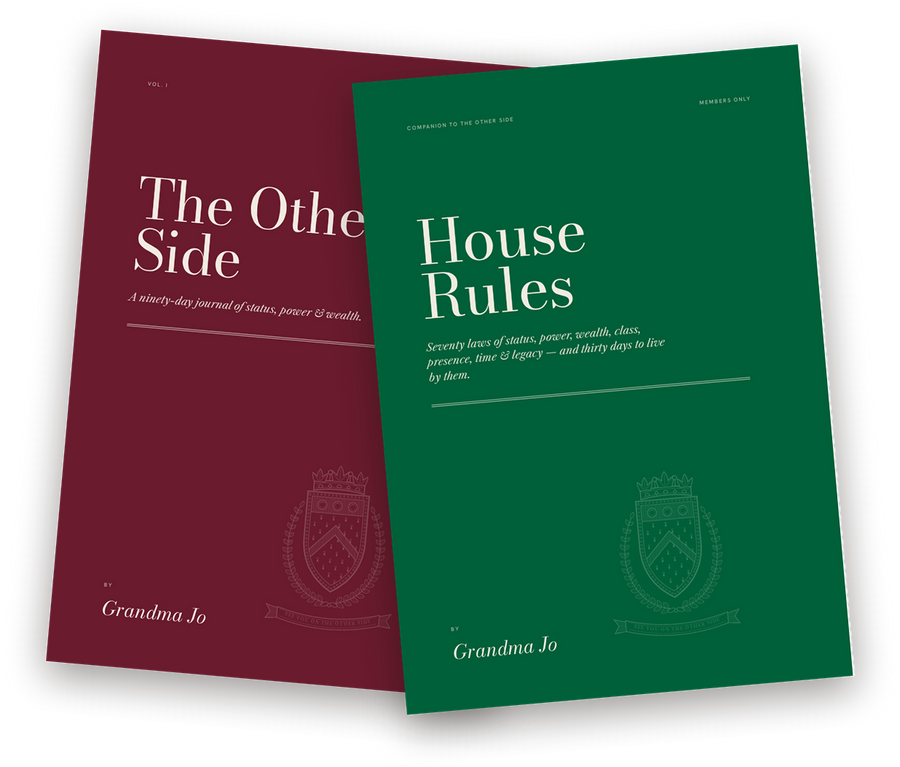
That practice is what I built The Full House for, and the page in it that belongs to this article is the morning one. Every day The Other Side asks you to finish a line that begins "I am". Mine, for most of a year, read: "I am someone who looks after what she has." On the mornings I'd left a jacket in a heap on the chair it felt like a fib, and I wrote it anyway. Then I hung up the jacket, because it's awkward to lie to your own handwriting before breakfast. One day you notice the sentence has stopped being a fib and turned into a description.
I never learned that woman's name. I think of her whenever I pick up a coat from the tailor, and I hope that one day, in some queue, on some wet Tuesday, a young person stands close enough behind you to notice your collar.
P.S. The handbag is still in the cupboard. I keep it to remind me what trying looks like from the inside.