Most advice on how to be a gentleman begins with doors, jackets and which side of the pavement to walk on, and almost all of it misses the point. I can prove it. The most accomplished door-holder I ever met was the man I spent four of my twenties trying to please. He opened every door I walked through. He also kept the keys.
I was young, and I thought his manners meant something. I thought a man who stood when I came back to the table must be a good man. It took me far too long to understand that manners without character are just choreography, and that the real rules for men were sitting in my grandmother's notebook, which hadn't come to me yet.
So here is my answer, in one sentence, for anyone who typed the question at midnight: a gentleman is the man who does what he said, notices who is being left out and never makes anyone pay for his moods. Reliability. Discretion. Attention. Everything else is tailoring.
My grandmother sewed for families who sat at the heads of long tables, and a dressmaker in a big house sees the men as well: husbands pacing the hall while a fitting ran over, sons sent upstairs with a message, suitors waiting in the morning room with their hats on their knees. She noted how the good ones behaved in the same plain lines she used for their wives, and the lines fit either. Here are eleven of them, as a modern gentleman would need them, in the order I'd teach them to my grandson (and in some cases already have).
1. Be where you said, when you said
My grandson came to Sunday lunch last spring at twenty to two. Lunch was at one. At twelve fifty-eight I'd had a message: "running a bit late", followed by two exclamation marks, as though enthusiasm were a form of transport.
I didn't scold him at the table. I waited until he was helping me with the plates and said, "The lamb was ready at one. So was Mrs Pell from next door, who is eighty-one and came on two buses. What did you have that was worth more than her forty minutes?" He went red to the ears. He has not been late since, which I mention only because he may read this.
My house rules call lateness a kind of theft, and they're being polite. A man who is reliably on time is telling everyone in advance that he values what isn't his. Punctuality has its own chapter on this blog, so I'll only add this: if you are going to be late, say so before the time, with a number. "I'll be there at ten past" is a courtesy. "Running late" with two exclamation marks is weather.
2. Put the phone away, not face down
Face down on the table still says: I'm waiting for someone more interesting. I once had lunch with a man, years ago, who came back from the cloakroom and said, "I've left my phone in my coat. If anything's on fire, the restaurant has the number." I remember nothing we ate. I remember that sentence, and I remember that I told him more in that hour than I had intended to.
The house rule asks for the whole of you at the table. Face down gets them about two-thirds.
3. Learn the doorman's name, and use it
After I left that door-holding man, I spent some years checking guests in at a hotel that still handed out brass keys on tassels. One regular, Mr Lindqvist, a grey-haired man in a navy overcoat, arrived every second Thursday. He greeted Mr Doyle on the door by name and asked after his knee, which had been bad all winter. He never tipped more than anyone else. But when the hotel was full and a room had to be found at eleven at night, guess whose name went to the top of the list?
That's rule 37, word for word: "Know the doorman's name. And use it. Doors open differently for people who remember." He wasn't being clever. He was being attentive, and attention is the one thing people can't counterfeit for long.
4. Keep other people's secrets as though they were money in your wallet
A gentleman doesn't repeat what he's told. He doesn't repeat what he overhears. And he steers the table away from anybody's bank balance, anybody's diagnosis and any marriage but his own.
When someone leans in with a juicy one at a party, you don't need a lecture. You need a sentence. "I'm hopeless with secrets, so I'd rather not be trusted with that one." Say it lightly and change the subject to something about them. They'll be mildly put out for about a minute. Then, later, when they have something that matters, they will remember who didn't want the gossip.
5. Correct in private, even when you're right in public
I once watched a senior man in a meeting let a junior colleague present a figure that was plainly wrong. Everyone at the table knew it. He said nothing, thanked the young man and moved on. Afterwards, in the corridor, I heard him: "Walk with me a minute. The second number on page four. Let's fix it before it goes out." The young man looked at him as if he'd been handed a coat on a cold night.
Praise goes in front of the room; correction goes in the corridor. Men who get this backwards win the moment and lose the man.
6. Never be the loudest thing at the table
The first man to raise his voice at a table has handed the evening to everybody else. The wrong dish arrives: "I think this may be someone else's. No rush at all." The taxi goes the long way: "I think we've taken the scenic route. Shall we settle on the usual fare?" The same sentence at half the volume is twice as persuasive and about ten times more attractive. I have never once seen a man shout his way into anybody's respect. I've seen plenty shout their way out of it.
7. Settle the bill away from the table
The wrestle over the bill, two men with their cards raised like duelling pistols, is one of the least dignified sights in a restaurant. If you invited, you pay, and you pay invisibly. On your way back from the cloakroom, hand your card to the waiter. When the bill never arrives, your guest will understand.
And then don't mention it. Not the amount, not the wine, not "well, that was a good one." A figure named afterwards costs more than the dinner did. Tip generously and quietly, the way a man tips when he still remembers the years he was carrying the plates.
8. Apologise once, and then stop
An apology from a man who's been raised to think apologising is weakness is a rare and beautiful thing. Make it complete: "I was short with you this morning. That was wrong of me, and I'm sorry." No "if you were offended". No "but you have to understand". Then let it land and change the subject.
Rule 39: "Apologise once, beautifully, and move on. Grovelling is a second offence." A man who apologises for twenty minutes is asking to be comforted, which rather turns the apology inside out.
9. Write the note by hand
A young man I'd had lunch with once, a friend's son looking for advice about starting out, sent me a card four days later. Two lines. He thanked me for the lunch and repeated back, exactly, one thing I'd told him about asking for terms. He'd been listening. I would have taken his call for the rest of my life after that, and I'd barely have known why.
A handwritten card is the cheapest luxury a man can offer, and a thank-you note people keep takes five minutes, a stamp and a proper pen. The effect is out of all proportion to the effort.
10. Be the calm one when the ceiling comes in
At that same hotel, a pipe burst one December night above the lobby. Water came through the ornamental ceiling in a brown ribbon, right onto the luggage trolley. The night manager was shouting into a phone, the receptionist was crying, and I was standing there holding a mop I didn't know how to use. A guest in a dinner jacket, back from some function, put down his coat, went to the trolley and started lifting suitcases onto the dry side of the carpet. He looked at the night manager and said, "Tell me where you want these." That was all. The whole room calmed down, because one man in it had.
Nobody asked him to. That's what made him a gentleman, rather than a helpful guest. In a crisis every room looks round for the one person who isn't panicking, and that night it found a man in a wet dinner jacket.
11. Hold open the doors that actually matter
I did say this wasn't about doors. It's about one kind. Rule 62 reads, "Hold open the door you once waited outside." The introduction you make for someone younger. The name you put forward when you're asked for a recommendation. The half hour you give a nervous man at the start of his career, because someone once gave it to you. It's the rule I'd keep if I could keep only one, and the door I once waited outside is a story I've told before.
The man with the keys held every door and never opened one of those. That's how I eventually knew the difference.
How to be a gentleman on an ordinary Thursday
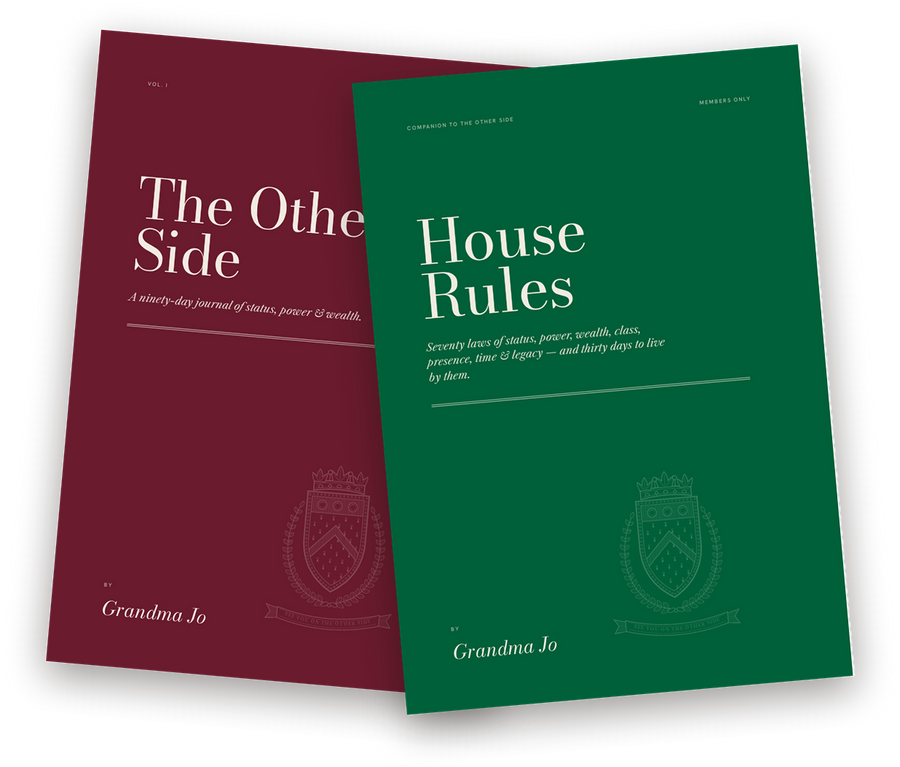
People ask me whether this is really for men too, usually a little warily, as if a grandmother's diary must be full of instructions about gloves. Yes. Every one of the seventy rules in House Rules works exactly the same way for a man, because none of them is about what you're wearing or who you are. They're about what you do when nobody is marking your homework. My grandmother wrote them down by watching women, and the rules still turned out to fit their husbands better than their husbands' suits did.
What most men lack is not the rules but the repetition. You can read all eleven of these tonight and agree with every one, and on Thursday you'll still be twenty minutes late with your phone on the table. Knowing isn't the difficulty. Practising is.
So I built the practice around the one meal most men eat alone. House Rules gives each rule a lunchtime: you read it over your sandwich, write two sentences about the man who already keeps it, make one small move before two o'clock and note what came back. Rule, script, move, receipt. A month of that and "be where you said, when you said" stops being something you agree with and becomes something you've done thirty times. The Other Side carries it into the evenings with a Carriage score out of ten, a plain verdict on the man you were between breakfast and bed. After ninety nights of honest scores a man knows exactly what kind of gentleman he is, which is more than most ever find out.
Both come as The Full House, for less than the round you'd stand three friends on a Friday night. Nobody remembers that round by Monday. Ninety days from now you'll still be using this.
Start with rule one. Be where you said, when you said. Then add the rest, one at a time, until they stop being rules and become the way you are.
And now, since it's Sunday and nobody's watching, I'll raise a glass. To the men who arrive on time, remember the doorman's name, take the phone call later and never once mention the bill.
"And to all of you cut from the finer cloth — I'll see you on the other side."