The gentleman in room fourteen asked me for his bill and a pen, and gave me my first lesson in the old money mindset. I got the lesson backwards.
He had come down at seven minutes past eight every morning for a fortnight, always in the same tweed jacket, gone soft and shiny at the elbows. I was three weeks into the job, still learning which key hung on which brass hook behind me, and I watched him read his bill line by line while a small queue gathered behind him with its suitcases. Halfway down he stopped, tapped an entry and said, "I think this newspaper belongs to someone else," in exactly the voice you'd use to hand back a dropped glove. I corrected it. He paid, thanked me by name, and on his way out gave the porter an envelope and the night manager a handshake.
I decided, with all the wisdom of twenty-six, that he was a retired schoolmaster making his pension stretch. Mr Doyle, the doorman, put me right that afternoon without naming names. He tipped his cap towards the hills beyond the car park and said, "His family owns most of what you can see from the roof."
Here is what I understand now, after years of watching people like him arrive and leave. The old money mindset is attention without anxiety. You know exactly where your money is, you almost never mention it in company, you buy little and keep it for years, and you think in decades rather than seasons. It is a temperament, and temperaments can be practised.
One thing before we go any further. This is about how people think and behave around money, not what they do with it. I don't give investment advice, and you shouldn't take it from a woman writing in a journal. For decisions about your own money, find a qualified professional who knows your circumstances. What follows is manners and mind.
"They never have to think about money"
This is the myth I held longest, and the tweed jacket should have cured me of it on the spot. The people I checked in and out thought about money constantly. They simply did it on a schedule and in private. They read bills. They queried charges without embarrassment. They knew, to a surprising degree, what things cost, and they were not ashamed to know.
What they didn't do was fret about it in the lobby. The thinking was done at a desk, at a set hour, with a pen, and then it was put away.
House rule 30: "Look at your money every week. Things you ignore tend to leave."
Most of us do the reverse. We avoid looking for weeks, then lie awake doing sums on the ceiling, which is the most expensive way to think about anything.
"Old money buys the best of everything"
It buys the best of very few things, and then it stops buying. I once carried a suitcase up to the second floor for an elderly lady whose handle had been replaced at least twice; you could see three generations of stitching in the leather. She caught me looking and said, "My father's. The saddler in town does it. He's cross with me for waiting so long this time."
New luggage would have taken her ten minutes and a signature. She preferred the saddler. The pleasure was in keeping it. That suitcase is the whole case for why the truly wealthy rarely look it, packed into one object: nothing new, nothing loud, everything looked after.
"Rich people think big and move fast"
The loud ones do, and you'll have noticed how often the loud ones are gone by the next season. The people I'm describing were almost impossible to hurry. I watched a woman at a reception once being told by a very keen young man that some opportunity or other closed on Friday. She smiled, set her glass down and said, "Then I expect I shall miss it." She wasn't being rude. She simply didn't make decisions on other people's timetables.
As for how rich people think in the families that stay rich, it's closer to a gardener than a gambler. They are patient with good things and suspicious of anything that insists on being rushed. I won't turn that into a strategy for your savings; that isn't my place. I'll only say that a person who can't be hurried is very hard to take advantage of, in business, in love, or at a car showroom on a Saturday.
House rule 59: "Patience compounds. So does panic. Choose which one you'd like more of."
"Generational wealth is about the inheritance"
My own inheritance would fit in a coat pocket: a diary whose ribbon has worn down to a few pink threads, kept by a seamstress who spent her life on her knees with pins in her mouth, hemming other women's dresses. It would fetch nothing at auction. To me it is worth more than the house she never owned, because it holds the habits of the women she fitted: how they came through a door, when they kept quiet, whom they never chased.
The generational wealth mindset, as far as I've seen it, is mostly that: habits that travel with the money, or instead of it. Families who keep what they have tend to hand down a way of behaving along with the silver. Patience. Repair. Discretion. A horror of debts for things that lose their value. The children who get the money without the habits are the ones who make the gossip columns. My grandmother's diary put it plainly:
Mrs H. says her grandfather left them the house and her grandmother left them the sense to keep it. She says the second was worth more and nobody thanked her for it.
The habits are the part anyone can learn, which is why I gave the everyday habits of old money a list of their own. They cost nothing to start.
"They never talk about money"
They never talk about it at dinner. That's different. Prices stay off the tablecloth, and the guest who puts them there is, more often than not, the newest to the table.
But in private, with the right person, they were more precise about money than anyone I've met. They could tell you what something should cost. They asked for terms, never favours. They disliked vague arrangements, a handshake with no date, an invoice with no detail. Vagueness, one of them told me years later, stirring a cup of lapsang she hadn't touched, "is what people with money pay other people to clear up." I've kept that line for thirty years.
So the replacement for this myth is a wealthy mindset that is quiet at the table and exact at the desk.
"Old families look down on new money"
Some do, and they're the least impressive people in any room I've been in. The best of them are far too busy to look down on anybody. The gentleman in room fourteen thanked me by name. He was just as courteous to the porter and to the boy who brought the newspapers. Of all the differences between old money and new money, the one that matters most has nothing to do with taste. It's who gets your attention. His went to everyone who handed him anything.
"Old money is lavish with its generosity"
It's generous, often astonishingly so. Lavish is the wrong word, because lavish wants an audience. The hotel hosted a charity dinner every winter, and one year I was put on the door with the list. When the coffee came round, the chairman read out the gifts. One modest sum was read out twice, at the donor's request, and he stood up both times. The largest gift of the night wasn't read out at all. The couple who gave it had asked, in writing, that it not be mentioned, and they left before the coffee.
I only knew because I'd typed the envelope. I remember thinking it was a strange way to spend so much money: to get nothing for it, not even a round of applause. I was well past thirty before I saw that they had got exactly what they wanted. Giving on purpose, quietly, and never out of guilt is a habit you can start with a very small sum. Nobody needs to hear it read out, least of all you.
"You have to be born into it"
My grandmother wasn't. I certainly wasn't. I came to that hotel from a back bedroom where Mrs Adair, my landlady, counted the milk bottles on the step each morning, and I learned the old money mindset the way my grandmother had: by watching people who had it and copying what they did with their hands, their voices and their bills.
I got it wrong for a long while first. I spent my first decent wage on a handbag with a very visible name on the clasp, because I assumed the ladies signing the register carried the same. They didn't. Theirs had no name at all. It went to a charity shop within the year, and I felt the fool for a while, which is how most of us learn anything worth knowing.
What the old money mindset looks like on an ordinary Tuesday
Take away the hotel and the tweed, and here is what I'd want you to practise. None of it needs a portfolio.
- Look at your money on a set day, at a set hour, for a set length of time. Then close the book.
- Read every bill before you pay it, including the ones that are always right. The one day it's wrong, you'll know.
- Before any purchase above the everyday, ask whether you'll still want to own it in ten years. If you won't, ask why you want it this week.
- Mend one thing this month instead of replacing it.
- Keep money out of the dinner conversation entirely, yours and everyone else's.
Five lines, and none of them glamorous. It is boring in the way that good tailoring is boring, and it outlasts everything louder. Quiet luxury, properly understood, is a behaviour for the same reason: the habits arrive long before the look, and they stay after it has gone out of fashion.
Seven nights, one rule
If you'd like to test this before you believe me, and I'd think more of you for it, try a single rule for seven nights.
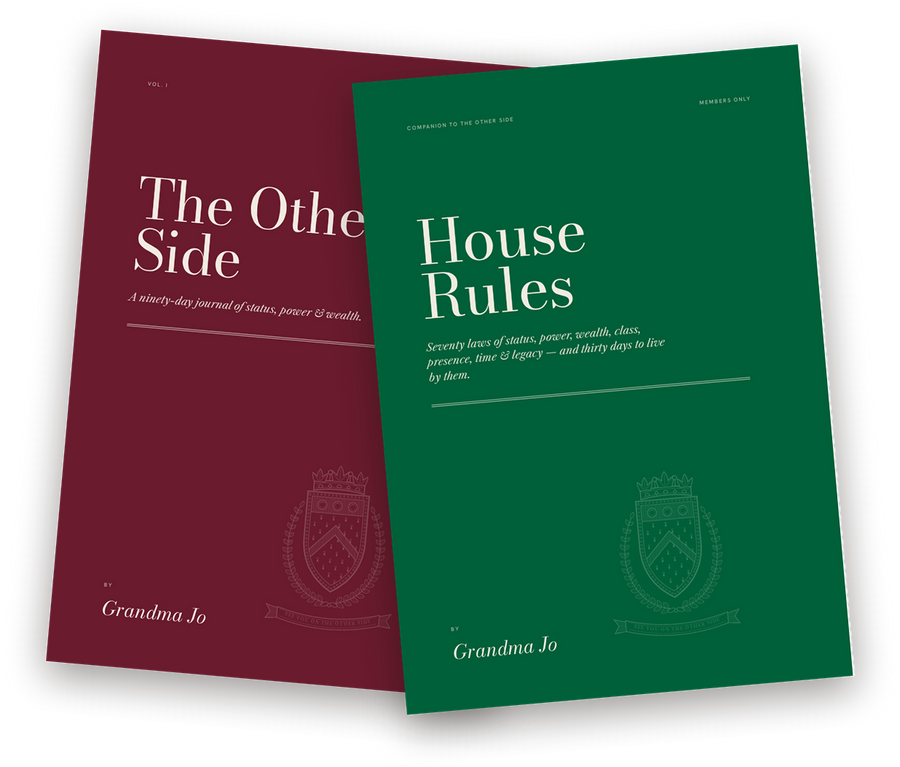
Rule 21 in House Rules reads: "Wealth is a habit long before it's a number." For the next seven nights, before you go to bed, write one line: something you paid for today, and whether it was considered or unconsidered. Nothing more. No totals, no guilt, no budgets. Only the honest word beside the thing.
By the fourth night you'll notice a pattern, and it will probably embarrass you slightly, which is how you know it's working. By the seventh you'll be pausing before you pay, for about a breath, the way the gentleman in tweed paused over his newspaper. That breath is the mindset.
If the seven nights do something for you, there are sixty-nine more rules where that one came from, and a journal built to hold ninety days of them. You'll find them in The Full House. If they do nothing, you've spent seven lines of ink and learned something about your own bills, which the gentleman in tweed would have called a fair trade.
Every night, before I turn off the lamp, I write down the one thing I paid for that day and the word beside it, then put the pen back in the drawer with its cap on.