Advice is the least useful thing you can give a person who is trying to get somewhere. I realise that is an ungracious thing to say for a woman who has written two books of it, so let me be precise. Ask me how to help others succeed and the answer is almost never a lecture, a reading list or a long lunch in which you tell them what you would do in their shoes. The answer is a door. You say their name in a room they can't yet get into. You put them in front of the one person who can say yes. Then you step back and let them walk through without holding their elbow.
Advice is what we give when we'd like the credit without the risk. A door costs you a little of your name, which is exactly why it works, and exactly why so few people offer one.
I learned this the way I learned most things worth knowing: by standing on the wrong side of it first.
The morning a stranger skipped my references
I had been out for eleven days. I had a case I could lift with one hand and a room at the top of Mrs Adair's house, with a window that looked onto a brick wall so close I could have hung washing on it. I had a little money in an envelope pinned inside the lining of the case, and a diary in brown leather that I read every night as if it might tell me the ending.
What I did not have was a single person who could vouch for me. The only one who could account for the last several years of my life was the man I had just left, and he was not going to write anyone a letter.
There was an advertisement in the paper for a reception clerk at a hotel near the station, the sort with a revolving door and brass that somebody polished every morning before six; you could smell the polish from the pavement. I ironed my one good blouse, cream, with a collar I had turned myself, using an iron borrowed from the woman across the landing and the back of a chair for a board. When I arrived there were five girls on the bench outside the manager's office. Every one of them had an envelope on her knee. I had my handbag and my hands.
At a quarter past nine a woman came out. Navy dress, reading glasses on a chain, a pencil behind her ear that I never once saw her use. Her name was Mrs Carrow and she ran the front desk. She went down the bench taking the envelopes one by one, glancing at each for about as long as it takes to read a bus timetable. When she reached me, I started to explain. I had prepared the explanation for two days. It had three parts and an apology at the end.
She held up one finger.
"Don't," she said. "Can you add up a bill without a machine and smile at a man who is shouting?"
I said yes. I had been smiling at a man who was shouting for years; the arithmetic was the part I was less sure of.
"Six o'clock tomorrow," she said. "Wear that blouse again. It's the right one."
That was the first door. I did not understand, then, what it had cost her. I thought she liked me. It took me years, and a desk of my own, to see that she had put her judgement on the line in front of a manager who would certainly have asked why she had hired the girl with no references. If I had stolen from the till or cried at a guest, it would have been her name in the conversation, not mine.
She kept holding it, too, in ways I missed at the time. She put me on the desk at six in the evening, the worst hour, when the trains came in and everyone wanted their key at once. When the man in 214 came down to complain about the radiator, she stood three feet behind me and did not rescue me. And the next morning, when the manager asked what had happened, she said, in front of me, "Jo handled it." I had half handled it. She gave me the whole.
"Take the blame in private. Give the credit in public." House rule 67.
Seven years later, when I told her I wanted to leave and build something of my own, she did not give me a speech about risk. She took a hotel card from the drawer, wrote a man's name on the back and a telephone number beneath it. He had stayed with us one week in every month for longer than I had worked there.
"Tell him I sent you," she said. "After that, never mention me again. If you're any good, you won't need to."
That was the second door. I walked through it on a wet Monday in a coat I couldn't quite afford, and I never did mention her again, to him. I mention her often to everyone else.
How to help others succeed without making them owe you
I wrote to Mrs Carrow when I signed the lease on my first office. It was a long letter. I thanked her for the blouse remark, for 214, for the card. I told her I would find a way to repay her. She wrote back on hotel paper, one line, in pencil, so she must have found a use for it after all.
"Good. Now do it for someone else."
That is the whole of the method, really, but I'll unpack it, because I have watched plenty of well-meaning people get it wrong, and I got most of it wrong myself before I got it right.
Say their name where they aren't. Mentoring happens face to face. Holding a door is something you do on their behalf, when they can't hear you and can't thank you. The most useful sentence you will ever say for someone else is spoken in a meeting they don't know is happening: "You should talk to Ruth. She's the best I've seen at this." Then you stop. You don't add a paragraph. The shorter the recommendation, the more it sounds as if you've staked something on it, and you have.
Make the introduction and then leave. An introduction done properly is three sentences. Who they are. The one thing they do better than anyone you know. Why the other person should care. "I'd like you to meet Tom. He's the one who fixed our accounts when nobody else would look at them. I think you've got exactly that problem." Then you excuse yourself and go and find a drink. Standing there while they talk is holding the door and then standing in the doorway.
Let them do it badly, their way. Mrs Carrow stood three feet behind me and let me stumble with the man in 214. It would have been quicker for her to take over. It would also have taught me that I needed her. Lifting others means letting them carry their own weight while you stand close enough to catch it. Not closer.
Give it away clean. "A gift given freely is power. A favour begged is a debt." That is rule 66, and it cuts both ways. If you hold a door and then keep a little ledger of what the person owes you, you haven't given them anything; you've lent it, at interest. People can feel an invoice even when it's never sent. Forget you did it. If they do well, you'll hear. If they never thank you, that is their manners, not your business.
Hold it for people who don't remind you of you. This one is harder than it sounds. We are all tempted to help the young person who has our accent, our school, our particular brand of nerves. It feels generous. Mostly it's vanity with a kind face. The girl on that bench with no envelope did not look like Mrs Carrow's idea of a front desk clerk. That, I suspect, is partly why she chose me.
And one more thing that goes wrong, quietly and often: holding a door you don't actually have. Promising an introduction you can't make, or talking up a connection who barely remembers you. It feels kind in the moment and it does real harm, because the person you're trying to help walks into a room expecting a welcome and finds a puzzled face. Only open what you can open. It's usually more than you think, and it's always enough.
Do it quietly, too. The less fuss you make about helping someone, the more weight your help carries, for the same reason that the stillest person in a room tends to get the most respect: nobody suspects them of wanting applause.
The door I nearly didn't open
I'd love to tell you I took Mrs Carrow's one line and lived by it from that day. I didn't. For quite a while I thought that giving back meant being available: taking the call, having the coffee, sharing what I knew. All good things. None of them doors.
Years ago, when my own firm was still small, the nephew of the woman who did my alterations (a proper tailor, with a pincushion strapped to her wrist like a watch) came to see me. He was twenty-three, clever and badly dressed in the particular way of clever young men, and he wanted to get into a line of work where I happened to know people. I gave him tea and forty minutes of advice. It was good advice. I was rather pleased with it. He wrote notes in a spiral pad and thanked me very nicely at the door.
On the way home, on the top deck of the bus, I felt that small warm glow of having been generous. And then, somewhere around the second set of lights, I heard a pencil on hotel paper. Now do it for someone else. I had not done it. I had done the thing that costs nothing. I had given him a lecture and a pat on the arm and sent him back to the bench with no envelope.
The next morning I wrote two letters. Short ones. Each named him, said the one thing I'd noticed about him that I'd have hired him for, and said that I would consider it a personal kindness if they gave him twenty minutes. I did not tell him I'd written them. I rang him and said only, "Someone may call you this week. Be early, and wear a jacket that fits."
What happened after that is his story, and he tells it better than I do. What I'll say is that the letters took me eleven minutes, and the forty minutes of advice, I'm fairly sure, he has forgotten entirely.
That is the uncomfortable arithmetic of lifting others. The part that feels generous to you is often the part that matters least to them. The part that matters most usually takes a few minutes and a little courage, and is invisible to everyone except the person whose life turns on it.
Class shows up in exactly these unwatched moments, and the one test of class I trust was taught to me by a girl taking coats at a party. A young man with a spiral pad and the wrong jacket can do nothing for anybody yet. That's the point.
Why I keep the rule where I can see it
Here is my confession: I don't hold doors by instinct. My instinct, like most people's, is to be busy, to be helpful in the ways that are easy, and to forget. The only reason I remember is that I've arranged my life so that I can't avoid remembering.
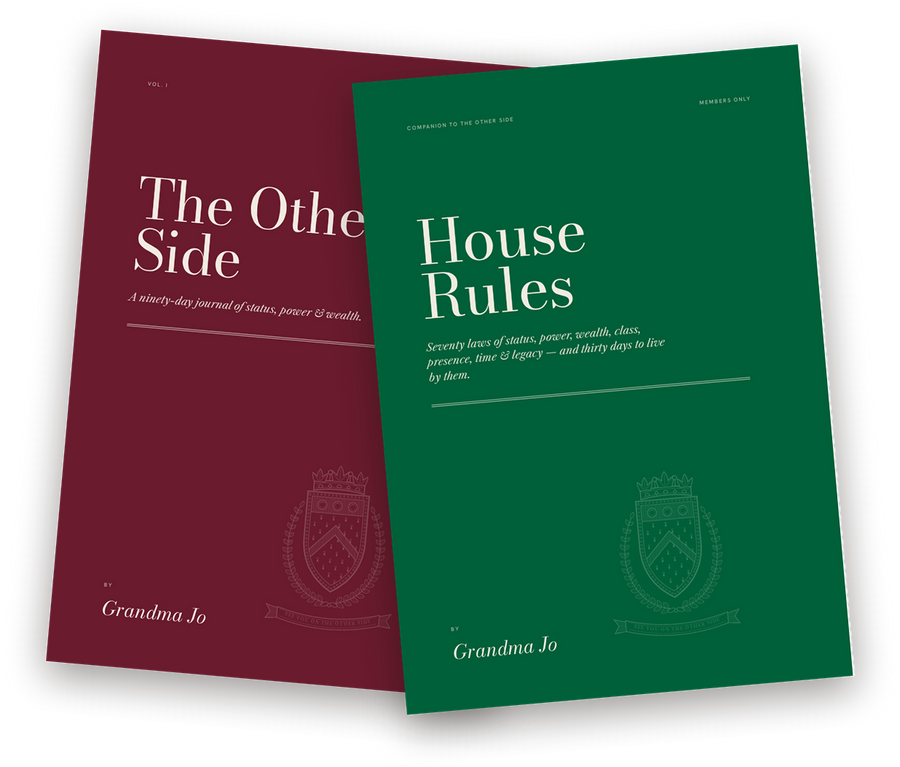
That's the reason the three pieces of The Full House belong together, and the reason I'd rather you had all three than any one. In House Rules you read the rule itself, rule 62, "Hold open the door you once waited outside," among the seventy, and there's a thirty-day practice done in five minutes at lunch: rule, script, move, receipt. The move might be one sentence in one meeting. The receipt is noting that you did it.
The journal itself, The Other Side, is where you practise it, twice a day for ninety days. Each morning it wants "the move", a single thing you will actually do before dark. Some mornings mine is simply a name and a person to say it to. And at the back there's the ledger, where each door that opens for you goes down with its date. I keep a second column in mine, in pencil, for the doors I've held, because a ledger that only runs one way is a very poor ledger.
Then the lock screens, twelve of them, so that rule 62 can be sitting there when a message arrives from someone asking for twenty minutes of your time. I resisted those at first; I thought a telephone was rather beneath the rules. I was wrong. The phone is exactly where most of us are when someone asks for help and we're deciding whether to answer properly or send a thumbs up.
Read it, practise it, see it. None of it is complicated. It is merely rare, and rare is the only reason anyone notices. If you'd like to begin with the whole set, start tonight, and put one name in the pencil column before the week is out.
Mrs Carrow retired before I could do anything as grand as I'd planned. I did send flowers, and a card, and I told her about the tailor's nephew. She wrote back, in pencil again, two words this time: "And next?"
I keep that card inside the cover of my ledger. Most Sunday evenings I take it out, look at it, and ask myself the only question she ever really cared about: whose name did I say this week, in a room they couldn't yet get into?