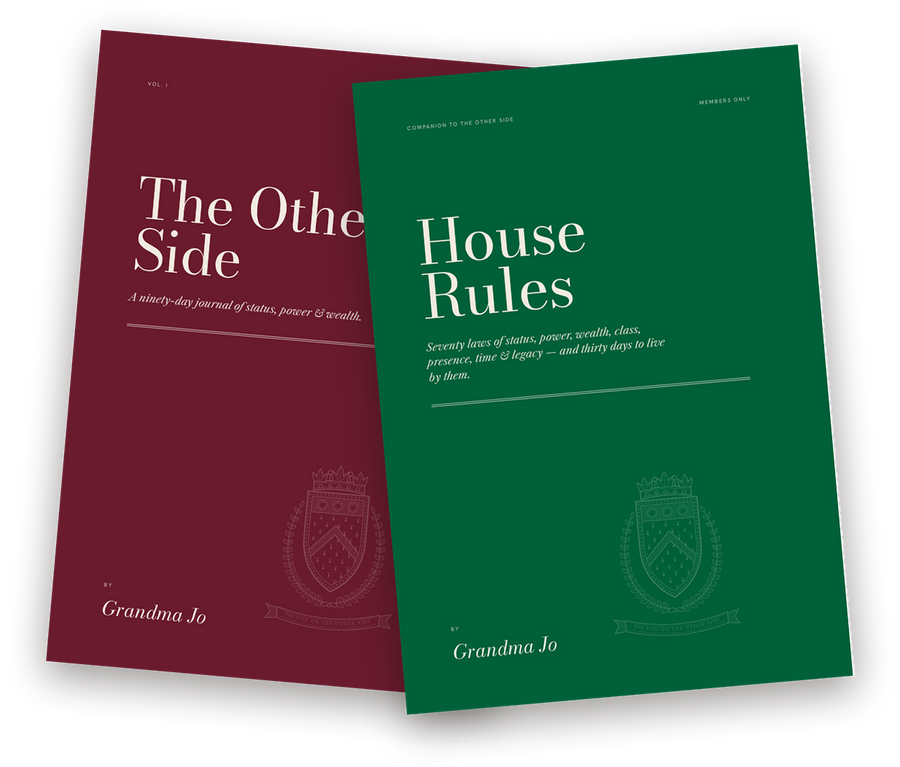
"We don't hold our knife like a pencil in this family, Josephine."
His mother said it across a Sunday lunch table when I was twenty-three, in front of his father, his sister and a leg of lamb. She said it pleasantly. That was the point. The sentence wasn't about my knife, or about table manners at all. It was about who belonged at that table and who was being allowed to sit at it on sufferance, and I understood that perfectly, and I put my knife down and didn't pick it up again until the pudding.
I've thought about that lunch a great deal in the forty-odd years since, usually while holding a knife correctly in a far better restaurant than any that family ever booked. And I've come to a view on table manners that I'll give you plainly: some of the old rules exist to make everyone at the table comfortable, and those still matter enormously. Others exist to make somebody feel small. Those were never manners. They were a password, and you're allowed to stop caring whether you know it.
Here's how to tell the two apart, one belief at a time.
"You have to know which fork to use"
Half true, and the true half takes ten seconds to learn. Cutlery is laid in the order you'll need it, so you work from the outside in. Dessert things sit above the plate. Bread plate on your left, glasses on your right. That's the whole of the mystery, and anyone who makes it sound more complicated is selling a course.
The false half is the idea that using the wrong fork marks you for life. It doesn't. I once watched a dowager with a rope of pearls and several farms eat her fish with the meat fork, notice, laugh, and carry on. Nobody cared, because she didn't. What people do notice is the other thing: the fluster, the hand hovering over the cutlery like it might bite, the whispered "which one?" to your neighbour. If you're not sure, glance at the host and follow. If you've got it wrong, finish with the fork you've got. The fuss is always louder than the fork.
"Elbows off the table, always"
This one began, as far as I can tell, as a rule about posture and space, and got promoted to morality somewhere along the way. The part worth keeping is the space. While you're eating, elbows on the table mean you're taking room from the people either side of you and putting your sleeve in the gravy. So keep them in.
Between courses, or leaning in over coffee to hear someone properly, an elbow on the cloth is perfectly civilised. Some of the most gracious hostesses I've known did it constantly once the plates had gone, chin on hand, listening to a guest as though nobody else were in the room. That isn't bad manners. That's attention, and attention outranks deportment every time.
"The way you hold your knife shows your breeding"
Now, that Sunday. Is there a sensible way to hold a knife? Yes: handle in the palm, index finger along the back, so you can cut without sawing like a cellist and without the blade squealing on the plate. That's function. It's quieter and it's easier, and I'd teach it to any child.
But his mother wasn't teaching me. She was ranking me. The rule she was enforcing had nothing to do with how the lamb got cut and everything to do with where I'd come from, and that kind of rule is snobbery dressed as etiquette. If someone holds their knife like a pencil and eats neatly and quietly, they have good table manners. The grip is a regional accent. It isn't a crime.
My grandmother, who sewed for some very grand families and sometimes stayed to supper in their kitchens, summed up the grandest of them in six words: "ate like farmers, kind to maids." I thought she was being romantic for years. I've since sat at enough of those tables to know she was being accurate.
"Correcting someone's manners is doing them a favour"
This is where I have to confess something, because I got it badly wrong once, and not so very long after that lunch.
Having been corrected, I became a corrector. It's a common enough reaction; people who were made to feel small sometimes go looking for someone smaller. Some years later, at a work dinner, a young woman who'd just joined the firm where I then worked was eating her soup by tipping the bowl toward herself. I leaned over and said, quietly I thought, "Away from you, dear. Always tip it away." Two people heard. Her ears went red to the tips. She said "Thank you" in a tiny voice and didn't finish the soup.
I went home and realised I'd just been his mother. I'd done precisely the thing I'd sworn I'd never do, and I'd done it for the same reason: to show I knew.
So here's the rule I've kept since. You don't correct an adult's table manners at the table. Ever. House Rule 36 says, "Compliment in public. Correct in private. Never the other way round," and I'd go further for manners at dinner: most of the time, don't correct them at all. The breach you'd be pointing out is always smaller than the breach of pointing it out. If it's your own child, a quiet word on the way home. If a colleague asks you (and some will), tell them over a coffee, kindly, once.
"Nobody waits for everyone to be served any more"
Some people don't. It's still a table manner that matters, and I'd defend it to anyone.
Waiting until everyone has a plate in front of them is the simplest way a table says, we're doing this together. It's also a small courtesy to the person whose food came last, who would otherwise eat alone while everyone else watches, or rush to catch up. If your host says to start, start: "Please, go ahead, don't let it get cold" is an instruction, not a test, and ignoring it just leaves everyone's food going cold out of politeness to you. If you are the host, say it early and mean it.
If you're in a restaurant and one dish is very late, the person waiting should be the one who releases everyone else: "Please, start. Mine will turn up." That sentence is worth learning by heart. It turns an awkward five minutes into a small act of generosity.
"A phone face-down on the table is fine"
It isn't, and I think most of us know it isn't, which is why we turn it over rather than putting it away. A phone face-down is still a guest at the table. It's the guest who might, at any moment, be more interesting than you. Everyone sitting opposite it can feel it waiting.
House Rule 47: "Phones away. Whoever you're dining with deserves the whole of you." Away means in a bag or a pocket, on silent. If you genuinely must be reachable (a sitter, a sick parent, a delivery at the office), say so before the menus arrive, briefly, and step out if it rings. "I'm so sorry, I'm on call for my mother tonight. If it goes, I'll take it outside." Nobody minds that. They mind the glance at the lit screen during the story they were telling you.
"Sending food back is rude"
It's rude to sulk through a dish you can't eat and let the whole table feel your disappointment for an hour. Sending it back properly is the better manners.
Properly means once, to the waiter, not the table. One plain sentence, no drama, no speech about the last time you ate here: "I'm sorry, this is quite a lot rarer than I asked for. Would they mind giving it a few more minutes?" Then turn back to your companions and tell them to carry on. The more lightly you do it, the less anyone remembers it happened. And be kind to the waiter while you do it. How you speak to someone you'll never need anything from is the one test of class I've never known to fail, and everyone else at the table is quietly marking it.
The table manners that still matter, in one sentence
When I strip it all back, the rules worth keeping come down to one question. Does this make someone else more comfortable? Chewing with your mouth closed does. Passing the salt instead of stretching across a neighbour does. Waiting, listening, putting the phone away, pouring for the person next to you before you pour for yourself, steering the talk away from the three subjects that should never reach the tablecloth: all of that does. It's why good manners cost nothing and look extraordinarily expensive, as Rule 32 has it.
The fish knife doesn't. The pencil grip doesn't. The ritual of which way to tip a soup bowl, frankly, doesn't much either. Keep those if you enjoy them, the way you'd keep an old family recipe, but never use them as a ruler to measure someone else. A table manner is worth keeping if it makes someone else more comfortable. If its only job is to catch people out, let it go.
My granddaughter, at about eight, wanted to know why you always pass the salt and pepper together even when someone has only asked for the salt. I told her what I'd been told: so that nobody at the table ever has to ask twice. She thought about it with a bread roll in each hand and said, "So it's for the next person." Exactly that. Most of the good rules are for the next person. She passes them together to this day, and gives me a look when I forget, which I do, occasionally, on purpose, to see the look.
Hosting runs on the same logic, only you're answerable for the whole table's comfort instead of your own corner of it; the host's half of the bargain is laid out in my dinner party etiquette notes.
Ninety nights from now
Here's what I'd like for you. Not ninety nights of fretting about forks: ninety nights of practising the part underneath. There's a practice in The Other Side called scripting: you write the evening you want as though it has already happened, in the present tense, and embarrassingly specific. Not "I am good at dinners." Something more like: "I'm seated between two people I don't know. I ask the woman on my left how she knows the host, and then a second question about her answer. My phone is in my bag. When the fish is late, I tell everyone to carry on without me." It feels faintly ridiculous to write. It feels much less ridiculous three weeks later, when you notice you've done every line of it without thinking.
Do that for ninety nights and picture where it lands you. A private room upstairs at a restaurant with a low beamed ceiling and too many candles. A long table, white cloth, eight people, half of whom you've never met. Someone important to you is at the far end. The wine list comes to you by mistake and you hand it on, smiling, with a small "I'll leave this to the expert." A dish arrives late and you're the one who says "Please, start." The man beside you knocks his water; you've already moved the bread plate out of the way before anyone else notices. Nobody at that table will remember what you ate. Several of them will remember that you were easy to sit beside. That's the whole point of table manners, and it's the kind of thing that gets you invited back to rooms like it.
Scripting is one of the practices inside The Full House, which also includes a lock screen that puts rule 47 on the very object you're trying to leave in your bag, which I find a satisfying sort of joke. You could write your first dinner tonight, after the washing-up.
And when you walk into that upstairs room, the candles will already be lit, your name will be on a card halfway down the table, and you'll pull out your chair as though you'd been doing it all your life.