Pricked the lady with a pin at the second fitting, and blood on the lining. Said I was sorry, the once, and that I'd have the lining new by Thursday. Did not go on about it. She has asked for me again for the spring.
My grandmother wrote that in pencil for once, not ink, near the back of her diary, a few pages before the ribbon marker, which has frayed over the years to four burgundy threads. I must have read it thirty times before I understood it wasn't a note about sewing.
If you've typed "how to apologize properly" into a search bar late at night, with a knot under your ribs, here is the answer in one breath. Say exactly what you did. Say you're sorry, with no "but" and no "if". Say what you'll do to put it right. Then stop. That's all an apology is, and all of it is in her four lines: the fact, the sorry, the repair, the silence. House rule 39 is my own version: "Apologise once, beautifully, and move on. Grovelling is a second offence."
What follows is how to do it, what to say, and where it usually goes wrong, because I've gone wrong in most of those places myself.
"How to apologize properly," answered in four parts
Name it exactly
"I'm sorry for everything" is fog. The person you hurt wants to know that you know what happened, so tell them in plain words without softening it. "I said your idea was naive in front of the whole team." "I forgot your birthday and didn't call." "I was forty minutes late and didn't let you know."
Precision is a form of respect. It tells them you've looked at it from their side of the table.
Say sorry, and nothing after it
"I'm sorry." Full stop. The most dangerous word in any apology is the one that comes next, because it's usually "but", and whatever follows a "but" cancels whatever went before it. "I'm sorry, but I'd had a terrible week" means "I'm tired, and you should allow for it." Keep the terrible week for another conversation, or for nobody.
Offer the repair
Say what you'll do. Sometimes it's practical: "I'll write to everyone who was in that meeting and make it clear the idea was yours." Sometimes it's a change in behaviour: "From now on, if I'm going to be late, you'll hear from me before, not after." Sometimes there's nothing to mend except the relationship, and then the repair is simply: "I'd like to make it up to you, if you'll let me."
The best repair I ever watched was made by Mrs Carrow, head of the front desk at the hotel where I worked in my twenties. A guest arrived just before midnight, in a wet fur collar, to find her room had been given to someone else. Mrs Carrow came out from the back office with her reading glasses pushed up into her hair and said, "We gave your room away. That was our mistake, and I'm sorry. I've booked you into the hotel across the square, there's a car outside, and tonight is on us. I'll ring you at nine to arrange your return." The guest had arrived ready for a fight. She got into the car almost smiling. Fact, sorry, repair, and not one word about how busy the evening had been.
Then stop
This is the step most people fumble. They've said the thing, the silence afterwards feels enormous, so they fill it: with reasons, with more sorries, with "please say you're not angry." Don't. Let the other person have the silence. It belongs to them now, and they may need a minute with it, or a week.
Three apologies, word for word
Advice is easy to agree with and hard to use at the moment it's needed, so here are three I've either given or wished I had.
To the friend you let down
"I promised to help you move on Saturday, and I didn't come and didn't call. You'd booked the van and you waited in for me. I'm sorry. I'd like to come over next weekend and help you unpack the rest, if you'll have me."
To the colleague whose credit you took
"In Tuesday's meeting I presented the pricing idea as if it were mine. It was yours. I'm sorry. I've written to the director this morning to say so, and I've copied you in." Notice what's missing: no "I didn't mean to," no "it just came out that way." You did, and it did, and now you're mending it. Anyone who manages people knows the old principle of praise in the open, correction behind a closed door. Credit follows the first half of it: whatever you took in public, you hand back in public.
To someone you love, after you snapped
"I spoke to you sharply this evening when you asked about the car. You didn't deserve it. I'm sorry." Then, perhaps, a hand on the arm. Between people who love each other, the repair is often nothing grander than being gentler tomorrow and letting them see you try.
Where a sincere apology goes wrong
Apologies tend to fail in a handful of familiar places. You'll recognise several. I certainly do.
The most common is the "if": "I'm sorry if you were upset." It apologises for their feelings instead of your behaviour, and everyone hears the difference. Close behind comes the essay, the careful account of how it happened and the pressures you were under. Explanation can be useful later, if they ask for it; at the start it's a defence dressed up as candour.
Then there's the demand for absolution. "Are we all right? Please tell me we're all right." You've just asked the injured person to look after you, and that reflex has the same root as the hunger for everyone's approval: the need to be told you're still liked before you've earned it back. There's the wrong channel, a text message for something you said to someone's face; if it happened in a room, the apology belongs in a room, or at least on the telephone, where they can hear your voice. And there's the gift instead of the words. Flowers are lovely after an apology, but a bouquet delivered with no sentence attached says "I would rather spend money than say it."
Last comes the repeat: sorry again the next day, and the day after, which brings me to the thing I got most wrong.
Grovelling is a second offence
For years, I apologised for everything. The weather, the traffic, standing in a doorway. Long before I had anything of my own, I shared a home with someone who found most things were my fault, and I learned to say sorry the way other people learn to turn their collar up in a cold wind. It wasn't humility. It was armour, and like all armour it was heavy and made me clumsy.
I took the habit with me when I left, folded in with everything else, and it was years before I set it down. The moment I understood what it cost other people came much later. I'd double-booked myself and missed a close friend's fiftieth birthday dinner. A real failure, and she was hurt. So I rang her. She didn't pick up, and I left a message on her answering machine. Twenty minutes later I rang again to add something. By eleven o'clock I'd left four messages, each longer than the last: the muddle with the diary, how awful I felt, how I'd never forgive myself, how she must think terribly of me.
She sent back a postcard with a seagull on the front. On the back it said: "Jo. Once would have done. Lunch on Sunday? Bring nothing."
I read it standing in my hall and went hot to the ears, because she was right. My four messages had asked her to spend her evening comforting me about her own birthday. That's what grovelling does: it hands the comforting back to the person who was hurt. One clean sentence, "I missed your fiftieth, and I'm so sorry. Let me take you to dinner," would have given her something. The messages took.
An apology is a gift to the person you hurt. Grovelling is a bill you hand them afterwards.
Apologising to someone with less power than you
The hardest apologies are often the ones owed downwards: to a junior colleague, to the person who serves your lunch, to a child. Nothing forces you to make them, and that's exactly why they count.
Last summer I told my grandson off, quite sharply, for a long scratch on my dining table. He said he hadn't done it. I didn't believe him. Two days later I put my hand flat on the table to stand up and heard my own ring drag across the wood, in precisely the same place. I went and found him in the garden. "I blamed you for the scratch on the table. It was me, with my ring. I'm sorry I didn't believe you." He considered this for a moment, and then said, with great kindness, "That's all right, Granny. You're quite old."
He'll forget the scratch. I hope he remembers that the grown-up came outside and said it plainly, without a speech, and that it was over in half a minute. Children learn to apologise from watching whether the adults do. Junior staff learn it the same way.
When the apology isn't accepted
Sometimes you do everything right and the other person isn't ready. They say "fine" in the voice that means the opposite, or they say nothing. Let them. An apology is not a coin you put in a machine to get forgiveness out. You give it because it's owed.
What you can do is keep the promise inside it. If you said you'd write to the director, write. If you said you'd call before you're late, call, every time, for months. Kept promises are what finally make an apology believable, which is why I file it with the plain discipline of keeping your word rather than treating it as a separate skill. And if weeks go by and they still hold it against you, you may say, once and gently, "I meant what I said. I'm here whenever you'd like to talk." After that, the door is theirs to open.
One more thing, because it's what keeps people up. After you've apologised you'll often replay it late in the evening: the tone you used, whether you should have said more. You shouldn't have said more. You've done your part, and the rest is theirs.
The habit behind the apology
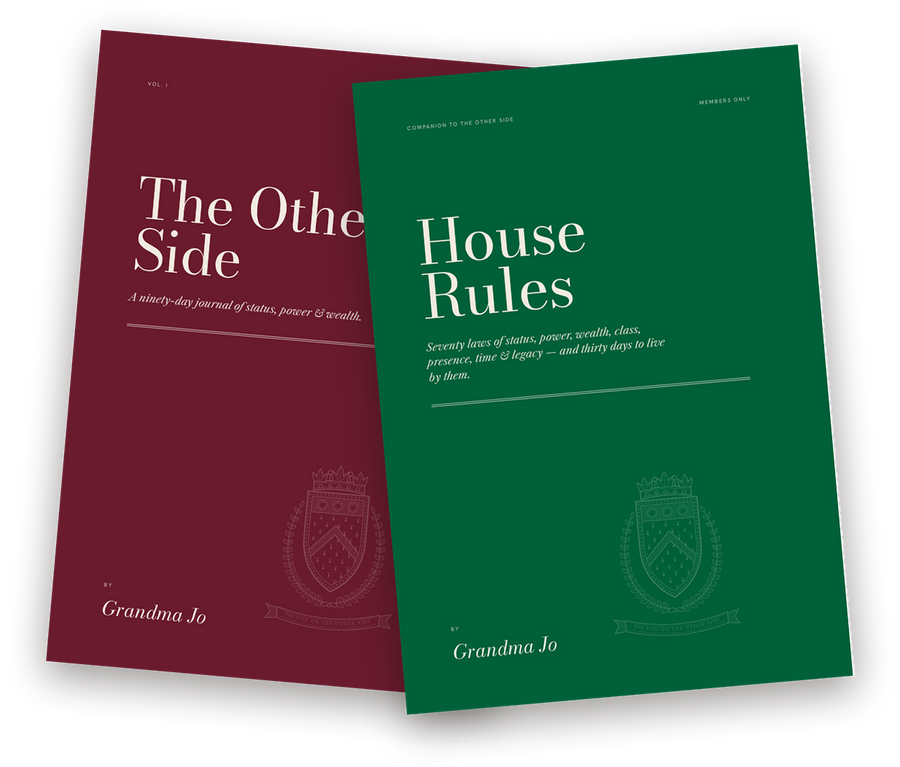
Nobody learns to apologise beautifully in a crisis. You learn it in small moments, over and over, until the clean version comes out before the grovelling version has a chance to start. That's the kind of repetition I built into House Rules, which runs a thirty-day practice at lunch, five minutes a day, in four beats: Rule. Script. Move. Receipt. On the day you reach rule 39, you'd read it, write your own line for it as though it were already true ("I apologise once, and then I act"), make one small move before the evening, and note the receipt: what the other person did when you didn't grovel. Most people are surprised by the receipt. The other person usually looks relieved.
The book sits inside The Full House, and the whole set costs less than one of those restaurant dinners you can't quite recall a week later. That meal is gone by the time the bill is folded. A clean apology, once it's a habit, is something you'll use in every friendship you keep for the rest of your life.
My friend and I had that lunch, by the way. She ordered the sole and never once mentioned the messages. Years later I found my reply to her seagull tucked in her recipe book: a plain card with one line on it. "Thank you for Sunday."
And my grandmother, a few pages on from the pin:
Unpicked the crooked seam and sewed it again straight. A mended seam, done honest, is the one that holds.