"You corrected her beautifully, Josephine. Pity you did it in front of me."
That was said to me in a lift, about twenty years ago, by a client of my firm who was holding a black umbrella with a horn handle and looking straight ahead at the brass floor numbers. She didn't turn her head. She didn't need to. By the time the doors opened on the ground floor I'd understood that I had just lost a little of her good opinion, and that I'd done it while thinking I looked rather impressive.
If you've come here wanting to know how to give feedback, that lift ride is the whole answer. Praise in public. Correct in private. And never, ever reverse the two. The rest is detail, and the detail matters, so stay a while.
"Compliment in public. Correct in private. Never the other way round."
That's House Rule 36. I've learned it three times in my life, from three directions: as an employee, as an employer and as a mother. I'll tell you about all three.
What I did wrong in that meeting
We were in the client's own boardroom. A young woman who worked for me, twenty-four, very bright, quicker than me in most respects, was taking the client through the timetable. She said the work would be delivered on the twenty-second. It was the twenty-ninth. I knew it was the twenty-ninth because I'd moved it myself the previous Friday and hadn't told her.
And I said, across the table, pleasantly: "No, that's not right, it's the twenty-ninth. Sorry, she's still learning the file."
I thought I was being efficient. I thought I was protecting the client from a wrong date, and I thought, if I'm honest with myself, that a small correction delivered calmly would show everyone in the room that I was in charge of the details. What I actually did was humiliate a capable young woman in front of a stranger, for a mistake that was mine, and tell the client (who was much cleverer than I gave her credit for) that I would do the same to her people whenever it made me look good.
The young woman went pink from the collar up. She didn't say another word until the coffee came. And the client waited until we were alone in the lift.
I once believed that correcting people on the spot was a sign of standards. It's a sign of nerves. People who are sure of their position don't need an audience to prove it.
Why correction in front of others never works
Correction in front of an audience is never about the mistake. It's about who is watching. The moment there's a third person in the room, the person you're correcting stops listening to what you said and starts managing how they look. They will defend, or deflect, or go silent and hate you quietly. The one thing they can't do is learn, because every ounce of their attention has gone into getting through the next thirty seconds with their dignity intact.
And the audience learns something too, though not what you intended. They learn that you're willing to spend other people's standing to buy your own, which is the exact opposite of what makes people follow a leader. Whoever you correct in front of others, everyone watching quietly files it away: one day that'll be me.
The worst of it is how small the moments are. A raised eyebrow at a colleague's slide. "Actually, it was Tuesday" at a dinner party, when your husband is telling a story and it doesn't matter in the least whether it was Tuesday. A sigh at your son when he holds his fork wrong in front of his friend's parents. None of these feels like cruelty from the inside. From the outside, every one of them does.
How to give feedback that someone can use
Privacy is the first condition. There are others. I've been corrected in private very badly, too, by people who closed the door and then took forty minutes to tell me what sort of person I was. So here is what I learned to do after the lift, and it hasn't changed much in two decades.
Choose the time yourself. Not in the heat of it, and not a week later when the other person has forgotten the details and you've polished your grievance into something shiny. Within a day is right. I used to say, "Have you got ten minutes at four? I'd like to go over this morning with you." Four o'clock became a sort of joke in my office. People knew what it meant, and they knew it would be short.
Start with what happened, in plain words, and keep it to the action. "The date you gave was wrong" is something a person can fix. "You're careless" is something they can only resent. When I finally had the conversation with that young woman, the first thing I said was: "The date was wrong, and it was wrong because I didn't tell you I'd moved it. That was mine. What I did in the meeting was also mine, and I'm sorry for it." Then I stopped. One clean apology does its work; a second one starts asking the other person to comfort you.
Ask for their side before you give the rest of yours. "What happened from where you were sitting?" You will be surprised how often the answer changes what you were going to say.
Give one thing to do differently. One. Not a list of seven. "Next time you're not certain of a date, you can always say: I'll confirm that by the end of the day. It's a perfectly good sentence, and nobody will think less of you for it." A person can carry one sentence out of a room. Seven, they drop in the corridor.
Then close it. Don't circle back tomorrow to see if it landed. If you've done it well, it has.
The trouble with the compliment sandwich
Somebody will have told you to wrap your criticism in praise: something nice, then the correction, then something nice again. It's a well-meaning idea and it works exactly once. After that, everybody learns to wait for the middle.
Worse, it spoils your praise. If every compliment you give is packaging, people stop believing any of them. They hear "Lovely work on the report" and brace for the "but". I'd rather keep the two apart entirely. Praise when it's earned, in front of people. Correction when it's needed, behind a closed door. Each becomes more believable for not being used to cushion the other.
Praise in public, and be exact about it
Most people are too stingy with public praise and far too vague when they do give it. "Great job, everyone" is a pleasant noise. It lands on nobody.
Exact praise, said aloud in front of people whose opinion matters to the person you're praising, costs nothing and is worth more than almost anything a manager, a parent or a partner can give. Say the name. Say what they did. Say what it made possible.
"Anna caught the clause on page eleven that would have cost us the whole of next week. Thank you, Anna."
"Your sister cleared the table tonight without being asked, and it meant I got to sit down with a cup of tea for the first time all day. I noticed."
"He booked this place three weeks ago and didn't tell me. I've wanted to come here for years."
Notice there's no gushing in any of those. Exactness does the work that adjectives can't. A person who hears their specific effort named in front of others walks a little differently for a day or two. I've watched it happen at boardroom tables and at kitchen tables, and I've never once seen it fail to do some good.
Constructive criticism at home is the hardest kind
With colleagues, at least, there are doors and diaries. At home the audience is always there: the children, the in-laws, the friends round for supper. It's why the rule is broken most often at home, and why it matters most there.
With a partner, the test I use is two questions, asked silently. Is it true? And does it matter? If your husband says the holiday was in 2009 and it was 2010, it's true that he's wrong and it does not matter in the slightest. Let him be wrong. If he's about to tell his boss something that will embarrass him, that matters, and the kind thing is a quiet word in the kitchen before the guests arrive.
With children there's one honest exception, and I'll give it to you plainly. If a child is being unkind to someone (rude to a waiter, cruel to a smaller cousin), you don't wait for four o'clock. You deal with it at once, but you do it low and brief. Bend down. Lower your voice. "We'll talk about this in the car." The conversation itself still happens in private. The child learns that the behaviour is taken seriously and that their parent will not make a show of them. Both of those are lessons in class, and they'll need both.
My daughter once told me, when she was grown, that the thing she remembered about being told off as a child was that I never did it in front of her friends. She didn't remember a single thing I'd told her off for. She remembered where.
When your temper is doing the talking
The hardest moment to keep this rule is the moment you've just been embarrassed yourself. Someone's mistake has made you look bad, in front of people you wanted to impress, and every instinct you have says: make it clear it wasn't me.
That's exactly what I was doing in that boardroom, now that I think about it. The wrong date made me look disorganised, so I pushed the disorganisation across the table to someone with less power to push back. It's a very old move, and nobody watching is fooled by it for a second.
Wait. Say something neutral ("Let me just check that date before we confirm") and move on. Of all the ways of staying calm under pressure, this may be the most useful: the ability to let a mistake sit on the table for an hour without needing to assign it to anybody. The meeting will survive. The person will be grateful long before they understand why.
Why I keep the rule in three places
I know this rule by heart, and I still break it when I'm tired. Knowing it is easy. Remembering it in the half-second before you speak, with your mouth already open, is where I still come unstuck.
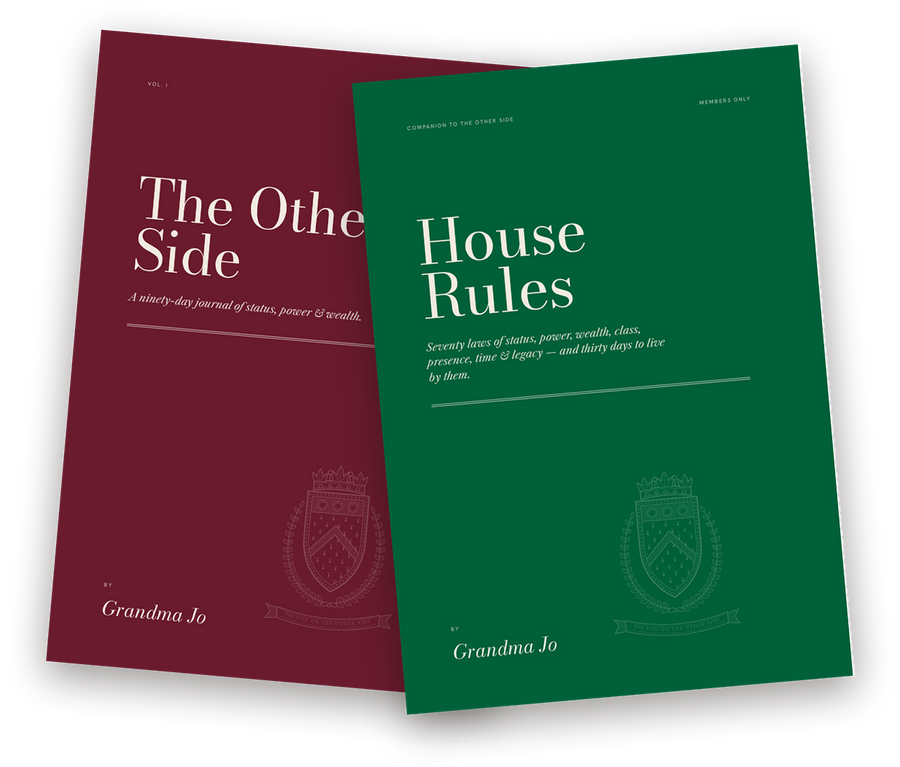
So I stopped relying on memory and put the rule in three places, because each one catches what the others miss. In House Rules you read it properly, and give it one of the book's thirty lunchtimes, with one small move to make that afternoon. In The Other Side you practise it in the evening, where the last line is Carriage, a mark for how you held yourself, and a day on which you corrected someone in front of an audience does not come out as a nine. And on the lock screen you meet it at the precise moment it's needed, which in my case is with my thumb hovering over a tart reply in the family group chat. Read it, practise it, see it: that's the whole logic of The Full House.
I never did apologise to that client for the meeting itself. I didn't need to. She hired us again the following year, and on the first day she asked for the young woman by name.
Tonight, before you sleep, send one person a line of exact praise for something they did today.