In the top drawer of my desk, under the good envelopes, is a letter I wrote and never posted. Four pages of cream paper, both sides, in a blue-black ink I stopped using years ago. It is addressed to the man I left in my twenties. It is even stamped. Not sending it was the first time I understood the power of silence, and I have kept the envelope ever since as a sort of paperweight for my temper.
I wrote it at the little table under the window of my rented room, a few weeks after I'd gone. It explains everything: why I left, what I had put up with, what I thought of him and his mother. Some of the sentences are the best I have ever written. He wrote to me three times that winter, long letters and then shorter ones and then a single line, and I answered none of them. Every page I might have sent would have given him something to argue with. The silence gave him nothing, and he read it perfectly.
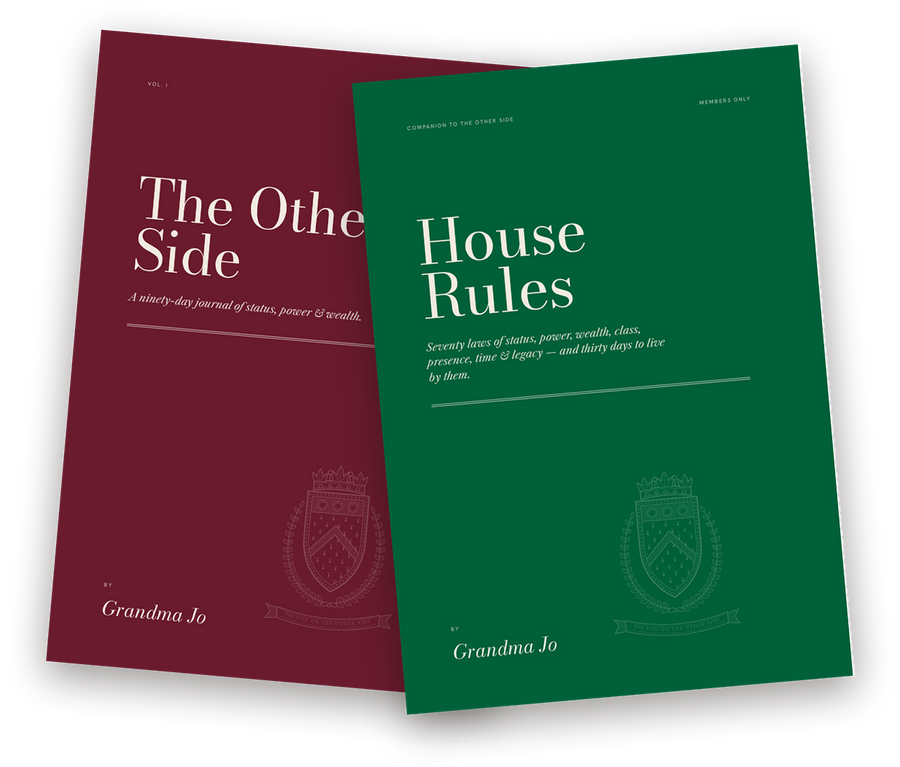
That is the power of silence in a sentence: the person who says less keeps their position whole and gives everyone else room to show theirs. Most people can't bear a gap in a conversation. They fill it, and what they fill it with is usually more than they meant to say. My grandmother saw it at every fitting she ever did, and it's rule 11 in House Rules:
"Say less, darling. The room leans in."
But silence has a shadow, and I've stood in it too. So this is about both: where saying less wins the room, and where it's just a comfortable place to hide.
Why the power of silence works on nearly everyone
A pause makes people uneasy in a very particular way. It feels like a question they haven't been asked. So they answer it. They explain the thing they already said, soften the request they already made, add a detail they'd meant to keep back. You don't have to do anything clever to benefit. You only have to not rescue them.
It works on the speaker, too. When you stop talking, you hear what has just been said, including what you said. Half the foolish things I've done in my life came from answering before I'd finished hearing the question.
And it looks like something. A person who doesn't hurry to fill a gap looks like a person with nothing to prove. You can't fake that with volume. You can fake it, for a while, with silence, and after enough practice it stops being fake.
Saying less at the negotiating table
The year we outgrew our first office, I sat across a table from a landlord's agent to renew the lease on the second. He was a pleasant man in a pale blue shirt with a pen he clicked when he was thinking. He named his terms. They were not good terms.
I wrote them on my pad. I looked at what I'd written. I didn't say anything. He clicked the pen twice. I think the whole thing lasted six or seven seconds, which in a small room is a very long time.
"Of course," he said, "if you were to take a longer term, there'd be some room."
I hadn't asked for room. I hadn't asked for anything. He'd negotiated with the silence and lost, and I'm not sure he ever noticed. What I said next was, "Let me think about that. I'll call you on Thursday." And on Thursday, I did.
The principle is plain. Once you've made your request or heard the other side's offer, the next person to speak usually gives something away. So make your ask clearly, once, and then stop. Resist the need to justify it ("because our costs have gone up, and you know how it is, and we've been good tenants"). Every clause you add is a clause they can argue with. Rule 20 adds the drink: "Ask clearly, once. Then wait — preferably with a drink."
The hard part comes later, usually around eleven at night, when a voice in your head replays the pause and insists you looked difficult. The Other Side keeps a page for exactly that hour, called Old story, new truth. You write the old story down ("If I don't explain myself, they'll think I'm being awkward") and then, underneath, what actually happened ("He offered better terms without being asked"). After a few weeks of it, the old story starts to sound like somebody else's.
In an argument, the one who stops talking often holds the floor
Arguments are where silence is hardest and where it does the most. Someone raises their voice, and every instinct you have says to match it, or to defend yourself line by line.
Don't. Rule 16: "Whoever raises their voice first has already lost the room." When somebody is shouting, a calm pause before you answer lets them hear themselves, and very few people enjoy what they hear. The heat drops by itself. When I worked in a hotel, I watched furious guests run out of fury in about forty seconds simply because the person behind the counter (usually me, in a navy jacket two sizes too big, with Mrs Carrow's eye on my back) let them finish, waited a breath, and said, "I understand. Let me see what I can do." No defence. No counter-attack. Just a gap they had to fill with their own reasonableness.
The same holds in private. In a disagreement with someone you love, the sentence you most want to say is almost always the one to hold back for a minute. Say, "I'm listening," and then listen. You'll find out what the argument is really about, which is rarely what it started as.
Reasons are the usual thing people pour into a silence, and the more of them you offer, the more there are to pick apart. Over-explaining is silence's opposite, and it nearly always costs more than it buys.
Silence at dinner, where the best stories live
Most hosts panic at a lull. The conversation dips, the candles are low, someone is scraping the last of the pudding, and the host leaps in with a question about holidays.
Let it sit. Some of the best moments I've had at a table came out of a pause nobody rushed. At a friend's house one winter, after coffee, the talk simply stopped. Nobody minded. A retired engineer who had barely spoken since the soup turned his glass slowly on the tablecloth and said, "My father built the bridge you drove over to get here." Then he told us about it for half an hour, and it was the best half hour of the night. If anyone had filled the silence with holidays, we'd never have heard it.
A comfortable silence at dinner says that the people at the table trust each other, and a host can build that trust simply by not panicking. A lull is always better than what people reach for to fill it, which is so often house prices or somebody's divorce, two of the subjects I keep off my table.
Grief, and the only time I'd say nothing at all
When someone you love is grieving, you will want to say the right thing. There isn't one.
The morning after my friend Ruth lost her husband, I went round with a loaf of bread and sat with her at her kitchen table for most of the day. People came and went with casseroles and sentences. "He's at peace now." "Everything happens for a reason." "At least it was quick." Each one was kind, and each one asked her to do something with it: agree, or be comforted, or reassure the person saying it.
I said very little. I made tea when the pot was empty. I answered the door. At one point I said, "I haven't got anything clever to say. I'm just going to stay." And I did. Months later she told me that was the only thing anyone said that day she could remember.
In grief, silence isn't strategy. It's company. Stay, keep your hands busy with something useful, and let them talk if they want to. If they don't, the quiet is doing its work.
When silence is cowardice (and I've been the coward)
Now the shadow. There is a silence that commands and a silence that hides, and from the outside they can look exactly alike.
At my firm, a long time ago, we mislaid a client's documents when we moved premises. It was my decision to move them that week, against the advice of a young man named Daniel who worked for me. In the meeting with the client, the client turned to Daniel and asked, fairly sharply, who had been responsible. Daniel looked at me. I said nothing. I called it keeping the meeting calm, in my head, and what I was keeping was myself comfortable.
I rang the client that afternoon and told them the decision had been mine, and then I apologised to Daniel in my office with the door shut. He was gracious about it, which made it worse. But the silence in that meeting was the most expensive thing I said all year, and I can still see the back of his neck going red.
So here is my test, and it's the only one I trust. Silence is command when it protects the conversation. It's cowardice when it only protects you. If someone is being blamed for what you did, speak. If someone with less power is being treated badly in front of you, speak. If your silence will be taken as agreement to something you don't agree with, speak, briefly and clearly, and then return to your silence.
And one more thing, because some of you need it said. Silence you kept because speaking was frightening, in a home or a relationship where your voice was not welcome, was not cowardice. It was survival, and you don't owe anyone an apology for it. If that silence is still being enforced on you, please reach out to a helpline, a doctor or a support service near you. You don't need to be sure first.
How to practise saying less, starting tomorrow
Silence is a habit, and like any habit it's built in small, unglamorous pieces.
Count two after someone finishes speaking before you begin. Nobody will notice the delay except you, and you'll notice that you answer better.
End your sentences on a full stop, with your voice going down. The sentence that trails upwards is inviting someone to interrupt it. The voice has its own habits here, and they are why I move quickly but speak slowly.
Cut the last sentence. Whatever you were about to say in an email, a meeting or a text, the final line is usually the apology, the justification or the "does that make sense?" Leave it off and see what happens. Mostly nothing happens, which is the lesson.
In meetings, give the one-sentence answer first. If they want the long version they'll ask, and a person who is asked for more is in a very different position from one who volunteered it.
And once a day, when you feel the gap open and your mouth start to move, let the gap win. Just once. You'll hear something you would otherwise have talked over.
If you'd like a page to catch the eleven o'clock voice on, The Full House has one. I won't say more than that. It would rather spoil the point.
The letter is still in my drawer, and the ink is fading, and my grandmother, who knew nothing about any of it, had already written the lesson down in her diary decades earlier, in a note about a client and a hem:
"Mrs P. said nothing through the whole fitting and got the hem, the price and the Thursday she wanted. I shall try it on the landlord."