The ladies who own the big houses speak the way you pour from a heavy jug. Slowly, and nothing spills. The ones who married into them talk like a tap left running.
My grandmother wrote that in her diary one winter when she was making gowns for a family who had owned the same house for a very long time. It's still the best answer I know to the question of how to speak with confidence. You pour from the heavy jug. You move quickly, you decide quickly, you walk into the room with purpose, and then, when you open your mouth, you slow right down. Energy in the body, calm in the voice. Say less than you planned, finish each sentence on a falling note, and leave a small silence after it for the room to fill with attention.
That's House Rule 43, and it's one of the few I'd tattoo on someone if they asked nicely:
"Energy in the body, calm in the voice. Never the other way round."
The "never the other way round" is the part that matters, because the other way round is how most of us do it. We stand stiffly, hands clasped, feet rooted like a schoolchild reciting, and then the words come out at a gallop. A still body and a racing voice. The listener doesn't know why, but they stop trusting what they hear.
Why fast talkers sound frightened
I spoke very fast for the first half of my twenties. I thought it made me sound capable. Behind the hotel desk I rattled through check-ins like a woman reading a train timetable aloud: name, room, breakfast times, lift on the left, enjoy your stay. Efficient, I thought. Modern.
The night manager was a tall Scotsman with a moustache he waxed at the points, and one evening, after a couple had walked away from my desk looking faintly alarmed, he leaned over and said, "Slow down, girl. You sound like you've stolen the keys."
I was furious. He was right. Speed carries a message underneath the words, and the message is: I'd like this to be over. Guests hear it as nerves, or as a lack of interest, or (worst) as something hidden. A slow voice says the opposite: there's time, I'm not worried about how you'll take this, I've done it before. Which is precisely what you want to hear from a hotel receptionist at eleven at night, or from anyone holding a scalpel.
I practised on the next guest. "Good evening. You're in room four-twelve." Pause. "Breakfast is from seven." Pause. The man smiled at me as though I'd done him a favour. I had, in a way. I'd let him arrive.
How to speak with confidence: the body does the hurrying
Nerves are energy, and energy has to go somewhere. The trick of Rule 43 isn't getting rid of it. You can't, and you shouldn't want to; a person with no energy at all is not confident, just asleep. The trick is moving the energy out of your voice and into your body, where it looks like purpose instead of panic.
The first woman I ever saw do this properly chaired a meeting I was invited to, many years ago, when my firm was small enough to fit in two rooms. She came through the door at a clip, coat already off, put her papers down square with the edge of the table, sat, and looked around at each of us. Then she said, at about half the speed of everyone else in the room, "Right. Shall we?" and I'd have agreed to almost anything she put on that table.
Watch the people you admire in a room and you'll see the same division. Quick feet, quick hands, quick decisions about where to sit and whom to greet. Then a voice that takes its time. The contrast is what does it. If you're slow in everything you seem tired; if you're fast in everything you seem frantic. The combination reads as someone who knows exactly what needs hurrying and what doesn't.
In practice, give the nerves a physical job before you speak:
- Press your feet flat into the floor, the whole sole, as if you were trying to leave a print in the carpet.
- Hold something, a pen or the stem of a glass, lightly, with one hand. Fidgeting hands are energy leaking out the wrong place.
- Breathe out before your first word, not in. An in-breath before speaking tends to come out as a gasp.
- Walk to where you'll speak at a proper pace. Don't creep. Arrive.
Walking into a room with confidence is the same rule seen from the door. By the time you open your mouth, the body should already have done all the hurrying.
How to speak slowly without sounding half-asleep
People worry that if they slow down they'll sound dull, or old, or as if they're talking to a child. They will, if they slow down in the wrong places. Speak slowly by pausing between sentences, not by stretching the words inside them. Each word at its normal pace. The full stop is where the time goes.
A few things I've learned the long way:
Shorter sentences do half the work for you. A long sentence spoken slowly is agony; a short one spoken slowly sounds like a verdict. If you notice yourself reaching for "and" to keep going, stop instead and start again.
Let the pitch fall at the end. A confident voice lands. When the voice rises at the end of a statement it turns into a question, and a question invites the listener to decide whether you're right. The worst offender is the little tag people add after saying something perfectly sensible: "Does that make sense?" It makes sense. Don't ask.
Cut the padding words. Just, sort of, a bit, kind of, I think maybe, I'm probably wrong but. Each one is a small apology for taking up air. You're allowed the air. Padding words are over-explaining shrunk to a syllable, and whatever cures the urge to over-explain yourself cures these too.
Answer first, reasons after. "No, we won't make that date. Here's why." A confident voice gives people the thing they asked for and then, if they want it, the working. The nervous voice gives the working first and hopes the listener will reach the answer on their own.
What a confident voice is not
It isn't loud. I want to be very clear about that, because a great deal of bad advice confuses volume with authority. House Rule 16: "Whoever raises their voice first has already lost the room." The loud voice is the tap left running again, just with more pressure behind it.
It isn't a put-on voice either. I tried that too, for a while in my twenties: a lower, rounder, borrowed voice that I thought sounded like money. It sounded like someone doing an impression of money. Your own voice, slowed down and finished properly, is always more convincing than a better voice you're wearing.
And it isn't flat. Slow is not monotone. The ladies my grandmother watched had plenty of music in how they spoke; they just didn't rush the music. If you're telling a story, let your voice go up where the story goes up. Then bring it back down to land.
A young woman once asked me how to sound authoritative in a meeting, and I gave her one line: say the thing, then stop, then let the silence do the persuading. Most people lose authority in the six words after they've made their point. They add a softener, a laugh, a "but that's just me." The room was about to agree, and they talked it out of it.
Scripts for the moment your heart is going
There are moments when the body is doing everything at once and all your good intentions go out of the window. Someone asks you a question you weren't expecting. You're introduced to a room of people who all seem to know each other. You're told, "Why don't you say a few words?" For those moments, have a couple of sentences ready that buy you time without sounding as if you're buying it:
- "Let me think about that for a moment." (Then do. Count to three. Nobody minds.)
- "Good question. The short answer is yes." (Then give the long one, slowly.)
- "I'll start with the part I'm sure of."
- "Before I answer that, can I ask what's prompting it?"
Every one of those gives you a sentence spoken at your own pace before the hard part arrives. By the second sentence, the voice has usually settled into the tempo the first one set. That's all a good opening line is for.
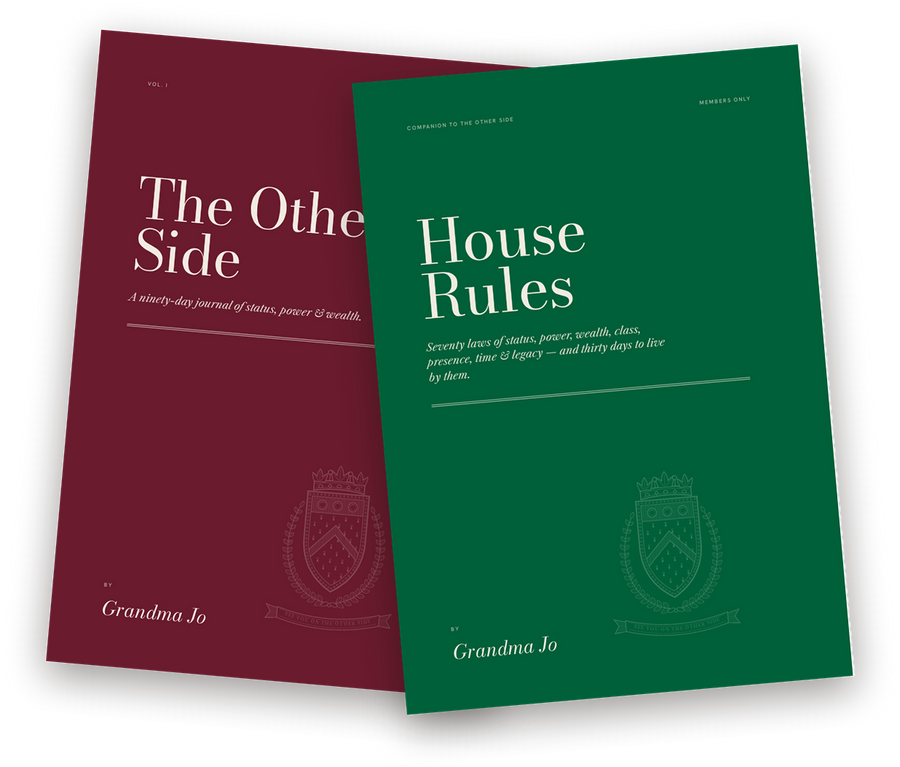
There's a small habit from The Other Side that I use before any conversation I care about. The morning page has a line called The move: one specific thing you'll do today. Some mornings mine is simply, "Say the first sentence at half speed." Written down at breakfast, it's surprising how often it happens by eleven.
Practise where it doesn't matter
Nobody learns to speak slowly in the meeting that decides their year. You learn it ordering coffee. You learn it on the phone to the bank, and leaving a voicemail, and asking the man at the hardware shop where the hinges are. Those small, forgettable conversations are the rehearsals, and there are dozens of them a week.
Pick one a day. Say it at the speed of the heavy jug. Notice what happens to the other person's face. More often than not they soften, or lean in slightly, or give you a little more than you asked for. That's not magic. People relax around someone who's relaxed, and they listen harder to someone who seems in no hurry to be understood.
My grandson came to me before his first proper interview, shirt ironed within an inch of its life, and asked me to test him. He answered my first question so fast I couldn't have told you what he'd said. So I put a cup of tea in his hand, a full one, in my good china, and told him he could answer as fast as he liked provided he didn't spill it. He laughed, and then he tried, and the answer came out at exactly the right speed: he'd moved the hurry into his wrist, where he could see it. We did six questions like that at the kitchen table. On the day, he told me afterwards, he pictured the cup. He didn't get that job, as it happens. He got the next one, and the woman who hired him said he was "very calm for his age," which he repeated to me three times on the phone, not calmly at all.
In the mornings, if you're alone, read one paragraph of anything aloud (a newspaper will do, a recipe will do) and put a full breath at every full stop. It feels theatrical for about a week. After that it's simply how you read, and not long after that it's how you talk. It fits easily into the morning routine of quietly successful people, and it takes less time than the kettle.
One honest thing: you'll speed up again. Under pressure, with someone you're trying to impress, on the day you slept badly. I still do, and I've been at this for forty years. When you catch it, don't apologise and don't restart the sentence. Just put a full stop in the next available place, breathe out, and carry on at the proper pace. Nobody else will have noticed the change. They'll only notice that you seem calmer than they are.
If you'd like rule 43 to be the last thing you see before you walk into the room, it's one of the lock screens in The Full House, alongside the morning page where the move gets written down.
Move quickly, then pour from the heavy jug, and let nothing spill.