Give the reason once, in one sentence, and then stop. If the other person wants more, they will ask, and if they have already decided not to understand you, no paragraph on earth will change their mind. That is how to stop over-explaining, and you could close this page now and start tonight.
Now the long one.
I was a champion over-explainer for the better part of six years. In my twenties I kept house for a man who liked to know where every coin had gone, and I learned to answer before he asked. I kept receipts in a biscuit tin beside the bread bin. A bar of soap came with a story attached: why that one, why this week, why not the one in the green paper, which was dearer anyway. I believed that if I explained well enough he would one day nod and say, "Of course." He never did. He wasn't listening for the reason. He was listening for the wobble in my voice, and my long explanations gave him plenty to listen to.
My grandmother had watched the opposite in the fitting rooms decades earlier. In the diary she left me there is a line I read the week I packed to go, sitting on the lid of the case because it wouldn't shut otherwise:
The ladies who owned the house never said why. They said what. "The blue, please, and two fingers shorter." Then they were quiet, and I pinned.
It took me years to hear what she meant. Clarity is the courtesy. The explanation is usually for you.
Why do I over-explain?
People ask me this as though it were a flaw of character. It is usually a habit learned somewhere sensible. If you grew up in a house where a short answer got you into trouble, you learned to bring evidence. If you once said no and paid for it, you learned to wrap every no in padding so it wouldn't bruise anyone, least of all you. Over-explaining is people-pleasing in a barrister's wig: you are arguing a case nobody has brought, to a judge who may not even be in the room.
And a long explanation says things you never meant to say. It says you think you need permission. It says the matter is open for negotiation, because you've just laid out every reason and each one is a door someone can push on. Worst of all, it tells the listener that if they stay silent you'll keep going, which is a lovely gift to anyone who enjoys winning.
The cure arrives before confidence does, which is lucky, because confidence tends to turn up late and underdressed. You need a sentence prepared in advance, said at an ordinary speed, followed by a full stop you actually observe.
House rule 15: "Never explain yourself to people who have decided not to understand."
Below are the lines I've collected since, the long version first and then the short one. Read them aloud. The short ones will feel rude in your mouth for about a week. They aren't rude. They're finished.
How to stop over-explaining when you say no at work
The long version: "Oh, I'd love to, it's only that I've got the quarterly figures, and then Sam's off on Thursday so I'm covering his calls, and I promised my sister I'd, well, sorry, I know it's a terrible time, if it were any other week I'd jump at it..."
The short version: "I can't take that on this week. I could look at it on Monday."
Notice what the short one keeps: a clear no, and one real offer if you have one to make. Notice what it drops: your sister, Sam, and the apology for owning a calendar. Your colleague needs an answer to plan around. They did not ask for a guided tour of your week.
If they push ("It'll only take an hour"), say the same sentence again, a shade slower. The second request is where most people crack and start reciting the list. Hold still there. The pause after your repeated sentence feels enormous to you and perfectly normal to everyone else.
Declining an invitation in one breath
The long version: "We would have adored it, but Robert's mother might be visiting, we don't know yet, and the babysitter has been so unreliable, and I've been exhausted lately, you know how it is..."
The short version: "Thank you so much for thinking of us. We can't make it this time, and I hope it's a wonderful evening."
Every reason you give is an invitation to solve it. Mention the babysitter and someone will offer theirs, and now you're declining twice. The short version is warmer, oddly enough, because it spends its words on the host rather than on your circumstances.
Leaving early without a speech at the door
The long version: "I'm so sorry, I have to dash, I've got an early start, well, not that early, but I didn't sleep last night and I've got the car and..."
The short version: "I'm heading home. Thank you, this was exactly what I needed."
The whole secret of a graceful exit from a party is that it's one sentence long. An explanation at the door turns a departure into a negotiation, and someone always says, "Oh, stay for one more."
Arriving late
The long version: The train, the signal, the phone on two per cent, the taxi driver who took the scenic route, the running in the wrong shoes.
The short version: "I'm sorry I'm late. Thank you for waiting for me."
One apology, and then you join the conversation already in progress. The long version makes everyone at the table sit through your morning a second time. If it happens often, the explanation was never the problem; lateness itself is, and that deserves its own evening of honest thought.
When someone asks what you charge
The long version: "Well, it's [the figure], which I know sounds like a lot, but it does include the revisions, and I could probably be a bit flexible if that's a problem, I don't want to price you out..."
The short version: "My fee for that is [the figure]. It includes the first draft and two rounds of changes."
Then you stop, and you let the silence sit on the table like a folded napkin. Anyone who has priced their own work knows the terror of that silence. Anyone who has bought from a professional knows it's the moment they decided to trust them. You have told them what they get. The rest is theirs to think about.
When family questions a choice you've made
This is where the biscuit tin comes back. "Why on earth did you buy that?" "Why would you leave a perfectly good job?" "Why aren't you coming for Christmas this year?"
The long version: A closing argument with exhibits.
The short version: "Because I wanted to, and I'm glad I did." Or, for the Christmas question: "We're staying home this year. I'll ring you on the day."
Family are the hardest audience because they knew you when you had no say. The short answer, given kindly and repeated if necessary, is how you teach them you have one now. You don't have to win the argument. You only have to decline to hold it.
When you're not drinking
The short version, and there is only a short version: "Not tonight, thank you. A soda water with lime would be lovely."
Nobody at a dinner is owed the history of what goes into your glass. If someone presses, smile and ask them about their holiday. People who insist on an answer to this question are telling you something about themselves, and you may file it.
Lines to retire this week
- "I know this sounds silly, but..." (Then don't say it silly. Say it plainly.)
- "I don't want you to think I'm..." (They weren't thinking it until you mentioned it.)
- "Does that make sense?" after a perfectly clear sentence. It hands them the gavel.
- "Sorry, I'm rambling." Stopping is the apology.
- "Just to explain..." when nobody asked.
Who deserves the long version
Some people do. Your manager when a project slips. A child asking why the rules have changed. A partner who wants to understand because they care about you. There's one question you can ask yourself in the moment: are they asking to understand, or asking to argue? The first kind get the real reason, once, in order, without the throat-clearing. The second kind get the short version, and then they get it again.
I learned this the awkward way. The first year after I left, I overcorrected. A dear friend asked why I hadn't come to her birthday lunch and I said "I couldn't," and nothing else, because I was so proud of my new short sentences. She spent a month believing she had offended me. She hadn't. I'd been at the hotel covering a double shift and was too tired to explain even that. When I finally told her, over a pot of tea she insisted on paying for, she laughed and said, "Jo, a short answer is fine. A locked door isn't." She was right. Brief should still be warm, and it should never go cold on the people who love you.
How to practise the short version before you need it
You won't find the short sentence in the moment. Nobody does. You find it the night before, at a table, with a pen.
Write down the three explanations you give most often. You know them already: the one about why you can't stay late, the one about why you're not having children yet, the one about your prices. Write each one out in its long form, exactly as you say it, including the "sorry" and the "I mean". Then cross out everything after the first full stop. What's left is usually the whole answer. Say it aloud to the bathroom mirror, and count silently to three after the last word. That count is the part you are really practising.
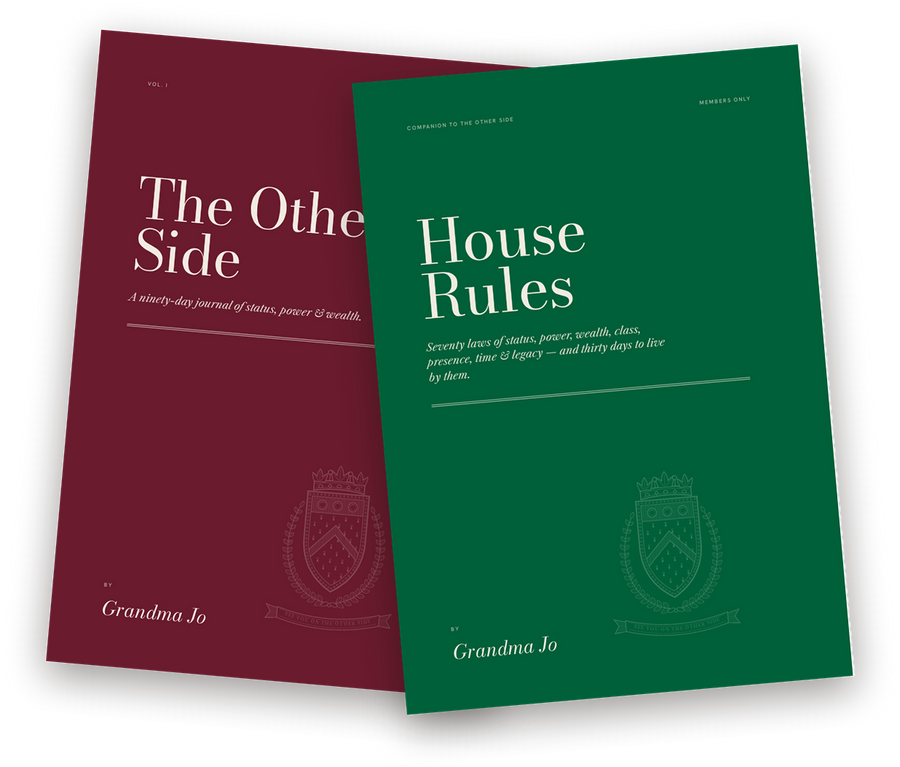
I borrowed that exercise from the lunchtime practice in House Rules, which runs in four beats: Rule, Script, Move, Receipt. With rule 15, the script might be "I say it once and I let it land." The move is one conversation that afternoon where you do exactly that. The receipt is what happened when you stopped talking, which is usually nothing at all, and that nothing is the most instructive thing you'll ever write down.
For the evenings when the old habit wins, The Other Side has a page called "Old story, new truth". It's for the replay that starts around eleven, when you lie there drafting the speech you should have given. You write the old story first (the one where you had to justify every soap and every Saturday), and underneath it the new one. I have never once seen the new one come out longer.
Ninety nights from now
Let me tell you where this goes, if you do the work.
Ninety nights from now you are in the small meeting room on the third floor, the one with the whiteboard nobody ever wipes properly and the chair that tilts if you lean back. Your manager asks whether you could take on the new account as well, "just until things settle". You hear yourself say, "Not this quarter. I can give you a plan for it by Friday." And then you do something you have never done in that room. You stop. You let the quiet sit there, and you don't mind it. Your hands are still on the table. Your manager nods, writes something down, and moves to the next item, and the only person who notices anything has changed is you, which is how the best changes arrive.
Whoever is sitting in that tilting chair got there one short sentence at a time, and The Full House is where that training lives: ten minutes in the morning, five at night, and a receipt in your own handwriting for every full stop you kept.
Say it once, plainly, to people who are listening. To the ones who have chosen not to hear, a single courteous sentence is the whole of what you owe.