"You spent that whole meeting answering, Josephine. I spent it asking. Now guess which one of us will be writing the minutes."
The woman who said that to me had chaired the meeting, if chaired is the word for someone who barely spoke. She was perhaps seventy, in a charcoal suit with a brooch shaped like a small silver bee, and she was the first person who showed me how to ask better questions. I had answered every question put to me that afternoon, and some that hadn't been, and I was still flushed with the pleasure of having talked so well for so long. She had asked five, or six at most. By the end of the hour she knew everything about everyone at the table, including me, and not one of us knew what she thought.
House rule 19 comes from that afternoon: "The person asking the questions is the person holding the pen." Her method, as I came to understand it, fits in four short instructions. Ask shorter questions. Ask one at a time. Ask how people decided things rather than what they think of them. And after you've asked, stop talking, for longer than feels comfortable. The rest is knowing which question suits which moment, and that's what the rules below are for.
I didn't always believe any of this. For years I thought asking questions made me look as though I didn't know things, and I would rather have walked into the sea than look as though I didn't know things. My first week at the hotel, Mrs Carrow showed me how to put calls through from reception, and I nodded as if I'd understood. That afternoon I cut off a gentleman calling from abroad twice in a row. The head porter, who had watched the whole thing, leaned over and said, "Next time, love, ask. It's cheaper." He was right. It always is.
1. When someone brings you an idea you doubt
Don't argue. Ask: "What would have to be true for this to work?"
It's the most useful question I know for meetings, because it turns a fight into a piece of joint work. The person with the idea starts listing conditions, and very often, halfway through the list, they hear for themselves which ones aren't true. You haven't said no. You've let the idea examine itself. And if it passes, you've learned why, and you can back it without reservation.
2. When someone is telling you a story
"And then what happened?" Four words, and the storyteller feels like the most interesting person in the room. Most of us, when someone is telling a story, are waiting for the gap where our own story can go. The person who asks for the next part instead is rarer than you'd think, and remembered for longer.
Strictly, this belongs to listening more than to asking, and listening well has already had its own hearing in this journal. The point here is simply that the best follow-up question is almost always smaller than you expect. When the story ends, resist the urge to say "That reminds me of the time" and hand it over to yourself. Ask for one more detail instead: what she said back, what colour the car was, whether he ever went again. Small questions tell people you were inside the story with them.
3. When you want to know who someone really is
My grandmother knew this long before I did. There's a line in her diary, squeezed into the margin beside a pencil sketch of a sleeve: "Never ask the lady what she wants. Ask her where she is wearing it, and who will be there. Then you will know what she wants better than she does." She wasn't being clever. She'd learned that people answer a practical question more freely than a personal one.
Ask how they decided. Not what they do, not where they went to school, but: "How did you end up choosing that?" About a job, a city, a house, a dog, a second career.
Opinions are cheap and people have them ready. Decisions carry values inside them, and when people explain a decision they tell you, without meaning to, what they were afraid of and what they wanted. I once asked a quiet man at a wedding how he'd come to be an architect, expecting a sentence. He talked for twenty minutes about his grandfather's shed and a set of pencils, and I learned more about him than his own sister seemed to know.
4. When a negotiation has gone stiff
There comes a point in most negotiations when both sides are repeating their positions a little more loudly. That's the moment for the most disarming of powerful questions: "What are you most worried about here?"
I asked it once of a supplier I'd been going round in circles with for a week. He took his glasses off, polished them on his tie for longer than they needed, and said, "Honestly? That you'll want the whole order in March and my factory can't do it." We'd been arguing about price. The problem was the calendar. We split the delivery into two, and I got better terms than I'd been pushing for, because I'd stopped pushing. When the voices start rising, remember that the calmer person usually wins the argument, and the calmest thing you can do is ask.
5. At the end of any meeting that matters
"What haven't I asked that I should have?"
It feels almost too simple. It isn't. The people across the table know things you don't, and some of them have been dying to tell you, waiting only for the door to be opened. I have learned about a resignation, a rival bid and a broken boiler that was about to cost a client a fortune, all from this one question, asked with my coat already over my arm.
If you're the most junior person at the table, it's also your safest way in. You aren't contradicting anybody; you're offering to be useful. The first time I asked it as the youngest in the room, there was a pause long enough to make me regret it, and then the finance director answered for ten minutes. Afterwards he stopped me on the stairs to ask my name.
6. When you're leaving someone who's been useful
"Is there anyone else you think I ought to speak to?"
This is how doors open that you didn't know were there. People like being asked for a name far more than they like being asked for a favour, because a name costs them nothing and makes them look well connected. Write the name down while they're watching. Follow it up within the week. Then write back to the person who gave it to you and tell them how it went. That last step is the one almost everybody forgets, and it's the one that makes them give you a second name.
7. Swap "why" for "what led to"
"Why did you do that?" sounds like an accusation even when you mean it as curiosity. People hear the headmistress in it. Try "What led to that?" or "Talk me through how you saw it at the time." You'll get the same information, without the defensive crouch that comes first.
The one question I'd retire altogether is "Does that make sense?" at the end of your own explanation. It sounds polite and asks the listener to admit they're slow. Ask instead, "What would you like me to go over again?" and watch how much more truthfully people answer.
8. Ask the person nobody has asked
There is always someone at the end of the table who hasn't spoken. Sometimes they're shy, sometimes they're junior, and sometimes they're the cleverest person present and have been quietly waiting to see who would notice. Turn to them, by name, and say: "You haven't had a chance yet. What do you make of it?"
It's generous, and it's also shrewd. You find out what the quiet one knows, and everyone at the table sees who was paying attention to the whole room rather than only the loud end of it. When you're learning to control a conversation, this is the lightest touch there is: you're not taking the floor, you're handing it to someone, and the person who hands out the floor is the person who owns it.
9. When you're asked something you'd rather not answer
Answer with a question, warmly. "What makes you ask?"
At a charity dinner a man I'd known for an hour asked me, over the fish, how much my business had made that year. I smiled and asked him what made him ask. He laughed, a little embarrassed, and admitted he was thinking of starting something similar and was frightened of the numbers. We gave the whole fish course over to his fear, which was far more interesting than my figures, and he never noticed I hadn't told him a thing. The question under an intrusive question is almost always better than the question itself, and gentler to answer.
10. After you ask, stop
This is the rule that makes all the others work, and it's the one I found hardest. You ask a good question, there's a pause, and every nerve in your body wants to fill it: to rephrase, to offer an example, to answer it yourself. Don't. Let the silence sit there. Count to five in your head, slowly, if you have to. The pause is where people decide to tell you the real thing instead of the prepared thing.
Ask one question. Then close your mouth and let the silence do the second half of the work.
House rule 11 says the room leans in when you say less. I could go on at length about what a well-kept silence can do, which would rather defeat the point. A good question followed by a good silence is the strongest move in any conversation I know.
How to ask better questions until it becomes habit
None of this comes naturally to people who were rewarded, as I was, for having the answer. It's a habit, and habits are built in small, boring repetitions until they become who you are.
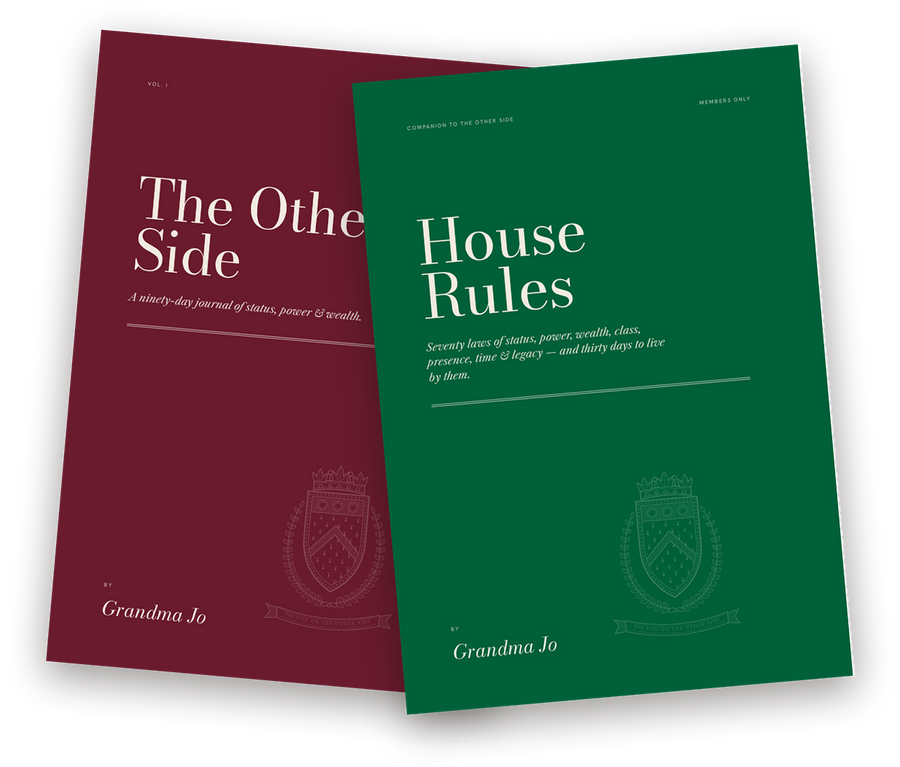
House Rules trains every one of its seventy rules the same way, over a sandwich: five minutes, four steps, thirty days. Take rule 19. The first step is the rule itself, read slowly. The second is one sentence about your own afternoon, written as though it has already happened: "In the three o'clock meeting, I ask before I answer." The third is the move, a single question and then silence. The fourth is the receipt: whatever you learned that you wouldn't have learned by talking. Keep the receipts somewhere you'll read them again (the journal has a line called Evidence for exactly this), and after a few weeks you'll have a small, private record of how much a room will tell you when you let it.
The woman with the silver bee brooch, by the way, did end up writing the minutes. She wrote mine, too, in a sense. She hired me two years later, and on my first day she asked me three questions and then said nothing at all until I'd told her everything I was frightened of.
So, before you go, let me raise a glass. To the ones who ask and then wait. To the ones who turn to the quiet end of the table. And to all of you cut from the finer cloth — I'll see you on the other side.
P.S. Rule 19, and the thirty lunchtimes that turn it from a good intention into a reflex, are waiting in The Full House; your first receipt could come out of tomorrow's three o'clock.