"Can you tell which ones are old money and which ones are new, just by looking?"
The young man across the aisle asked me this somewhere after the second stop. He was holding a paper cup of tea with the bag still in it, and he had been watching a family in matching ski jackets lift four identical cases down from the rack. He was perhaps twenty-five, in a good navy suit that was still a little proud of itself.
"Usually," I said. "But I never look at the money."
He wanted the long version, so I gave it to him between the third stop and the sixth. Old money vs new money is rarely about the age of the money. It is about whether the money still needs to be seen. Old money behaviour is what wealth looks like once it has stopped asking for witnesses; new money is wealth that still hopes someone noticed. There are families with three centuries of silver in the sideboard who behave like lottery winners, and there are people who earned every penny last spring who carry it as though it had always been there. The label follows the habit, not the bank statement.
So this is a comparison, and I intend it to be a fair one. I have stood on both sides of it, and in the long corridor between them, which is where most of the interesting people are.
Old money vs new money: the one difference that matters
Everything else on this page grows out of a single root. Some money needs an audience and some money doesn't.
House rule 22 says it more neatly than I can: "Wealth whispers, darling. Money shouts. Learn to hear the difference." The shout is not always loud. Sometimes it is a small gold buckle turned slightly towards the room. Sometimes it is a sentence that begins "We've just got back from…" and waits for you to ask where. The whisper is not always modest, either. I have met old families whose silence was simply a way of making you feel you weren't worth the conversation.
My grandmother, who took in hems and made gowns for families with their names carved over the gatehouse, noticed this long before I did. In the notebook she kept beside her pincushion, she wrote: "The richest woman I ever fitted never once asked me if it suited her. She asked how long it would last." That is the whole difference in two sentences. One woman wanted approval. The other wanted the coat.
Keep that in mind as we go through the pairs. Nothing below is about who deserves to be in the room. It is about what each kind of money is still hungry for.
The price tag and the repair bill
New money knows what everything cost. Old money knows who mends it.
I once sat next to a man at a wedding whose waxed jacket had been re-proofed so many times it had gone the colour of strong tea. He told me, with more feeling than he'd shown about the bride, the name of the man in a small town who had been doing it for him since the seventies. He could not have told you the price of the jacket if you'd held him upside down. He had stopped thinking of it as a purchase. It had become a companion.
On the other side of the same marquee was a woman who told three of us, before the soup, exactly what her shoes had cost and exactly how much she had saved on them. I liked her more than him, to be frank. She was funny and warm, and she asked the waitress about her evening. But every time she mentioned a price, a little of the shine went off the shoes. House rule 05: "The moment you mention what it cost, it cost you more."
The fair point for new money: knowing the price is a form of respect for money, and people who have had to count are often better with it than people who never did. The fair point for old money: repair is the most elegant thing a person can do with an object, and it is available at any income. A resoled shoe says more about you than a new one.
Arriving to be noticed, arriving because you're expected
Watch how people come through a door. New money tends to make an entrance, because some part of it still suspects it might be stopped. The voice goes up half a tone. The coat comes off with a little flourish. There is a quick glance to see who saw.
Old money walks in as though the room had been waiting, which, often enough, it had. The name is known at the desk. Nobody needs to be told who they are.
Here is where I must be fair again, because I spent years behind a hotel desk watching both kinds arrive. The new ones knew my name by the second morning. They had worked a desk themselves, or their mothers had, and they knew what it is to stand for eight hours being looked through. Some of the oldest families in the building never learned it in a decade of visits. If I had to choose which of the two I wanted to be seated beside, it was not always the one with the crest on the luggage.
The good version of old money behaviour is being expected and still saying good evening to the man who opens the door. The poor version is being expected and forgetting there is a man there at all.
The logo and the label nobody can read
New money signs are easiest to spot on the body. The logo on the belt, the monogram repeated across a bag until it becomes wallpaper, the watch large enough to tell the time from across a restaurant. House rule 35: "If it needs a logo to be understood, it isn't speaking to you."
A logo is a sentence addressed to strangers. It says, to people you will never meet, "I could afford this." Old money dresses to be understood only by people who already know, which is a much smaller audience and a much easier one to please. It is the whole reason the truly wealthy so rarely look it, and why a well-pressed collar or a cuff that fits, the small things people clock before you speak, carry further than any label.
I should confess that I learned this one the hard way. After my first properly good year in business, I bought a watch with a face so big you could have served canapés on it. I wore it to a lunch with a man I admired enormously, a quiet man with frayed shirt cuffs and a very good firm. Halfway through the fish he glanced at my wrist and said, "Are you late for something, Jo?"
I was not late for anything. I was early for a lesson. The watch lives in a drawer now. One day my granddaughter will find it and laugh until she has to sit down, and she will be right to.
Generational wealth manners at the table
Old families have a rule about money at dinner: you don't discuss it. My own house rules put it first among the three subjects that never get a chair at my table. New money, delighted and a little astonished to have any, often talks about it everywhere. The new car, the new house, the deal that went through on Thursday.
Now the part nobody says out loud. The same old families who never mention money at the table frequently discuss it at home in precise, unsentimental detail. The children are taken to meet the people who look after it. They know what the house needs to keep running. The silence is a public manner, not a private one.
And the new families who talk about money all evening in public sometimes never talk about it at home at all. The children see the car but not the arithmetic. So each side has half of it right. The best generational wealth manners I've seen take old money's discretion in company and new money's openness in the kitchen. Quiet at the dinner party, candid over breakfast.
Hurry and patience
New money buys the newest version the week it arrives. Old money waits for the good version, then keeps it for thirty years.
Let me point the wit where it belongs. The famous patience of old families is a great deal easier when there is a cushion underneath it. It is simple to wait for the right sofa when you already own four perfectly good ones. A young woman furnishing her first flat with one chair and a borrowed lamp is not impatient. She is sitting down.
Still, the habit is worth stealing, and it costs nothing to practise. Buy less. Wait longer. Choose the thing you would be glad to hand on. My grandmother wrote, beside a sketch of a collar, "Better one good pair of gloves than three that apologise." I have never found a way to improve on that.
Where new money wins, and where it doesn't
I promised fairness, so here it is plainly. New money is often kinder. It tips like it remembers. It is curious about people, because it has only recently been let into the rooms where they gather. It says thank you and means it. It has energy, and energy is attractive at any age.
Where new money loses is in the need. The need to be seen, the need to be told it belongs, the small anxious glance after the entrance. That need is visible from across a room, and it is the only thing on this page that reads as unconsidered. Not the logo, not the loud laugh, not the price mentioned over soup. The need underneath them.
For years I got this wrong in the other direction. In my twenties, checking guests in all day and going home to a room with a gas ring and a borrowed eiderdown, I resented old money. I thought the quiet ones were cold and the plain ones were mean. Then one winter a woman in a darned grey cardigan, whose family had been coming to the hotel since before I was born, left a handwritten note for the girl who cleaned her room. It thanked her by name for the way she'd folded a particular scarf. I saw the envelope on the trolley and felt about two inches tall. She wasn't cold. She simply didn't need me to notice her kindness. I have tried to learn that ever since, with mixed results. How I got from that linen trolley to a firm of my own is a longer story, and a less tidy one.
Status is not the age of your money. It is how little your money needs to be seen.
Which one are you? A seven-night test
Here is a way to find out that requires no inheritance and no audit. Buy something you're pleased with, however small, and time how long it takes before you want someone else to see it. Minutes means the money is still new. Days means it's settling. If you forget to show anyone at all, you've crossed over.
Then try one rule for seven nights. Rule 05, the one about cost. For seven days, do not mention what anything cost you. Not the shoes, not the dinner, not the holiday, and above all not the bargain, which is the sneakiest boast there is because it lets you mention the price while sounding thrifty. Each night, before bed, write down one moment when you nearly did and didn't. Just a line. You'll be surprised how often the urge arrives, and how light you feel when you let it pass.
The people who ask me whether this sort of thing is only for those who already have money have it backwards. It costs nothing. It is available at any balance. The ones who most need it are those of us who started with none, because we're the ones still hoping to be seen.
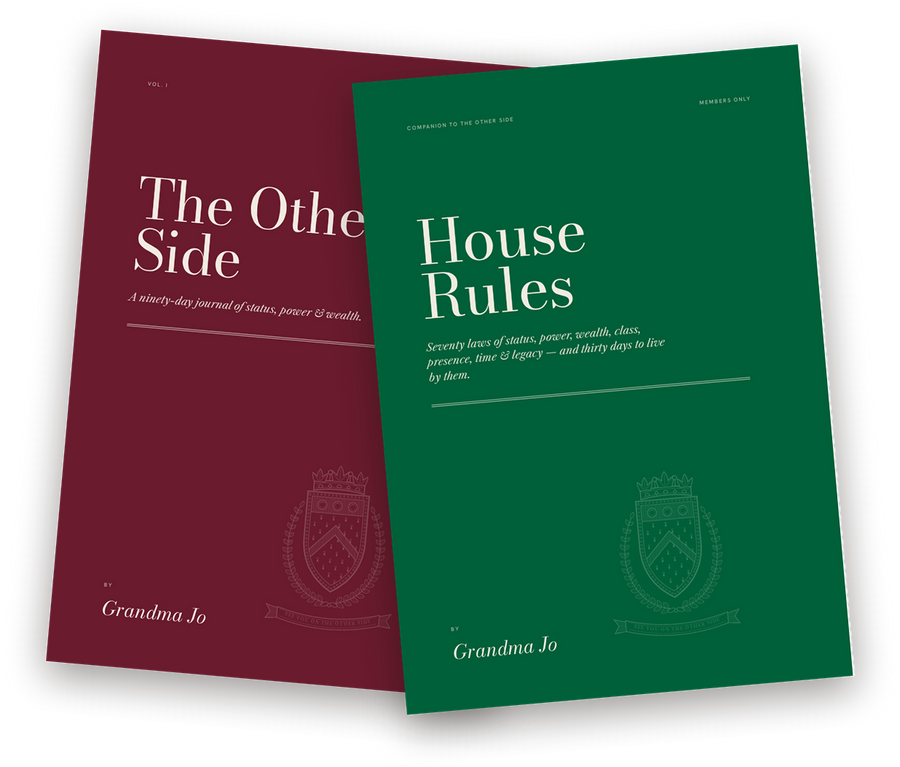
If seven nights of rule 05 works, you'll want the next rule, and sixty-nine more are waiting in House Rules, ten to a pillar, rule 22 about whispering and shouting among them. The one line you've been writing before bed has a proper home too: it is, near enough, how every evening in The Other Side begins, with a page that asks what you actually did rather than what you meant to. The Full House puts the two in one download.
And if you'd like the question underneath all of this put more plainly, the only test of class that counts is the same lesson through a different door.
What I told the young man on the train
By the sixth stop he had finished his tea and fished the bag out with a pen. He said, "So it's not about how long you've had it." I said no. It's about how long it takes you to stop wanting anyone to see it, and some people manage that in a year while others take four generations and never quite get there.
He nodded, stood up for his station, and then asked, very politely, which one I was.
He looked at my shoes for a long moment, as though they might settle the matter. They have been resoled three times, so they could have argued it either way.