"Mrs. B. came for her fitting in the same grey coat as last winter. The girls stood up when she came in. They never stand up for the new ones." (my grandmother's diary, page 12)
My grandmother wrote that about a customer, not a duchess, and I have read it perhaps two hundred times. She ran a workroom of three girls and a treadle machine, and she noticed that the girls never stood up for the expensive fabric. They stood up for the woman inside it.
Here, then, is how to be elegant, in one breath. Elegance is what you do when nothing is being asked of you. It lives in habits, it costs almost nothing, and a man can have it every bit as easily as a woman. Below are the ten habits I've watched in the most elegant people I have known, in hotel lobbies and boardrooms and one very long lunch on a boat, along with what they actually said and did.
First, a confession. My first winter handing out room keys, I saved for months for a camel coat. The proper kind, heavy, with horn buttons. I wore it to work every day as though it were an argument I was winning. It took me a year to understand that the coat was the least elegant thing about me, because I kept touching it, adjusting it and checking whether anyone had noticed it. The coat was fine. I was the problem.
1. Arrive a little before you're needed
From the front desk you learn who people are by when they come down. Some guests appeared in the lobby five minutes before their car, sat, and read a newspaper. Others arrived eleven minutes late, apologising loudly to a driver who had been standing in the rain. Same hotel, same rooms, often the same bill. Only one of them looked as though the day belonged to them.
Arriving a little early is the cheapest elegance there is. You get to take your coat off slowly. You get to choose your seat. You are never the person rushing in with their hair across their face and a story about traffic. My full case against being late is made elsewhere, so I'll only add this: hurrying is the opposite of elegance, and the only reliable cure for hurrying is leaving earlier.
2. Finish your movements
This one took me years to see. Elegant people complete their gestures. They put a glass down all the way, not halfway and then let go. They close a door until it clicks, quietly, instead of pushing it and walking off. They finish a sentence rather than trailing away into "so, yeah, anyway".
I once sat beside a man at a board dinner, charcoal suit, no tie, perhaps seventy, who set his knife and fork down at the end of each course without a sound. Not one click against the plate in two hours. I noticed it because I was clattering. Half-finished movements look like hurry, and hurry looks like fear. A completed movement looks like someone who has time.
Try it tomorrow with something small. Put your keys down on the table as though they were made of glass.
3. Look after what you own before you buy anything new
My camel coat taught me this in the end, because I had bought it with money I didn't really have and then had nothing left to look after it with. The most elegant man I ever worked for owned, as far as I could tell, four suits and one briefcase. The briefcase had been re-stitched at the handle twice, and every Friday afternoon he fed the leather himself, at his desk, with a soft cloth and a small round tin, as calmly as other men read the paper.
For women it's the same principle with different objects: the handbag with its corners cared for, the silk scarf pressed rather than crushed in a drawer, the blouse with every button present. People can't always tell what something cost. They can always tell whether it has been looked after, and that tells them how you treat everything else. The wealthiest people I've known are usually the most careful with old things, which goes a long way to explaining why rich people so often dress plainly.
A clothes brush, a shoe tree, a needle and thread. My grandmother would have added: learn to sew on your own buttons. It's a ten-minute skill that will outlive every trend you'll ever be sold.
4. Keep your hands quiet
Nervous hands give you away before your face does. The ring twisted round and round, the phone turned over and back, the pen clicked under the table where you think nobody can hear it. At the hotel I could tell who was about to complain before they reached the desk, simply by what their hands were doing.
The elegant people rest their hands. On the table, in their lap, round a glass. One hand, still. If you need something to do with them, hold something with a purpose (a notebook, a cup) and then leave it alone. And if you notice you're fidgeting, don't snatch your hands away as though they've been caught. Just let them go quiet, slowly, the way you'd lower your voice in a library.
5. Let people finish their sentences
This is the elegance nobody photographs. An elegant woman, an elegant man, lets you get to the end of what you're saying, even when they know where you're going, even when they disagree. They wait a beat after you stop. Then they answer.
When someone trails off in the middle of a thought, the most elegant thing I know to say is two words: "Go on." It tells the other person they have your whole attention, and it costs you nothing but the pleasure of hearing yourself sooner.
I was a terrible interrupter in my twenties. I thought it showed I was quick. It showed I was frightened of being forgotten, which is not at all the same thing.
6. Never the loudest thing in the room
One of the house rules I return to most often says it plainly:
"Never the loudest thing in the room. Not your voice, not your perfume, not your handbag."
Loud is anything that arrives before you do. A scent that reaches the table before you've sat down. A logo you can read from across a restaurant. A laugh pitched for the next table. None of these are crimes, and I've committed all three. But elegance is a kind of courtesy to other people's attention: you let them come to you, rather than going after them with your cologne.
A good test before you leave the house is to ask which thing about you will be noticed first. If the answer is anything other than your face, you know what to leave at home.
7. Thank the person carrying the tray
I learned this from the other side of the counter. The guests who looked at me when they said thank you, who knew my name by the second morning, who said "good evening" to the man mopping the lobby floor at midnight, were almost never the loudest spenders. They were the ones the staff quietly looked after for years.
Elegance that switches off for waiters, drivers and doormen was never elegance. It was a performance for an audience, and it closes when the audience leaves. It sits at the heart of what makes someone classy, too, but the habit itself is simple. Eye contact, a real thank you, and their name if you know it.
8. How to be elegant when nobody is watching
This is the habit my grandmother cared about most, and it came straight from her workroom. She judged clothes from the inside. Anyone can make the outside of a jacket look good, she'd say; turn it inside out and you'll see who made it. The seams finished properly where no one would ever look, the lining that didn't pull, the hem stitched by hand so it hung straight.
"Turned out Mrs. B.'s old coat to let it out. Beautiful inside. Whoever made it did not expect to be thanked." (page 30)
People are the same. Elegance is the towel folded in the hotel bathroom when you're checking out and will never see the maid. It's the email written kindly to someone who will never be in a position to return the favour. It's how you speak to your own children in the car. The inside seams, in other words. If they're finished, the outside takes care of itself, and if they're not, it shows eventually, usually at the worst possible moment.
9. Recover without a commentary
Everybody drops a fork. Everybody trips on a step, spills a little wine, calls someone by the wrong name. Inelegance isn't the fumble. It's the five-minute narration afterwards: "Oh, I'm such a klutz, I can't take me anywhere, honestly, look at me."
When something goes wrong in public, say "excuse me", deal with it, and carry on as though the moment has closed, because it has, unless you keep it open. The man in the charcoal suit I mentioned once knocked over a full water glass at that same dinner. He righted it, laid his napkin over the spill, said "forgive me" to the woman beside him and asked her the next question about her daughter. It took about six seconds. I have never forgotten how little fuss there was.
10. Leave while the evening is still good
Elegant people are rarely the last ones at the party. They go at the moment when everyone is still enjoying themselves, which means everyone remembers them enjoying themselves. The line I use is nearly always the same: "This has been lovely, and I'm going home on it." Then a word to the host, and out. No farewell tour of the room. For weddings, work parties and the friend who hides your coat, my exit scripts for parties have a line ready.
Where elegance actually gets built
You'll notice none of these ten habits can be bought. Every elegance tip that begins with a shopping list is selling you a coat, and I've already told you what happened with mine. What you can do is practise, a little every day, and keep honest score.
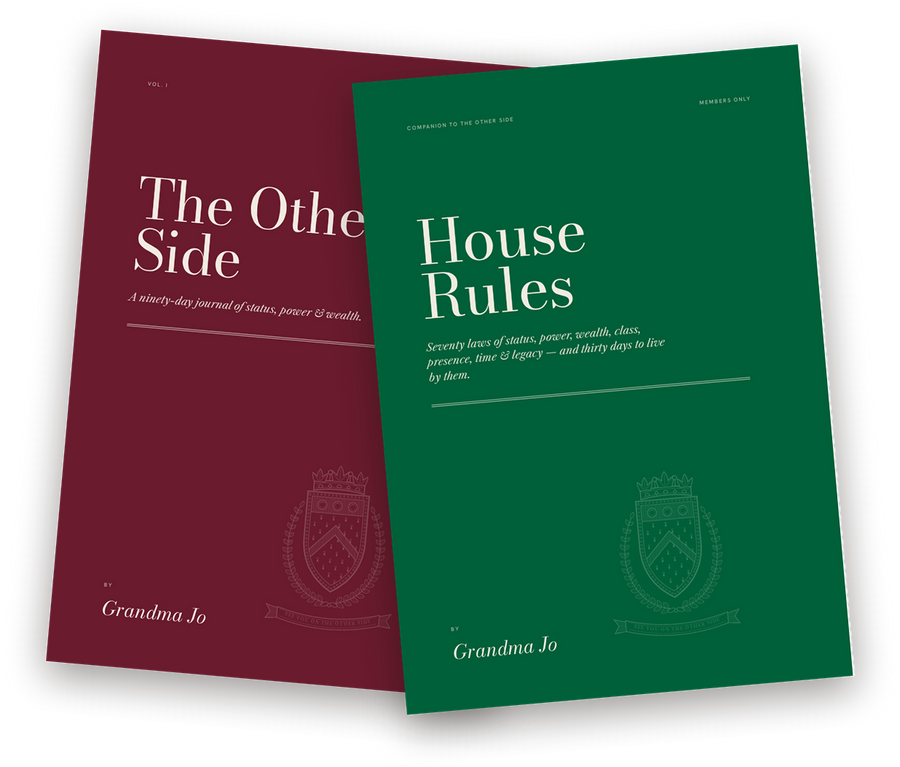
That's why the last line of each evening in The Other Side is the one I'm strictest about. It's called Carriage, and it asks for a single number, out of ten, for the way you moved through the day. Not how you looked. How you moved, how you spoke, whether you finished your movements and let people finish their sentences, whether you were kind to the person carrying the tray. It takes less time than brushing your teeth, and it's the only mirror I trust. Some nights you'll write a four. Good. A four you've noticed is worth more than a nine you've imagined.
It lives in The Full House, beside the rules it was written to practise. Presence is week five, and there's nothing to stop you reading that chapter first.
Elegance was never the preserve of the rich or the naturally graceful. My grandmother knelt on a workroom floor all her life and watched it walk in wearing last year's coat. She kept her notes so that someone who wasn't born to it could learn it anyway. I was that someone. I suspect, if you've read this far, you may be too. When you'd like to begin, the set is waiting.
Tonight, hang your coat up properly.