For about a year in my forties, I got up at a quarter to five every morning, and by nine o'clock I was the worst company in the building.
I'd read about the morning routines of important people in the kind of magazine that photographs them in a white kitchen with the sun coming in sideways, and I'd borrowed one wholesale: a brass travel alarm set for 4.45, a cold shower I hated, stretching on a mat that smelt of rubber, affirmations on index cards propped against the kettle. Two hours of it. I reached my small firm having done more before eight than most people do before lunch, and I was sharp with everyone.
So let me give you the answer I wish I'd been given. The morning routine of quietly successful people is short. They keep the first hour of the day free of other people's demands, and they spend about ten minutes of it, with a pen, deciding what the day is for. Then they get dressed and go. No ice, no candles, nothing to photograph.
What ended my bad year was a Wednesday when I handed a letter back to my assistant and said, "Is this a comma or a cry for help?" She went pink and said nothing. I apologised to her that afternoon, once and properly, and that evening the index cards went in the bin. I'd built a morning to look like a successful person's, and it had made me behave like an unhappy one. My grandmother's notebook had the principle all along, in one line I later made rule 52 of House Rules:
"The first hour sets the price of the whole day."
There's a morning I'll come back to at the end: my first in a rented room of my own, with a kettle that took eleven minutes to boil and a hotel shift that started at eight. I did one small thing that morning that I've done in some form ever since. It will make more sense once you've seen the rest.
What a morning routine is actually for
A morning routine isn't a self-improvement programme squeezed in before breakfast. It's a negotiation about who is in charge of the day, conducted before anybody else is awake to take part.
Think about what happens if you skip it. You wake up, and within a minute you are reading something: a message somebody sent at ten to one, a news headline, a work email with a red flag on it. Before your feet are on the floor, somebody else has told you what today is about. You spend the rest of it answering. Answering is necessary, but a day made entirely of answers has a low price, and you'll feel it by four o'clock as a sort of flat, busy tiredness that no amount of coffee touches.
The ten minutes change that. They don't make the day easier. They make it yours, which is not the same thing and is worth considerably more.
Keep the first hour of the day away from your phone
People fight me on this part, so let me be practical about it.
Buy an alarm clock. A real one, with a face. Mine is still the brass travel alarm from the bad year, now set for a quarter to seven, which I consider a civilised compromise. Charge your phone in the hall or the kitchen, anywhere that isn't within arm's reach of your bed. If you're worried about emergencies, turn the ringer up and leave it face down where you'll hear it. Emergencies ring. Everything else waits.
At work, tell people once, pleasantly, and then keep to it: "I start answering messages at half past eight. If something's on fire before then, call me." Almost nothing is on fire. The handful of people who truly need you at seven will call, and the rest will quietly adjust, the way people always adjust to someone who is consistent.
You don't need the whole hour empty. You can shower in it, feed the cat, make the tea. You just need it to be free of other people's agendas, and the phone is where those live.
The ten minutes, one line at a time
Sit down. That's the first instruction and people skip it. Standing at the counter with a pen while the toast burns doesn't count. I sit at the kitchen table with a lamp on and a white cup with a chipped gold rim that I refuse to replace, and I write four things.
Something I'm grateful for, and it must be specific. Not "my family", which is true and does nothing. "The woman at the bakery who kept the last rye loaf back for me yesterday without being asked." Specific gratitude wakes you up. General gratitude sends you back to sleep.
Three targets for the day. Not a to-do list. A to-do list is everything you might do. A target is something that, if it's done by evening, means the day was worth what it cost. "Send the proposal. Call my sister back. Walk home instead of taking the bus." Three is enough. Five is a wish list, and by Thursday you'll have stopped reading it.
One sentence beginning "I am", in the present tense. This feels silly for about a week. "I am someone who answers the difficult email before lunch." "I am calm in the Thursday meeting." You're not lying to yourself; you're writing the job description and applying for it.
The move. One small, visible action you'll take today that the person in your "I am" sentence would take. Not a resolution. An action with a time on it. "At ten, I'll ask for the budget figures in writing." Small enough that you'll do it, specific enough that you'll know if you didn't.
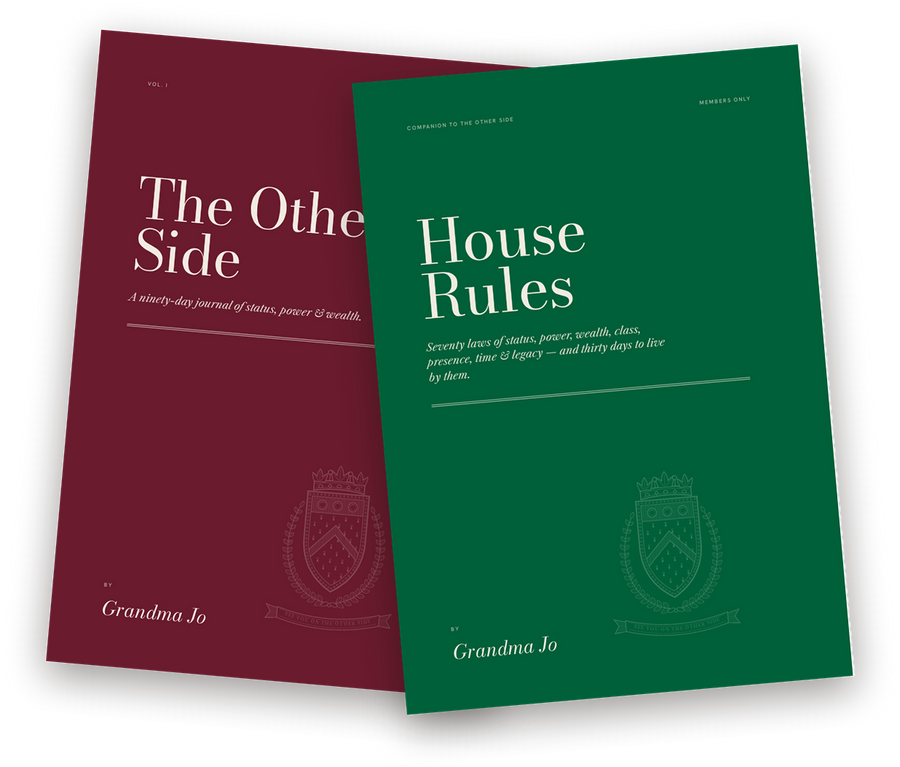
That's the whole of it. Gratitude, three targets, I am, the move. You can do it on an old envelope tonight and start tomorrow. It's also the morning page in The Other Side, and I'll admit the printed page helps on the days your own discipline doesn't turn up. But the envelope works. I'd rather you started on the envelope than waited for anything.
The rest of a successful morning routine is dull, and should be
After the ten minutes, the most successful mornings I know are almost boring. The same breakfast most days. Clothes chosen the night before and hanging on the wardrobe door. Keys in the same bowl. Shoes by the door with the laces already loosened. Nobody I admire has an interesting morning. They save their interesting decisions for later, when the decisions are worth making.
Get properly dressed, even if you work from the kitchen table. Not a suit, necessarily, but not the clothes you slept in. The body believes what you put on it. I learned that at the hotel, where the uniform went on at twenty to eight in a staff room with one mirror, under the eye of Mrs Carrow, who ran reception and checked our collars like a customs officer, and the moment the jacket was buttoned I became somebody who could deal with a furious guest at the desk. In my own clothes, a minute earlier, I couldn't have dealt with a furious pigeon.
And leave on time. So many mornings are lost in the last fifteen minutes, one more thing squeezed in before the door, and that quarter of an hour is where most lateness is manufactured. The morning routine and the arrival time are one habit, not two. A calm first hour that ends in a sprint to the station was not a calm first hour.
These are small, unfashionable things, close cousins of the old money habits that have nothing to do with money: repetition, maintenance, not making a fuss. People who have been comfortable for generations rarely have a morning worth filming. They have a morning worth keeping.
When the first hour isn't really yours
Some of you are reading this with a baby on one arm, or after a night shift, or with a parent in the next room who needs help getting up. The first hour on the clock doesn't belong to you, and no routine advice written by someone with a white kitchen is going to change that.
So take the first ten minutes that are yours, wherever in the morning they fall. At the hotel I worked the early shift with a woman called Pauline who had twin boys and a husband on nights. Her first hour was a blur of cereal and lost shoes. She did her ten minutes on the number 12 bus with a pencil stub and a notebook held together with an elastic band, and she was the most organised person on that desk by a distance. I remember her looking up as I came in one morning and saying, "I've already decided what today is, so don't bring me anything I haven't planned for." Then she laughed, because of course we would. But she'd decided, and it showed in how she handled what came.
If you share your mornings with people who need you, say it plainly and warmly: "Give me ten minutes with my coffee and then I'm all yours." Say it every day until it's part of the furniture. Children, in my experience, will respect a closed door for ten minutes far more readily than adults believe. Partners take slightly longer.
What goes wrong with morning habits
Most morning routines fail in one of four ways, and I've committed all four.
They're too long. A routine that needs two hours will survive until the first late dinner, and then it's gone, and with it your belief that routines are something you're able to keep. Build the one you can keep on your worst day, then let the good days be longer if they want to be.
They're too public. The minute you post your morning, it becomes a performance, and performances need an audience, and audiences get bored. Rule 02 in House Rules says "Announce the result. The move is none of their business." Your morning is a move.
They're all medicine and no pleasure. My bad year had nothing in it I enjoyed. Keep one thing that's purely for you: the good coffee, the ten minutes by the window, the radio programme you like. A routine you look forward to is a routine you'll keep.
And they're treated as a test. Miss one morning and the whole thing is declared a failure and abandoned until some future Monday. Don't. If you miss a morning, you don't go back to day one and you don't write yourself a letter of apology. You simply do the next one. The person who misses a day and carries on is far more reliable than the person with a perfect streak and no idea what to do when it breaks.
Why ten minutes beats two hours
Here's the arithmetic, and it's the only arithmetic in this piece. Ten minutes you'll actually keep, across ninety mornings, is fifteen hours of deciding what your life is for. Two hours you'll keep for nine mornings is eighteen hours, and then nothing, and a small, lasting suspicion that you're not disciplined.
The first gives you something more useful than the hours, too. Every morning you sit down and do it, you've kept a promise to yourself before anyone else has had a chance to ask you for anything. Rule 18 is about exactly that: "Power starts with keeping one promise a day to the only person who's always listening." The morning is the easiest place to keep it, because nobody is awake to interrupt.
If you'd like the ten minutes set out for you, ninety mornings of them with a different pillar steering each week, the printed pages are ready. If you'd rather use an envelope, use an envelope. Just start tomorrow, not on a Monday.
And the rented room. On that first morning I sat on the edge of a narrow bed and wrote in pencil across the baker's paper bag, At the desk by ten to eight, hair up, and nobody's business how you slept, and I was there at a quarter to.
P.S. Those four lines, printed for ninety mornings, are the first page of every day in The Full House, and the first morning can be tomorrow's.