He wore a grey raincoat, belted, with a folded newspaper tucked under one arm, and he put both elbows on the reception counter before he'd said good afternoon. Nobody had ever taught him how to ask for a discount politely, and it showed. It was a Tuesday, a little after four, the hour when the lobby smelled of floor polish and the toast being sent up for tea. "Five nights," he said. "What's the best you can do on the rate?"
I was new. I looked at the manager, a tall man who wore a white carnation every day of his working life. He smiled, took a small amount off, and handed the gentleman his key. When the lift doors had closed, the manager picked up the registration card, wrote something in pencil in the top corner, and slid it into the file. I asked him what it meant. "You'll find out," he said.
So here is how to ask for a discount politely: in most cases, don't. Ask for the terms instead. What's included, when, for how long, on what conditions, and what would make the arrangement good for both of you. That conversation is courteous, it treats the other person as a professional rather than an obstacle, and it nearly always leaves you better off than a few coins shaved from a price.
"Never ask for the discount, darling. Ask for the terms." (House rule 24)
The reason is plain to anyone who has stood behind a counter. The discount is a one-off. The way they price you afterwards is forever. The person who haggles gets the reduction and a small mark on their card, whether it's written in pencil or only in somebody's memory, and from then on they are served accordingly. The person who asks about terms is remembered as a serious customer. Serious customers get the quiet room, the early warning, the call when something better comes in.
Below are the lines I use and the ones I've heard work, arranged by the places you'll need them. Say them in your own voice. Say them once.
In a shop
Shops are where most people first learn to haggle, and where it looks worst. You're asking a person who doesn't set the price to feel awkward on your behalf.
What to say instead:
- "I'd like this. If I take both, could you have the trousers taken up for me?"
- "Is there anything similar coming in next season that I ought to wait for?" (Staff love this question. It shows you're not in a hurry, and they will tell you the truth.)
- "Could you hold it until Saturday? I'd like to sleep on it."
- "If you deliver, that would make this very easy for me."
The single exception is a flaw. If the thing is damaged, say so plainly and let them choose: "There's a pull in the weave just here. Would you rather take something off for it, or find me one without it?" That isn't haggling. It's accuracy, and good shops respect it.
With a landlord
When I rented my first room, from Mrs Adair, a widow who ironed her tea towels and bolted the front door at half past ten, I had almost nothing and wanted to say something clever about the rent. I didn't know how. So I said the only true thing I had: "I'm quiet, I pay on the first of the month, and I'd like to stay a long time." She never raised it once in the three years I lived there.
That's the shape of it. Landlords, like everyone, mostly want less trouble. Offer them that, and ask what they'd do in return:
- "I'd like to stay for a long time and look after the place as if it were mine. What would make a longer arrangement attractive to you?"
- "If I commit for longer, could the painting be done before I move in rather than after?"
- "I'd welcome a little flexibility on the start date. A fortnight later would suit me, if it suits you."
A sensible caution, because this is where people get into real trouble: anything that ends up in a lease should be read by someone qualified before you sign it. My job here is the conversation, not the clauses.
When a client asks you for a discount
Turn it around, because sooner or later someone will ask you. The worst answer is a quick yes. It tells them your price was a guess, and they'll ask again next time, a little harder.
The better answer keeps the price and moves the terms:
- "I'd rather not change the price. I'm happy to change the scope. Which of these would you like to leave out?"
- "I can do it for less if we take the deadline back by three weeks. Tell me if that works for you."
- "That's what it costs to do it properly. I'd rather do it properly for you."
Then stop talking. The silence after a price is where most people lose their nerve and start bargaining against themselves. Hold it; a well-kept silence has won me more negotiations than any sentence has.
With suppliers, who remember everything
Now for my own mistake, which cost me for years. When I had four people on the payroll and one client worth keeping, I had a printer, a man with ink permanently under his thumbnail and a radio always tuned to the cricket. I pushed him on price every single job. I was pleased with myself. Squeezing, I'd decided, was simply what grown-up businesses did. He always gave in, a little, with a sigh.
Then one autumn I needed something printed overnight. A real emergency, a client waiting. I rang him at five. "Sorry, love," he said. "We're full." I found out later he wasn't. He was full for me. The customers who paid on the nail and never squeezed him had been getting his late nights for years.
"Pay yourself first. Then everyone else — on time, and graciously." (House rule 23)
With suppliers, the terms that matter are the relationship. Try these:
- "We'd like to work with you for years. What do your best customers do that makes them easy to work with?"
- "If we gave you more notice on orders, would that help you on your side?"
- "We'll always pay promptly. In return, when we're in a rush, I'd love to be near the front of the queue."
The last one is worth more than every other line here, and it contains no number at all.
Buying from a person, not a company
Private sales are where haggling feels most natural and does the most damage, because the thing on offer often belonged to somebody's life. Some years ago I answered a small advertisement for a writing desk, walnut, with one drawer that stuck. The seller was a widower in a cardigan buttoned wrong, and the desk had been his wife's. He named a figure and then looked at the carpet, waiting for me to knock it down.
I didn't. I said, "It's lovely. I'll look after it. When would suit you for me to collect it?" He looked up. We fixed a Saturday morning, and when I arrived with a friend and a borrowed van, he'd waxed it, freed the drawer and put the matching chair beside it. "She'd have wanted them to stay together," he said.
I'm not telling you this so you'll expect a free chair. I'm telling you because the terms that mattered to him were care and timing, and I asked about those. The lines that work with private sellers:
- "Tell me whichever day is easiest for you, and I'll come to collect it."
- "I'd like to give it a good home, so do tell me anything I ought to know about looking after it."
- "I can come with cash on the day and take it away myself, if that saves you any trouble."
If the price is truly beyond you, say so kindly and leave your number: "It's more than I can do just now. If it's still here in a month, I'd love a call." Then mean it, and don't sulk if it's gone.
When the answer is no
Sometimes you'll ask for better terms and get nothing. That's fine. Say "Thank you for considering it," and mean it, and either go ahead at the price or walk away pleasantly. Never argue with a no you asked for. Hear it as "not yet, not on those terms", which is how a sensible person hears most refusals, and leave the door open behind you: "If anything changes, I'd be glad to hear from you."
People who take no well are the ones who get the phone call when things do change. People who sulk are simply crossed off, and they never find out why.
Lines never to say
These are the phrases of the man in the grey raincoat. Each one costs you more than it saves.
- "What's the best you can do?" It sounds tough and reads as nervous, and it invites the other person to make up a number.
- "I could get it cheaper online." Then do. You've told them you're only here for the price, and they'll price you accordingly.
- "Come on, you can do better than that." That's a line from a market stall, and it makes the other person defend themselves instead of helping you.
- "I'm a regular, you know." If you were, they'd know.
- "Is that your final price?" Once you've asked it, every answer is a small defeat for one of you.
- Anything about what somebody else charges. It makes you sound like a spy for their competitor, and nobody gives their best to a spy.
If you must ask for a discount, ask politely and once
There are occasions when asking about price is simply reasonable: a large order, a long commitment, a genuine mismatch between what you need and what's on offer. Do it like this. State what you want to do, name the constraint, and ask them to help you solve it:
"I'd very much like to go ahead. My budget for this is a little lower than your quote. Is there a version of this that fits, or anything we could adjust so it works for both of us?"
Then wait. Don't fill the pause. Don't apologise for asking. Don't explain your budget in detail; that's nobody's business, and every extra reason only weakens a perfectly good request. If they come back with something, thank them properly. If they don't, you have lost nothing and been remembered as courteous, which is the only reputation worth having in negotiation etiquette.
Notice what that sentence does. It treats the other person as someone clever enough to find a way, which most people are when you let them. You'll recognise it from the old money mindset: the people who've had it longest are almost never the ones haggling at the till. They're the ones asking what arrangement would suit everyone, and getting it.
The diary, and the one I wrote for you
My grandmother made dresses for women who could have bought her whole street. There's a page in her diary, the ink gone the colour of weak tea, noting that the grandest of them never once asked her for a lower price. "They asked me when," she wrote, "and how, and whether I could do the sleeves in the other silk. Then they paid on the day. I would have sewn through the night for any of them."
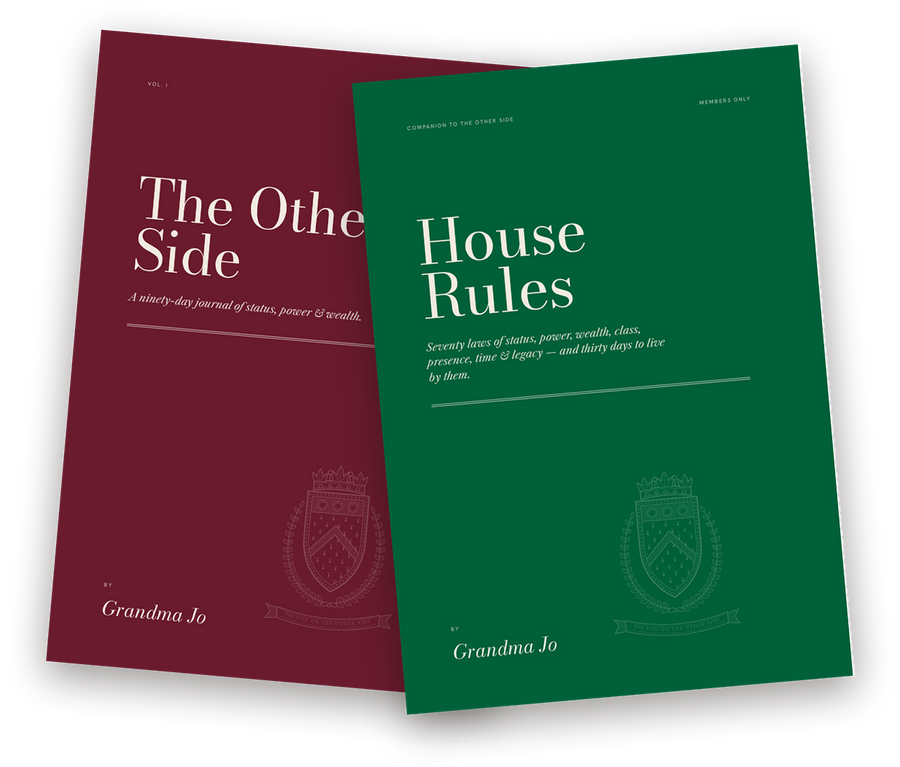
She never meant it for anyone but herself. It came to me in a shoebox when she died, and I've spent my life turning what she watched into rules I could keep. Then I did what she never thought to do and wrote them down for somebody else. Rule 24 is in House Rules with the others, and the step that matters here is the second one in its lunchtime practice, the Script: you take one of the lines above, the landlord's perhaps, and rewrite it in your own words, for your own landlord or client, until it sounds like you and not like me. The lines in this piece are my scripts. The page is there so you can write yours.
My grandmother left me a diary. I've written you one, and I'd rather you had it now than inherited it. It's called The Full House.
As for the pencil mark on the man's card: it was a single letter, R, for "rack rate", and he paid the full price every visit after that without ever knowing why.