You stop chasing people on the day you decide that anything which has to be chased was never coming with you anyway. Then you keep deciding it, every morning, for about a year, until it no longer feels like a decision and starts to feel like your nature. That is the short answer, and if you only have a minute, it's enough: never chase a person, a lover or an opportunity. Ask once, then walk at your own pace.
Now the long one.
The kitchen table
I was twenty-four. We lived in a flat with a green oilcloth on the kitchen table and a window that didn't quite shut, so in winter there was always a folded tea towel on the sill. On Friday evenings he counted out the housekeeping money onto that oilcloth, note by note, coin by coin. Then he asked me to count it back to him. Out loud.
"You wouldn't know what to do with more," he said once, not unkindly, the way you might tell a child it's too young for coffee. That was his gift, if you can call it one. He never shouted. He simply made very sure I understood that the money was his, the decisions were his, and my opinions were a sort of weather he tolerated.
And I chased him. I'm not proud of it, but it's the truth, and there's no point in my writing any of this if I tidy it up. I chased his approval the way some people chase a train that has already left the platform. Dinner kept warm in the oven until eleven. A new dress he didn't notice. "Are you cross with me?" asked so often it became a kind of hiccup. Every time he withdrew, I ran after him a little harder, and every time I ran, he withdrew a little further. It is a very old dance. Most people have done a few steps of it, with someone.
That spring my grandmother died. After the funeral my mother handed me a parcel in brown paper and said, "She wanted you to have this, and I've no idea why." Inside was a diary small enough to hide in a coat pocket, its ribbon worn to a thread at the end where she used to tug it, and page after page of small, slanted handwriting in fountain pen.
My grandmother made clothes for a living, and for forty years her clients were the sort of women whose front doors opened before they reached them. She knelt at their hems and kept her eyes open. How they arrived, when they said nothing, whom they never ran after: all of it went into the book in the evenings, under the lamp over her sewing table.
I read the diary on the bus to work, a few pages a day, because I didn't want it to end. About a third of the way through, I found this:
Mrs. W. never runs for the omnibus. I asked her why once, while I had the pins in. She said another always comes, and the ladies who run for it arrive red in the face and get the worst seat. I have thought about it all week. It is not about omnibuses.
I sat with that page on my knee until I missed my stop.
What I got wrong first
You'd think that was the moment everything changed. It wasn't. What I did first was clever and stupid in equal measure: I decided to stop chasing him so that he would come after me.
I went to bed at ten instead of waiting up. I stopped asking whether he was cross. I stopped explaining where I'd been and why the shopping had taken forty minutes. And he did notice, straight away. He followed me into the bedroom one night and stood in the doorway and said, "Nothing to say, then?" and I said, "No, I don't think so," and turned off the lamp.
For about a month I thought I'd won something. But lying there in the dark, I was still listening for his key in the door. I was still keeping score. I had simply found a quieter way of running for the same bus.
That is the mistake almost everybody makes with this rule, and I want you to skip it. Not chasing is not a tactic for getting the other person to chase you. The moment it's a tactic, you're still in the dance, just doing the steps backwards. Real detachment is when you stop needing the result at all: when you'd be perfectly all right if the bus never came, because you've remembered you have legs.
That took me longer. It came in small pieces. The first piece was a Saturday afternoon when I walked to the library on my own, without asking, and read for two hours, and realised on the way home that I had not once wondered what he'd think. The second piece was a card pinned up in that library: Receptionist wanted, the hotel by the station, evenings and weekends to start, apply in person to Mrs Carrow. I applied without telling him. When they offered it to me, I said yes on the telephone before I'd let myself think about how he'd take it.
He took it badly, in his quiet way. "You'll be back here in a month," he said. "They'll see through you."
I didn't argue. My grandmother had a line for that too, and it later became rule 15: don't waste explanations on people who have already chosen not to understand. Everything I've since said about giving fewer reasons started in that flat.
I left on a Thursday in October with a tan case whose clasp had given up, held shut with an old belt. I rented a single room from Mrs Adair, a widow who kept a canary and a very strict bathroom timetable; her name was on a brass plate by the bell, polished so often the letters had gone soft at the edges. My key hung on a piece of string just inside her door. He telephoned the hotel twice that first week. I didn't ring back. I didn't send a letter explaining myself. There was nothing to explain that he hadn't already decided not to understand.
No slammed doors, no speeches. I simply stopped running, and it turned out the life I wanted had been walking toward me at a steady pace the whole time.
One plain word, because some of you will be reading this in a flat of your own with a tea towel on the sill. If the person you're with frightens you, and not only diminishes you, please speak to your local support services or someone qualified before you do anything at all. Leaving well is a plan, not a gesture, and you deserve a good plan.
Why chasing always costs you more
Before long, from behind Mrs Carrow's reception desk, I watched the omnibus rule play out a dozen times a day. Guests who pursued the manager across the lobby for a better room got a room, eventually, and a reputation along with it. Guests who asked once at the desk ("If a garden room comes free this week, I'd love it; if not, no trouble at all") somehow always got the garden room on the Wednesday. Staff talk. Staff remember who ran.
Chasing tells the other person your price. It says: I need this more than you do, so you can set the terms. That's true of a lover, a friend who only calls when she needs something, a client who has stopped answering, a promotion you've hinted at for three years. The moment you run, the other person relaxes, because the effort has become yours.
"I have never run after a bus, a lover or an opportunity. Another one always comes." (House rule 13)
Now, does another one truly always come? Not the same one. The bus you missed has gone, and so has the man who wanted you to count the money back to him. What comes is the next one, and you arrive to meet it with your breath and your dignity, which in my experience is the only condition in which you'll notice it's any good.
How to stop chasing people, love and opportunities, starting this week
You stay warm, polite and generous throughout. What changes is the number of times you ask, and what you do while you wait.
With a friend who's gone quiet
Send one message, and make it easy to answer: "I've missed you. I'm free Thursday evening if that suits, and if not, another time." Then stop. No second message on Saturday with a joke in it. No little question mark three days later. If they want you, they have your number and a date. If they don't reply, they have answered you, and you've kept your dignity intact while they did it.
With someone you're seeing who's gone lukewarm
Say what you want, once, in words a child could follow: "I like you, and I'd like to see more of you. If that's not where you are, I'd rather know." Then let their behaviour answer, not their excuses. The kind of love worth having walks toward you at roughly your own pace.
With work and opportunities
Apply properly. Follow up once, courteously, after a reasonable interval: "I wanted to make sure my note reached you. I'd be glad to talk whenever it's convenient." That's all. People who chase a job like a lost dog tend to be offered less when they get it. It has its own line in the house rules: "Ask clearly, once. Then wait — preferably with a drink."
With yourself, at eleven o'clock at night
This is where most chasing happens: in the dark, with a phone in your hand, typing a second message you've already deleted twice. Put the phone face down in another room. Write the message on paper instead, in full. Read it in the morning. You'll almost never send it.
And notice what you do with the time you get back. That's the real prize. I got hours of my life back once I stopped waiting up, and I spent them reading, then working, then eventually building a small firm of my own. None of that would have fitted in a life spent listening for a key.
How I got from Mrs Adair's back room to rooms I never expected to sit in is told more briefly than it was lived. The habits I carried out of that flat turned out to be the quiet habits of old families, the same ones I later saw in people with fortunes, and not one of them needed a penny to start.
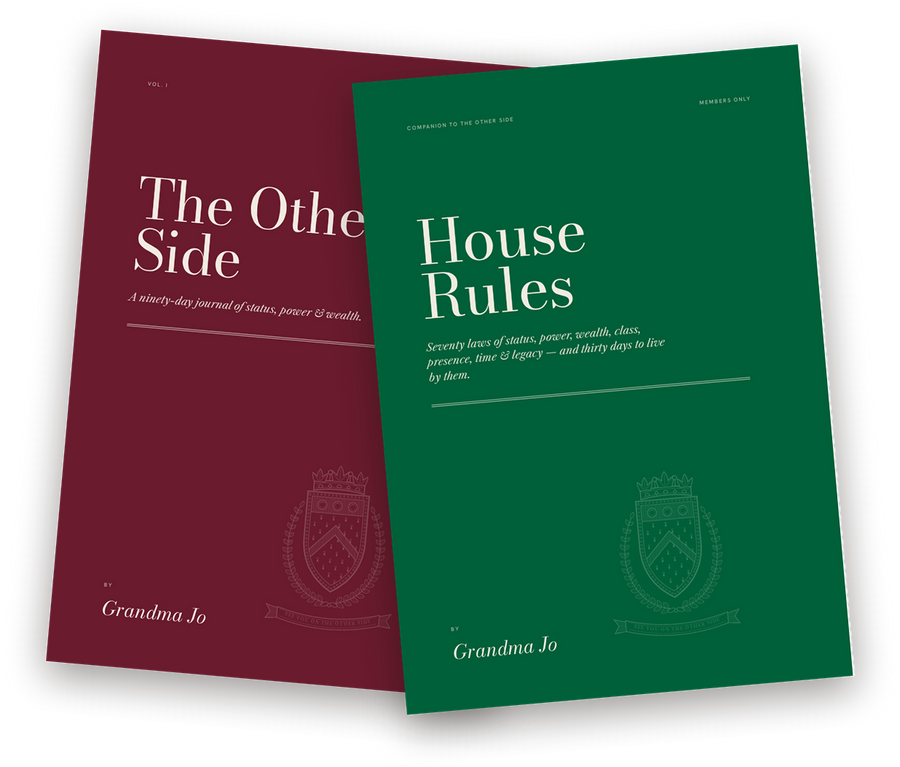
Habits, then, not heroics. It's why rule 13 has three homes in what I've made, and why I'd want all three for anyone trying to stop running. In House Rules it gets a lunchtime of its own among the power rules: you read it, write a sentence about your week as though you already keep it, make one small move and note what came back. In The Other Side it turns up at night, where "didn't send the second text" is perfectly good Evidence, and where a page called "Old story, new truth" waits for the doubt that arrives around eleven. And it sits on your lock screen, which matters more than it sounds, because the phone is where nearly all modern chasing happens; the rule is there before the message is. One to learn it, one to practise it, one to catch you in the act. All three are The Full House.
So. Somewhere ahead of you there's a room: a restaurant with white cloths and a window onto the street, early on a weekday evening. The person you used to chase is at the bar. You nod, finish your sentence, and walk to the table by the window.
It was already being kept for you.