Turn over the shoes you wore today and look at the heels. If they're worn down on one side, take them to be mended this week, before you buy another thing. That is the first of the old money habits, and I put it first on purpose, because it has nothing to do with money at all.
People expect a piece about old money habits to be about accounts and inheritances and houses with names. It isn't, and I'm not the person to write that piece anyway. I give nobody financial advice. What I know is behaviour, and the behaviour of families who keep what they have is surprisingly plain: they pay attention, they wait, they repair, and they don't discuss it. The number comes later, if it comes. When it stays, the habits are why.
There is a House Rule for this, and it's the one I'd keep if I could keep only one from the Wealth pillar:
"Wealth is a habit long before it's a number."
I didn't learn it from anyone with a fortune. I learned it from my grandmother, a dressmaker who was paid by the fitting and, by some of the grander households, three months late. She wore a tape measure round her neck for most of her life and kept a notebook in her apron pocket, and in it she tracked, without quite meaning to, which families stayed comfortable and which ones were selling the pictures within a generation. The difference, she decided, was never the size of the house. It was what went on inside it on a wet weekday afternoon with nobody watching.
Old money habits begin with attention
The first thing my grandmother noticed about her wealthiest clients was that they knew exactly what they had.
One of them, she wrote, could describe a jacket she hadn't worn in two years down to the number of buttons on the cuff and the fact that the third one was a slightly different shade. She knew which hems had been let down and which lining had been patched. She wasn't vain about her clothes. She was attentive to them, which is a different thing entirely.
I met the same quality decades later in a man I did business with for eleven years. He wrote the date and the town inside the front cover of every book he bought, in pencil, and could tell you where he'd been on the day he bought any of them. His shoes were old and gleaming. His car was older still. Nothing he owned was careless, and nothing he owned was new.
Attention is the root habit because every other one grows out of it. You can't repair what you haven't noticed is fraying. You can't be patient about a purchase if you don't know what you already have. And money, like everything else, behaves differently when it's watched. The House Rule puts it bluntly: "Look at your money every week. Things you ignore tend to leave." I'm not telling you what to do with it when you look. I'm telling you to look, because looking is the habit, and the habit is where it starts.
The same goes for people. The families who've kept their standing for generations tend to know the names of the people who work for them, and the names of those people's children. That isn't sentiment. It's attention, pointed outward.
Patience, or learning to want things slowly
My grandmother's best clients ordered their winter coats in April.
She found this baffling when she was young. Why think about wool in spring? By the time she was older she understood. A coat ordered in April could be made properly, fitted twice, altered at leisure and delivered in October, finished. A coat ordered in November was made in a rush, fitted once and worn before the hem had settled. Same woman, same cloth. The only difference was the wanting. One woman wanted it slowly, and got something better for it.
Wealthy habits almost all have this in them: a willingness to let time do part of the work. It shows up in small ways. They wait for the right chair rather than buying three wrong ones. They let a decision sit overnight. They are rarely the first to own anything and rarely have to replace it.
What I got wrong, and I got it thoroughly wrong, was the day my own money finally came. My little firm had a good year, the first proper one, and on a Saturday in March I went out and bought an entire wardrobe in a single afternoon. I remember the carrier bags lined up on the back seat of the taxi like passengers. I remember feeling, for about a day, rich.
Within a year, half of it had gone to a charity shop. It didn't fit my life. I'd bought it for a woman I'd imagined in the changing room, not the one who had to wear it on a Tuesday. I hadn't become wealthier that afternoon. I'd bought the costume of money and none of its habits, and I'd paid for the costume twice: once at the till, once in the embarrassment of carrying it back out of my own wardrobe.
Patience would have saved me all of that. One piece in March, another in June, each one chosen for the life I actually had. That's slower, and duller, and far more like what the women in my grandmother's diary did.
These days, when I feel the old Saturday itch coming on in a shop, I say the same sentence to the assistant every time, pleasantly and without apology: "It's lovely. I'd like to live with the idea for a week. If it's still here, it was meant to be mine." About half the time I go back. The other half, I find I've forgotten it by Wednesday, which tells me everything I needed to know about how much I wanted it.
Repair before replace, and not only for shoes
This is the habit that surprised me most when I finally saw it close up. The people with the most were the ones most likely to mend.
The heel on the shoe. The strap on the watch. The frayed cuff, turned. The chipped lid of a teapot, glued so well that you'd have to know. A wealthy woman I once sat beside at a lunch told me, with real pride, that the dining chairs we were sitting on had been recaned three times. She didn't mention what they'd cost, and I didn't ask. I've no doubt the answer was "rather a lot", but that wasn't the point she was making. The point was that they were still here.
Repair is a statement about time. It says: I intend to keep this, and I intend to be around to keep it. People who replace everything are, in a quiet way, admitting they don't expect to stay.
But the habits of wealthy families extend repair to something much more important than furniture, which is people. The families that hold together across generations are, as far as I've seen, the ones who mend quarrels quickly. A letter after a bad dinner. A phone call the following morning. The note of repair is first cousin to a thank-you note worth keeping: short, in your own hand, and specific about the thing you're sorry for.
If you need the words, these have served me well:
"I was short with you on Thursday, and you didn't deserve it. I'm sorry. I'd very much like to see you soon."
That's all. No essay attached, and no bargaining. You send it, and you don't send another if the first isn't answered quickly. Once is enough. A second letter asking why you haven't heard back turns an apology into an invoice.
Discretion is the habit that protects all the others
You'll have noticed that none of the people in this piece talk about money. I didn't pick them for it. It simply turns out to be, as far as I can tell, the single most consistent habit of families who have had it for a long time.
Part of it is manners. Part of it is self-defence. What people don't know, they can't envy or gossip about at weddings. And part of it is simply that money, once mentioned, changes the air in a room. Say what the watch cost and everybody at the table starts silently measuring. Nobody enjoys being measured, and nobody quite forgives the person who made them do it.
A price spoken aloud is a price paid twice.
People sometimes ask me what to say when someone asks outright. I have a line I use, smiling, which closes the subject without closing the conversation:
"Oh, it was a present to myself. I've very sensibly lost the receipt."
Then I ask them something about themselves, and we're off somewhere far more interesting.
Discretion is also why the wealthiest person in a room is so often the plainest dressed: the loudness belongs to people who still need to be told they've arrived. Set old money beside new and the gap is rarely the age of the fortune. It's whether the fortune still wants an audience. The old habit is to be recognised by the people who matter, and invisible to everyone else.
Why rich mindset habits fail without these four
You'll find a great deal written about rich mindset habits. Much of it is about believing you deserve more and picturing it in detail. I don't object to wanting. I'm in favour of it, in fact, and I've spent a good part of my life wanting things and then going quietly to get them.
But wanting without these habits underneath it produces exactly what I produced that Saturday in March: a back seat full of carrier bags and a wardrobe full of someone else. The habits are what make the wanting safe. Attention stops you buying the same grey jumper three times. Patience gets you the April coat instead of the November one, and mending means you still have it in twenty years, while discretion keeps everyone else's curiosity off it.
None of these requires a fortune to begin. My grandmother practised every one of them on a dressmaker's wage, in a flat with a gas meter that ate coins. She had one good pair of shoes, which went to the cobbler every spring whether they needed it or not. She knew what was in her purse to the penny, every Friday. She mended everything. And she never, in her whole life, told anyone what anything cost.
Who finishes a piece like this
I'll tell you something I've noticed. People who are looking for a trick stop reading a piece like this about halfway down, somewhere around the part about ordering coats in April. There's no trick in it, and they can tell.
If you're still here, you aren't looking for a trick. You're someone who suspected all along that wealth was mostly a matter of how you behave on an ordinary Tuesday, and you wanted somebody to say so. You are, in other words, already most of the way to these habits. What's missing is only the practice.
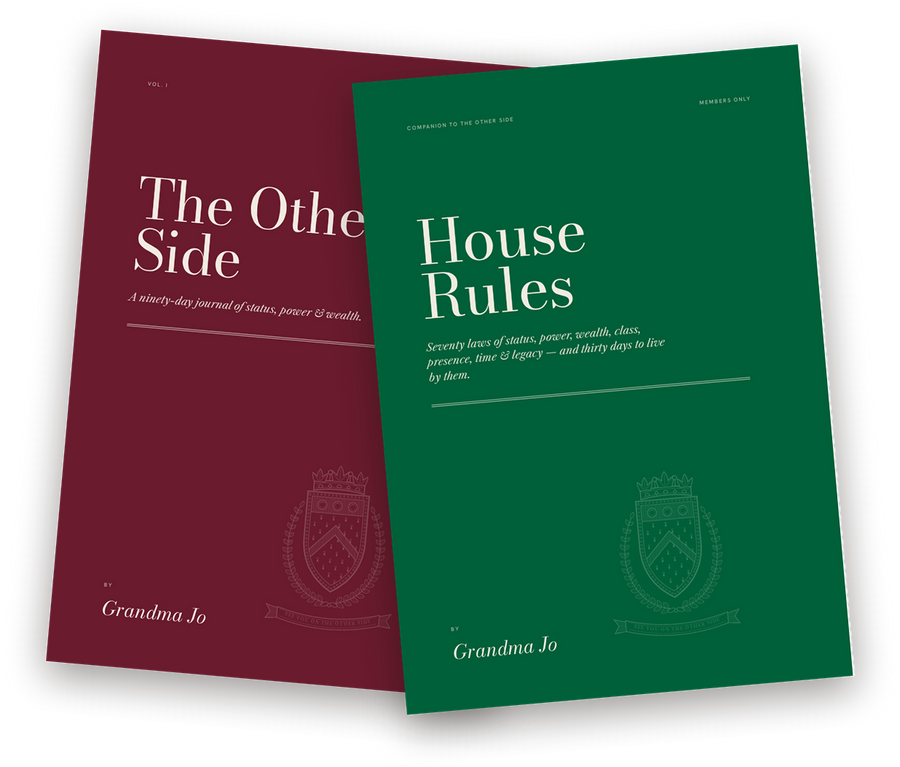
That's why The Other Side gives Wealth a week of its own, week three, and then gives it a second week in week ten, when you come back round to it with two months of evidence in hand. Once a month it also asks you to hold a small board meeting with yourself called Cut & Acquire: one thing you're finished putting up with (the heel you keep meaning to mend, the envelope you keep not opening) and one habit you're taking on in its place. It isn't glamorous. It's a notebook for people who turn their shoes over to look at the heels, and The Full House is where it lives.
My grandmother put the whole idea better than I have, as usual. On a page near the back of the diary, in handwriting that slopes further to the right the older she got, she wrote:
Mrs. L. paid on the Friday, as she always does, in an envelope with the sum written small in the corner so I need not count it in front of her. Her gloves are mended at three fingertips. She knows which three.