At twenty to midnight, on a wet Tuesday, a man came through the revolving door of the hotel carrying nothing but a paper bag of clementines. No suitcase. A raincoat gone dark at the shoulders. I was behind the desk that night, young and anxious and rather proud of my new name badge, and I reached for the register to ask who he was. I knew all about status symbols then, or believed I did, and he had none of them.
The night manager put his hand over the book before I could open it. He stood, which he did for almost nobody, and said, "Good evening, sir. The window on the left still sticks, so we've given you the one on the corner." The man said, "You're very kind," put a clementine on the counter for each of us, and went up.
Four hours earlier, a different gentleman had arrived with six matching cases, a car I couldn't name and a voice that carried to the lifts, and had told me his own name twice in case I'd missed it. He had the full set. The man with the clementines had the only one I've never seen anyone fake. He was expected.
I've spent forty years since collecting the others. The status symbols that matter to people who have everything are almost never things you can buy quickly: time, handwriting, being expected, discretion, a good name, a table where you're known. What follows is my catalogue, in no strict order, some entries a sentence long and some a good deal longer.
Real status symbols that money can't hurry
Time. The first and the rarest. Not free time as in idleness, but time that belongs to you. The most powerful person I ever sat beside at dinner stayed for coffee, then for a second coffee, and never once looked at a watch. That was the whole display. Nobody else in the room, you understood, was allowed to decide when his evening ended.
White space. A diary with nothing written on Thursday afternoon. People who have everything guard empty hours the way other people guard jewellery, and for the same reason: they're hard to get back once they've gone.
Not hurrying. You can tell a great deal from the pace at which someone crosses a lobby. The ones who own the building don't run for the lift. There'll be another, and they know it, and the knowing shows in their shoulders.
Being expected. See the man with the clementines. It can't be bought on arrival, and it can't be demanded. It is paid for in advance, over years, in small courtesies to the people who keep the register. I asked the night manager afterwards how long the clementine man had been coming. "Since before my time," he said. "He sends a card every Christmas. To the desk, not the manager." There was no more to it than that, and it had taken him twenty years.
A table where you are known. One restaurant, not twenty. A place where the bread arrives before you ask, where your usual is remembered and the owner comes over to tell you the fish is better than the lamb tonight. You don't get that by being the biggest spender. You get it by coming back, being pleasant, tipping well and never once making a fuss about the table. People with a great deal of money prize this out of all proportion, because it's one of the few rooms left where nobody is performing for them.
Signs of real wealth you can only see up close
Handwriting. A letter in ink, on paper that has some weight to it. My grandmother, who fitted gowns for most of her life and noticed everything while she did it, wrote in her diary: "The grand ones write their thank-yous by hand, and the letters come on the day after, never the week after." A good pen and a sheet of decent paper cost less than a round of drinks, which is exactly why so few people bother. The only template I'd recommend is the one in the short letter of thanks I've been writing for forty years.
Mended things. A cashmere jumper darned at the elbow with wool that almost matches. A string of pearls re-knotted every few years by the same woman in the same small shop. New is easy. Kept is a statement.
A doorman who uses your name. Because you used his first. Mr Doyle, who kept the hotel door in a greatcoat with one button always hanging by a thread, greeted perhaps a dozen guests by name. Every one of them had asked for his.
Old friends. Not contacts. People who knew you when you had one good coat and a rented room, and who still ring on your birthday. When someone with everything introduces you to "my oldest friend", notice how their voice changes. That friend is the thing they're proudest of in the room.
A good name. The one that walks in before you do. Rule 04: "Your name walks into the room before you do. Dress it accordingly." It is built out of small kept promises and it can be lost in an afternoon. The whole method, such as it is, sits in the piece on keeping your word: do what you said, when you said, every time, especially when nobody would know.
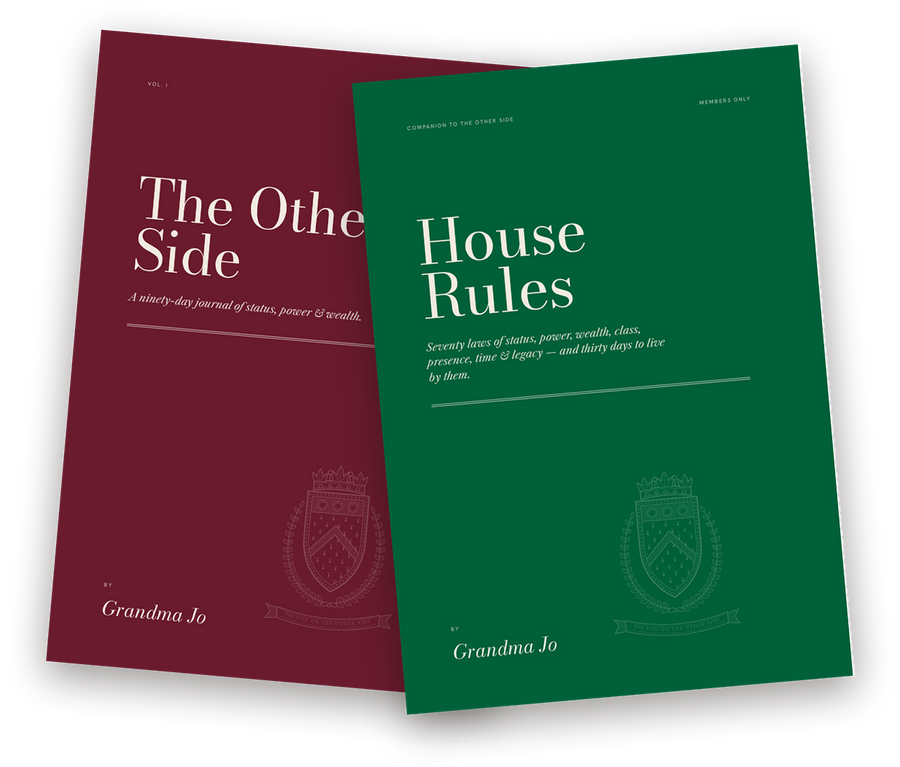
This is the one symbol I've tried hardest to keep an eye on over the years, and I do it on paper. In The Other Side, the journal I wrote for ninety days of practice, there's a page called the ledger: every yes, every door that opened, every promise kept, each with its date beside it. It isn't glamorous. It's where a good name is actually made, one line at a time.
What rich people value and almost never mention
Discretion. Knowing things and not saying them. The people I've known with the most influence were also the ones who knew the most secrets and repeated none. My own rule names three subjects I won't discuss at a table. The people I'm describing keep to a far longer list, and never tell you what's on it.
Privacy. Not being photographed. Not being findable. A house you can't see from the road. The richer the family, in my experience, the fewer pictures of their dinners exist anywhere.
Silence. The ability to sit at a table without filling it. Most of us talk to prove we belong. People who have everything have nothing to prove, so they listen, and the silence around them starts to look like authority.
The right to say no without explaining. "No, I shan't be able to, but thank you." Full stop. No excuse, no apology, no story about a dentist. It sounds small. For most people it takes decades.
Competence with the hands. Being able to cook a proper meal, sail a boat, re-hang a door, mend a hem. I have watched men with more money than some countries spend a whole weekend restoring a wooden chair, and describe it afterwards with more pride than any acquisition. You can't delegate the satisfaction.
One poem by heart. Rule 50 asks for three things by heart: "one poem, one toast and one very good joke." The poem is the one that impresses people who have everything. Recited quietly, at the right moment, it tells them there's something in you that no one could have sold you.
Books that have been read. Cracked spines, pencil in the margins, a bus ticket as a bookmark. A shelf of unopened leather sets is furniture. A shelf of battered paperbacks is a person.
Staff who stay. To learn how someone treats people, don't look at their friends. Look at how long the people who work for them have stayed. A housekeeper of twenty years, an assistant who followed her from one firm to the next, a driver who is invited to the daughter's wedding. Nobody who has everything will mention it. Everyone who works for them will.
Leaving early. Rule 57: "Always leave while they still want you to stay." The grandest guest at any party I've attended was the first one to find her coat, and the room was a little flatter the moment she'd gone. Nobody leaves early who is afraid of missing something.
Children who write letters. Of all the things I've watched very wealthy grandparents boast about, the one that makes them glow is a thank-you note in wobbly capitals. Not the school, not the grades. The note.
Status symbols I once believed in
The club. I include this entry because I spent a whole year trying to get into one. A private members' club with a green door, a porter in a top hat and a waiting list I was told, rather grandly, was "considerable". I wrote the letters, found the sponsors, sat the lunch at which I was quietly inspected over the potted shrimps. When the card finally came I carried it in my purse for a month and took it out more often than I needed to. Then I asked a woman I admired, who ran a firm three times the size of mine, whether she'd be there on Thursday. "Oh, I let mine lapse years ago," she said. "They never could remember how I take my coffee."
What I'd misunderstood was the direction of it. I'd wanted a place that would let me in. She valued a place that knew her. The first is a door with a list. The second is a table where you are known, and no committee can hand it to you. It was the club that taught me what I'd later call quiet luxury, a behaviour rather than a look. I let the membership lapse after two years, and nobody at the green door noticed, which rather proved her point.
The address. For a few years I thought where you lived was the thing. Then I met a woman who owned half a street and lived in the smallest house on it, with a blue door and a lemon tree in a pot. The address was never the symbol. The lemon tree was, if anything.
Busyness. The most seductive false symbol of all, and I wore it proudly for a decade. Being always rushed, always on the telephone, always late for the next thing. It feels important. From the outside it looks like someone who isn't in charge of her own day.
How to start collecting the ones that count
Anything you can buy this afternoon impresses mostly the people who can't.
Here's what I notice about the catalogue, reading it back. Almost none of these can be bought, and almost all of them are available to anyone who is willing to wait. Handwriting costs a pen. A table where you're known costs going back. A good name costs keeping your word on the days it's inconvenient. Being expected costs being kind to the person holding the register, years before you need them.
If you'd like to begin this week, choose two entries and no more. Write one letter by hand to someone who did something for you last month, and post it tomorrow. Pick one café or restaurant and go back three times before the month is out, at the same sort of hour, and learn one name there. That's all. In a year, the café will be a table where you're known and the letter will be a habit, and neither will have cost you more than a stamp and a few coffees.
The ledger I mentioned earlier is where I'd start. Nothing in this catalogue can be bought, but every entry can be recorded as it's earned, and a page that shows you, in your own handwriting, that you kept your word eleven days running is the only status symbol I know of that fits in a drawer. The ledger lives in the journal, and the journal lives in The Full House. One line tonight is plenty.
Every night, sitting up in bed with my reading glasses on, I write one line in the ledger in ink: the promise I kept that day.