"Sorry, can I ask," said the young woman on the next stool, "is that coat quiet luxury?"
We were at a hotel bar on a grey afternoon, both waiting for people who were late, and she had been looking at my coat since her lime and soda arrived. Camel, single-breasted, a little long in the old way. She held up her phone to show me what she meant: a woman in an oatmeal jumper, standing in a white room, explaining the ten pieces you need to achieve the quiet luxury look, with a link beneath each one.
I told her the truth, which was that the coat is twenty-two years old, it has been relined twice, and the second button from the top came out of a cigar box of odd buttons at my tailor's. "So I suppose it's quiet by now," I said. "It's stopped talking."
She laughed, and then she looked genuinely disappointed, because what she wanted was a name and a link. I understood. I'd have wanted the same at her age. But the honest answer to her question is the one I'll give you now. Quiet luxury means owning good things and behaving as though they are ordinary. The clothes are the smallest part of it. What makes it real is a handful of habits: you don't explain, you don't name prices, you look after things, and you keep them for decades. None of those come with a link.
What the popular advice gets right
I want to be fair to the woman in the white room, because she isn't wrong about everything. The advice you'll find about quiet luxury style usually goes like this: fewer logos, better cloth, neutral colours, good tailoring, nothing that shouts. As far as it goes, I agree with every word. My grandmother, who dressed women with more coats than cupboards, would have agreed too, and my house rules are rude about logos for good reason.
A plain jacket that fits across the shoulders will say more about you than a monogram ever could. Go through what people actually notice about you before you speak and almost none of it is brands. It is fit, fabric, care, and the way you move inside the thing you're wearing.
So the popular advice points in the right direction. My quarrel with it is that it stops at the wardrobe, and then it sells you the wardrobe.
Why buying quiet luxury in a weekend doesn't work
The moment quiet luxury became a trend, it stopped being quiet. That's the joke nobody in the white room seems to have noticed. A look that half the internet is photographing, tagging and buying in the same four shades of oat is a uniform, and a uniform, whatever it's made of, is a costume.
There's a second problem, and it's the one I care about more. You can put on the whole look, cashmere to loafers, and still be loud. I've seen it many times: the beige jumper, the unmarked bag, and then the owner tells you where the bag came from before you've taken your coat off. Or sighs about the price of the jumper. Or mentions, twice, that the loafers are the ones everybody's trying to get. The clothes are whispering and the person is shouting over them.
I know this because I did it for years, and my weakness wasn't a handbag. It was explaining. When I first had a little money of my own, after years of having none and being reminded daily that I had none, I couldn't accept a compliment on anything without giving a full account of it. A woman at a lunch once said she liked my blouse. I told her where it came from, that it had been reduced, that I'd nearly not bought it, that it was really meant for a wedding and there was a mark on the cuff if you looked. She listened to all of it very kindly, the oldest shoes at the table on her feet, and then she said, "I only meant it was a pretty colour, Jo."
She talked to me about her garden for the next forty minutes and never mentioned the blouse again. On the way home I worked out what had happened. The blouse had been perfectly quiet. I was the one making the noise, because I still needed the women I admired to see me, and they had long ago stopped needing to be seen at all.
That lunch taught me the thing the videos leave out. Quiet luxury was never a set of objects. It's a behaviour, and you can do the behaviour in a coat from anywhere.
Stealth wealth is mostly what you don't say
People call it stealth wealth, which makes it sound as though everyone involved is hiding something. The women my grandmother dressed weren't hiding. They simply didn't raise the subject. If you asked where a coat came from, they'd tell you plainly, once, and then ask about your children. There is a world of difference between secrecy and ease, and people can feel it from across a room. Here is what ease sounds like.
When someone compliments what you're wearing
Say "Thank you." Then stop. Resist every one of the following, all of which I have heard, some from my own mouth: "Oh, this old thing." "It was on sale, actually." "My husband bought it, I'd never have spent that." "It's the one from that shop, you know the one." Each of them is an explanation, and every explanation is a small plea to be judged kindly. You don't need to be judged kindly. You need to be complimented, which you just were.
When someone asks what it cost
Don't tell them. A price said aloud costs you in two directions. Mention a high price and you look as if you're keeping score. Mention a low one and you've told the other person that the thing they admired wasn't worth admiring. Either way, the conversation is now about money, and you put it there. If someone asks directly, I say, pleasantly, "I honestly couldn't tell you, I've had it for years," which in my case is true, or "More than I meant to spend and less than it's worth," and then I change the subject to something about them. People almost never ask twice.
When you want to say where you got it
Wait to be asked. If you're asked, answer in a sentence. That's the whole rule. The urge to volunteer is the urge to be associated with the name, and the name is doing the talking you're meant to be doing yourself.
The quiet luxury meaning my grandmother would have recognised
My grandmother wrote in her diary:
"The ladies with the most money bring me the oldest coats. Lady M. brought the grey again today, fourth winter I have turned the cuffs. She stood very still while I pinned and asked after my mother's chest."
That entry has stayed with me more than almost anything else in the diary. Here was a woman who could have bought a new grey coat every winter for the rest of her life, standing in a dressmaker's back room, having the cuffs turned for the fourth time. And while she stood there she asked after the dressmaker's mother.
That is the real meaning of quiet luxury, as far as I've ever been able to tell. Buy the good thing once. Look after it as though you'll need it for thirty years. Have it mended by someone skilled, and know their name, and ask after their mother. None of it is for show; there's nobody watching in a fitting room.
"Buy less, buy better, keep it forever. Then leave it to someone you love." House rule 63.
In practice this means unglamorous things. A clothes brush by the front door, and actually using it. Cedar in the wardrobe. Wooden hangers, wide at the shoulder, so coats don't grow those little peaks. Shoes resoled before they need it, not after. A tailor, a cobbler and a dry cleaner you've used for years and trust, who know you by name because you've been in so many times, not because you spent a fortune once. Of all the habits old money keeps, this is the plainest: maintenance is a form of respect, for the thing and for the people who made it.
It also means patience at the moment of buying. I don't buy a coat in a week. I look for months, sometimes a year, and I often buy nothing. The girl at the bar wanted ten pieces by Friday. My grandmother's ladies wanted one piece for a decade. Those are two completely different ways of living, and only one of them is quiet.
What quiet luxury looks like when nobody's dressed for it
The clearest example I ever saw had nothing to do with clothes. In my hotel years, a man used to arrive twice a year in a raincoat so worn that the new night porter once tried to direct him to the side entrance. The man thanked him warmly, used the side entrance, and never mentioned it to anyone. It was the manager who found out, the next morning, when he saw the name on the register and went white. The man owned a good part of the street.
What stays with me is that he never needed the porter to know who he was. He didn't correct him. He didn't do the dreadful thing people do, "Do you know who I am?", which is the loudest sentence in the English language. He simply went round the side, and tipped the porter the next day as though nothing had happened.
That's what I mean by a behaviour. You could dress that man in anything. What made him quiet was that he had nothing left to prove, and he behaved accordingly. Most of what separates old money from new turns out to be behaviour too, and very little of it is the bank balance.
The better version of the advice
So here is my version, to set beside the one in the white room. Keep the good cloth and the plain colours, by all means. Then add the parts that can't be bought.
Say "thank you" and stop. Never name a price, high or low. Wait to be asked where anything came from. Look after what you own as if you'll be leaving it to someone. Know the people who mend your things. Buy slowly. Be, as rule 46 puts it, "Never the loudest thing in the room. Not your voice, not your perfume, not your handbag." And practise all of this until it stops being a practice and becomes simply how you are, because the one thing quiet luxury can't survive is visible effort.
That last part is the hard part, darling, and it's the part I can help with.
When my grandmother died, the notebook came to me, its spine gone soft from being opened at the same pages, full of women who stood still while she pinned them. It was a gift of habits, written down by someone who had watched closely enough to see what the clothes were covering. I lived by it, page by page, for most of my adult life.
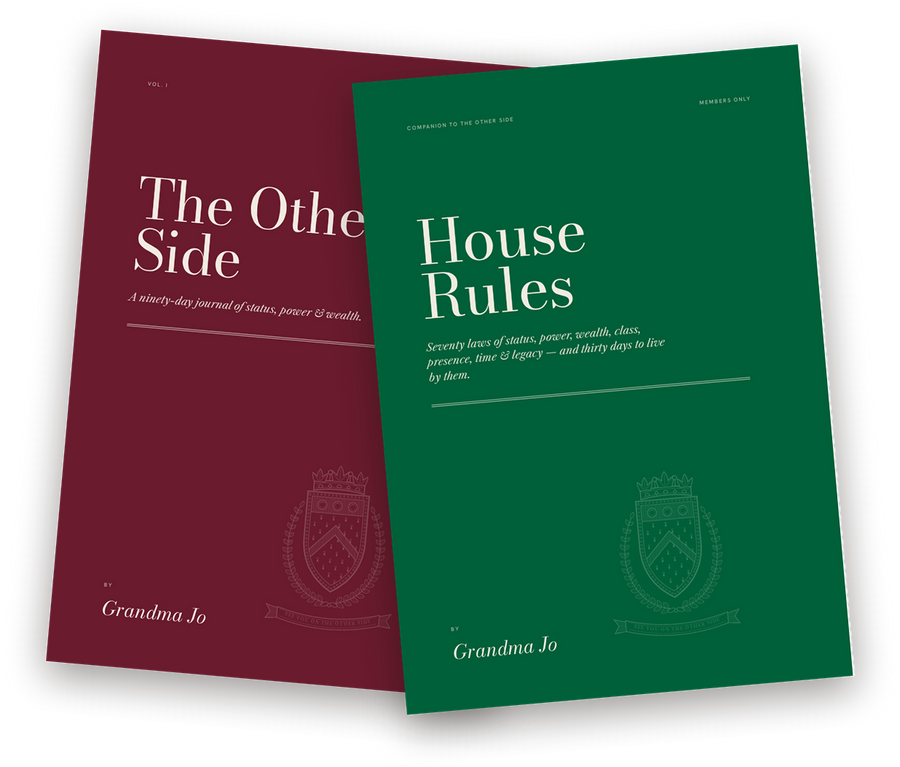
I have tried to do for you what she did for me. The Other Side is ninety days of these habits, a pillar a week, each one opened with an essay and closed with a practice page; Class and Presence, weeks four and five, are where this piece lives. From week eight the pillars come round again, and the second time you meet them you'll have evidence of your own. It is the diary I've written you, with House Rules beside it, and the pair cost less than a single piece from that list of ten.
Her friend arrived before mine. As she gathered up her things she said, "I think I'll just look after my coat, then." I said that was the best idea I'd heard all week.
Every night, before bed, I hang the camel coat on its wooden hanger and brush the shoulders twice, top to bottom.