Write the plan down. Close the notebook. Put it in a drawer, and then tell nobody who doesn't need to know.
That's the whole instruction, and if you do nothing else after reading this, do that. People ask me why you should never announce your plans, as if there were some mystical reason. There isn't. There are two very ordinary ones. Saying a plan out loud pays you some of the reward before you've done the work, and it hands a crowd a vote in something that was never theirs to vote on. Both of those make the work harder. Neither makes it better.
"Announce the result. The move is none of their business." (House rule 02)
I'd like to take those two reasons one at a time, and then tell you how I learned them, which was not gracefully.
The applause arrives before the work
You know the feeling. You're at dinner, the second bottle is open, and someone asks what you've been up to. You tell them: the business you're starting, the book, the move abroad, the weight you're going to lose, the exam. Faces light up. "How brilliant." "Good for you." "I always knew you would." For about twenty minutes, you feel like the person who has done it.
And the next morning, sitting down to actually begin, the plan feels strangely flat. As though something had been let out of it overnight.
Something had. I've no study to quote you and I won't invent one; I'll only tell you what I've watched, in myself and in other people, for a very long time. Applause is a wage. Take it before the work and you'll find you've already been paid. The warm glow at dinner was a large part of what you wanted from the whole enterprise, and you got it on credit, and now the work itself has to be done for less.
The people who get things done tend to keep their appetite. They are a little hungry, privately, for the day when they can say "it's finished" instead of "I'm going to". That hunger is fuel. Spend it at a dinner party and you'll be running on fumes by Wednesday.
What an audience does to a plan
The second reason is more practical, and in my experience it does more damage.
The moment you announce a plan, you have an audience, and audiences have opinions. Your uncle knows a man who tried the same thing and lost his shirt. A friend sends you an article about why it won't work. A colleague mentions, casually, that she's been thinking along similar lines herself. Your mother asks about it at every birthday for the next three years.
None of these people mean harm, mostly. But you are now managing them as well as the plan. You're giving updates. You're justifying delays. And worst of all, you've lost the freedom to change your mind quietly, which is the freedom every good plan needs. Real plans bend. You start a shop and find the money is in the repairs, not the sales. You start a novel and it turns out to be a play. If nobody knew what you'd promised, nobody notices you've changed course. If everybody knew, every sensible adjustment looks like a small public failure, and you'll be tempted to stick to the worse plan simply to save face.
There's a quieter risk too. Some people will be glad for you. A few will not, and you won't always know which few. Envy doesn't usually do anything dramatic. It simply withholds: the introduction that never gets made, the favour that's suddenly inconvenient. Why hand someone a reason?
The spring I told everyone
I was about twenty-eight and still working at the hotel, where the brass on the front doors was polished at six every morning whether anyone came through them or not. I had begun, in the evenings, to sketch out a business of my own. I had a notebook, a list of possible first clients and an enormous amount of hope.
And I told everyone. The porters, the girls on reception, the chef when he came up for his cigarette. "I'll be gone by spring," I said, with the confidence of someone who had never yet been gone by anything.
Spring came. I was still there. The work took longer than the hope had allowed for; it always does. And Mr Doyle, the doorman, a kind man who kept a flask of very strong tea inside his greatcoat, took to greeting me every Friday with the same line: "Still spring, is it, Jo?"
He meant nothing by it. He liked me. But every Friday, for months, that sentence landed, and every Friday I felt a little smaller and a little more like someone who talked. I started taking my break in the linen room so I wouldn't have to see the staff room. I nearly gave the whole thing up that summer. The plan was sound; the trouble was that I'd made it into a performance, and the performance was going badly.
When I finally did leave, the following autumn, I'd learned my lesson so thoroughly that I went to Mrs Carrow on a Friday afternoon with my notice already typed and folded in an envelope. She read it, let her glasses drop on their chain and said, "Well. I didn't see that coming." It was the most satisfying sentence anyone had said to me in two years.
Mr Doyle shook my hand at the door on my last evening. "Spring after all," he said. It was October. I didn't correct him.
To move in silence is not to keep secrets
Now, before anybody takes this too far: I'm not asking you to become a spy. To move in silence is a way of working, not a way of hiding. People who are mysterious about everything, who answer "What have you been up to?" with a knowing little smile, are exhausting, and everybody can tell they're enjoying it.
Discretion has a simple rule. You tell the people who have a part to play. Your partner, because it's their life too. The friend lending you the van. The person you're asking for advice, because they can't help with what they can't see. One person, if you like, who'll ask you how the work is going rather than applaud the idea, and who won't bring it up at parties. That's usually a short list. Everyone else can hear about it when there's something to hear.
And have a true, warm answer ready for when you're asked. Mine is: "Oh, a few things. I'll tell you when there's something to see." Then ask them about their own news, which almost everyone is delighted to give. If someone presses ("Come on, what is it?"), smile and say, "You'll be the first to know when there's anything worth knowing." It's charming, it's honest, and it closes the subject. If they press a third time, you've learned something useful about them. A closed mouth has more uses than most people suspect, and one of the pleasantest is being quietly underestimated while you get on with things.
Why you shouldn't share goals where the whole world can watch
Everything I've said about the dinner table goes double for the internet. A posted goal ("Day one of my new life") collects more applause in an hour than my grandmother saw in a year, and every bit of it is on credit. Then day eleven comes, and nobody's clapping, and the silence is louder than it would have been if you'd never announced anything at all.
If you need accountability, and some people truly do, choose it carefully. One person, privately, with instructions to ask about the work and not to cheer the intention. That's accountability. A crowd is an audience, and an audience wants a show.
If you find you badly want to announce, it's worth asking yourself whose approval you're after. Often the urge to tell is a need for somebody else to say the plan is good before you believe it yourself. That need is worth looking at on its own terms, since the hunger for other people's approval is a habit, and habits can be broken. The plan itself doesn't care whether anyone approves. It only cares whether you turn up.
When the plan can't be hidden
Some plans have to be visible. You can't secretly move house, and you can't leave a job without telling the job. For these, the rule shifts a little: announce the decision, never the deliberation.
A friend's son once took me aside at his niece's christening, a slice of cake going soft on the saucer in his hand, and asked how to tell his parents he wanted to leave the law and cook for a living. He'd been rehearsing a speech for months, he said. It covered his reasons, his doubts, the finances, what his tutor had said, and a contingency plan in case it all went wrong.
"Don't give them the speech," I said. "Give them a fact. Go and get the first job in a kitchen, even a small one. Then tell them, 'I've taken a job at such-and-such, and I start on Monday.'"
He looked at me as if I'd suggested he rob a bank. But the logic holds. A speech full of doubts invites a debate, and a debate with people who love you and are frightened for you is one you can lose even when you're right. A fact with a date attached invites them to catch up. I don't know what he did in the end. I hope he's somewhere hot, shouting at a sous-chef.
The same goes for the office. "I'm leaving at the end of March. I've loved it here" is a complete announcement. Your reasons, your nerves and your plans for afterwards can stay in the notebook in the drawer.
Never announce your plans. Announce what you've finished.
When it's done, say so. Plainly and briefly, and generously, because hardly anyone arrives anywhere alone. "I have some news: the shop opens on Saturday, and I'd love you to come. I couldn't have done it without Ruth, who put up with me all winter." That's an announcement. It gives people something to celebrate that exists, it gives the credit away, and it asks them to be part of the next chapter rather than judges of the last.
A result speaks well of you for years. A plan speaks well of you for about a fortnight, and then it starts to ask awkward questions.
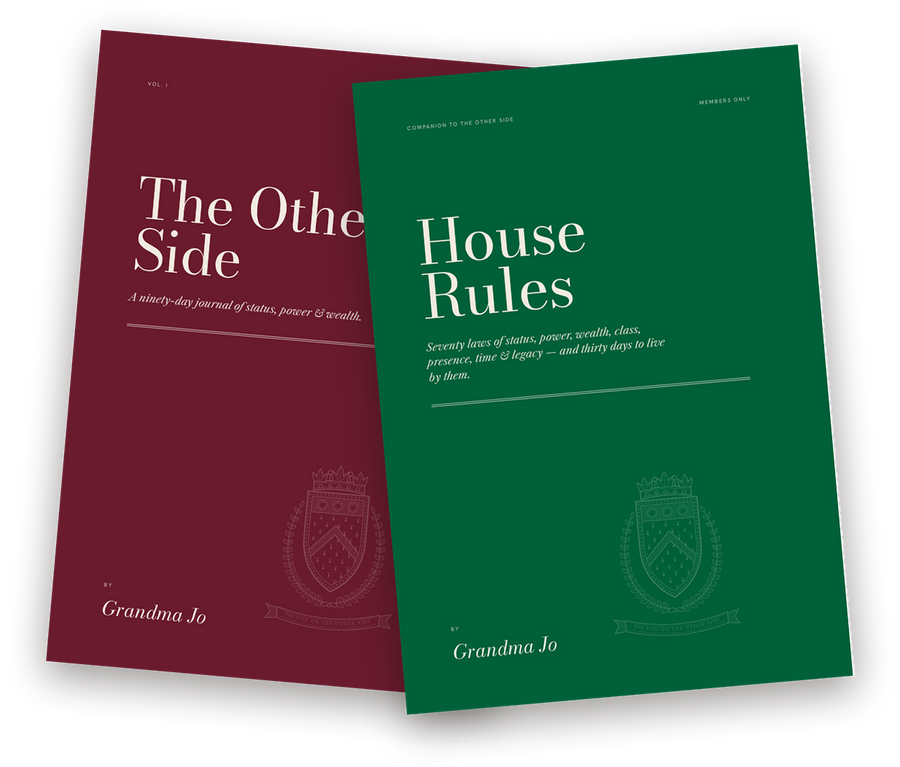
There is a practice for all this, and I built it into The Other Side on purpose. Each morning has a line called The move: one move you'll make today toward what you're building, written in ink, for your eyes only. Nobody reads it. Nobody applauds. You simply make the move. At bedtime you write the Evidence: what actually happened. And at the back is the ledger, where the doors that opened go in with their dates, like arrivals in a hotel register. By the time you're ready to announce anything, you'll have the whole story in your own handwriting, and you'll find you need the audience far less than you thought.
Rule 02 is on one of the lock screens too, so it's waiting the next time your thumb hovers over "post". The Full House has both, and nobody need know you bought it.
People still ask me, at parties, what I'm planning next. I tell them lunch. I've never once missed that deadline.