Buy a box of plain cream notecards this week, the heavy kind that doesn't bend when you post it, and keep three of them in your bag. You'll want one the next time somebody underestimates you. I'll explain.
Being underestimated is the most useful thing that can happen to you in a room you've already been invited into. People speak freely in front of someone they've decided doesn't matter. They show you their worries, their deadlines and the one thing they can't afford to lose, and all you have to do is listen and choose the moment you let them know you heard. It's why my house rule on the subject ends with stationery.
House rule 03: "Being underestimated is a gift. I send thank-you notes."
The first time I sent one, I was in my late thirties, my small firm was three years old, and I needed a particular contract rather badly.
The meeting on the ninth floor
It was a Tuesday in October. The building had a revolving door that stuck halfway round, so everyone arrived looking faintly ruffled, and the boardroom on the ninth floor had a long walnut table, a plate of shortbread nobody touched and a clock on the wall that ran four minutes fast. I know it ran fast because I'd arrived early and set my watch by it, and then spent the first half of the meeting convinced I was late.
I had brought Daniel. He was twenty-four, clever with figures, and had worked for me for three weeks. He had a good grey suit his mother had helped him choose and he was taller than me by a head.
There were three of them across the table: a chairman with silver hair and a signet ring, a finance director who kept clicking his pen, and a younger man who said nothing at all and wrote everything down. The chairman came round the table, shook Daniel's hand warmly, and said, "Good of you to come." Then he turned to me, smiled, and said, "And would you mind taking a few notes for us, my dear?"
There's a version of me, the one who had spent her twenties being told she understood nothing, who would have gone red and said, "Actually, it's my company." I'd done exactly that at a meeting the year before. It hadn't gone well. The man I'd corrected spent the rest of the hour proving to his colleagues that he hadn't been embarrassed, and we didn't get the work.
So this time I said, "Of course," took out my navy notebook, and wrote down the date.
What they said in front of the notetaker
For forty minutes they talked to Daniel, and Daniel, who had the sense to realise something was happening, said very little and kept glancing at me. I kept writing.
Here is what I wrote. That their previous supplier had let them down in the spring and the chairman was still angry about it. That the finance director said, quietly, to the young man, "The board wants this signed before year-end, whatever it takes." That the young man replied, "Then we can't go back out to tender," and the finance director nodded. That the chairman used the word "reliable" four times and the word "price" once. And that the shortbread was, on closer inspection, from a tin.
Not one of those things would have been said in front of the owner of the firm across the table. They were said in front of the woman taking notes.
At about twenty past eleven by the fast clock, the chairman leaned back and said to Daniel, "Well. What's your number?" Daniel looked at me. So did everyone else, for the first time.
I put down my pen and said, "I think I can help there. I'm Josephine. It's my firm." And before anybody could apologise, which is a terrible thing to make a man do in front of his colleagues, I asked the only question I had come to ask. "Before we get to a figure, could you tell me what it would cost you if this weren't finished before your year-end?"
There was a pause of perhaps three seconds. Then the chairman laughed, properly, and said, "You've been listening." I said I had. We spent the next half hour talking about reliability, and dates, and what happens when things go wrong, and very little about price. We agreed terms I was proud of. I didn't ask for anything unreasonable, and I didn't mention what I'd overheard. There was no need. They knew.
Why I sent the chairman a thank-you note
I wrote it that evening at my kitchen table, on a cream card, with a fountain pen that leaked if you pressed too hard. It said:
Thank you for Tuesday. I learned more in your boardroom in forty minutes than I have in a month of meetings, and I'm looking forward to working together. With best wishes, Josephine.
He rang the following week about something else and said, before he hung up, "I've been trying to work out whether your note was a thank-you or a warning." I said, "A little of both," and he laughed again, and we worked together for eleven years. He never once asked me to take the notes after that. Near the end, he told me he'd kept the card in his desk drawer, and that he'd started watching the quiet ones at the table more carefully. I thought that was the best thing anyone had ever said about that meeting.
I'd been underestimated for years before that Tuesday, in a flat where I had no money of my own and no say over anything, and I'd believed every word of it. Nobody at that walnut table thought more of me than the people in my twenties had. I had simply stopped needing them to. How I got from that flat to that boardroom is told, briefly, on my own page, and it involved a great deal of note-taking.
Why being underestimated is an advantage, and when it isn't
The underestimated advantage is simple to describe and quite hard to use. People relax in front of you. They show their hand. They explain things to you they would never explain to a rival, because they assume you won't understand them or won't matter if you do. You get the one thing a negotiator would pay handsomely for, which is information nobody meant to give you.
My grandmother knew this better than anyone I've met. She did her fittings kneeling on a folded towel with a mouthful of pins, and the women she dressed talked over her head as if she were the hat stand. That is how the diary got written. One page reads:
They talk in front of the dressmaker the way they talk in front of the looking glass. I hear what they want and what they are frightened of, and most days it is the same thing.
She never repeated a word of what she heard, as far as I know. She used it to become the dressmaker they asked for by name, and to fill a diary with what the composed ones did that the anxious ones didn't. Being overlooked was her apprenticeship.
But the advantage has a shelf life. It lasts exactly until you reveal what you know, so the whole skill is in choosing the moment. Reveal it too early (my mistake the year before) and you've spent it on your pride. Wait too long and it sours into resentment, and resentment always shows on the face.
And I'll be honest about the limits, because I've seen people take this rule too far. Being underestimated in a room you're already sitting in is a gift. Being kept out of the room altogether is not a gift. It's a problem, and it wants dealing with plainly: one clear conversation, with the person who decides, about what you want and why you're ready for it. Sending thank-you notes to someone who keeps overlooking you for promotion is not quiet power. It's stationery.
Two habits make all of this easier, and both can be learned. One is comfort with a pause; half of what happened at that walnut table was silence doing the work. The other is resisting the itch to justify yourself, which is why the scripts for chronic over-explainers belong beside this piece. Someone underestimated who can also sit still in a silence is very difficult to beat at anything.
How to practise quiet competence this week
You don't have to wait for a boardroom. You'll be underestimated somewhere in the next seven days: at a garage, a school gate, a family lunch, a meeting where someone explains your own job to you.
Last spring a young man at the garage explained to me, very slowly and with diagrams in the air, what a tyre was for. He was being kind in his way. I let him finish, thanked him, and then asked whether the rear left was wearing on the inside edge because of the tracking, which I'd felt on the motorway. He looked at me quite differently after that, and he was right about the tracking, and he charged me exactly what he should have. That's the whole technique in a forecourt. Here it is written out.
- Don't correct it in the first minute. The urge to hand over your credentials is strong. Let it pass. You lose nothing by waiting, and you'll often hear something you'd never have heard otherwise.
- Write things down. In a meeting, a notebook. Everywhere else, your memory, then a notebook as soon as you're alone. Note the exact words. The exact words are where people give themselves away.
- Make your first contribution a question, and not a statement of who you are. Ask something that shows you heard everything. "What would it cost you if..." is my favourite, and it has never let me down.
- Never humiliate the person who misjudged you. You want a colleague afterwards, not an enemy who remembers blushing.
- Send the note: short, warm, handwritten, the next day. You're thanking them for the lesson. Whether they read it as a warning is up to them.
Humble confidence is mostly that list done calmly. People mistake it for modesty; I'd call it preparation with good manners. And a warning, since you've read this far: the better you get, the less often it happens, and you'll find you rather miss it.
What the practice costs, next to what it keeps paying
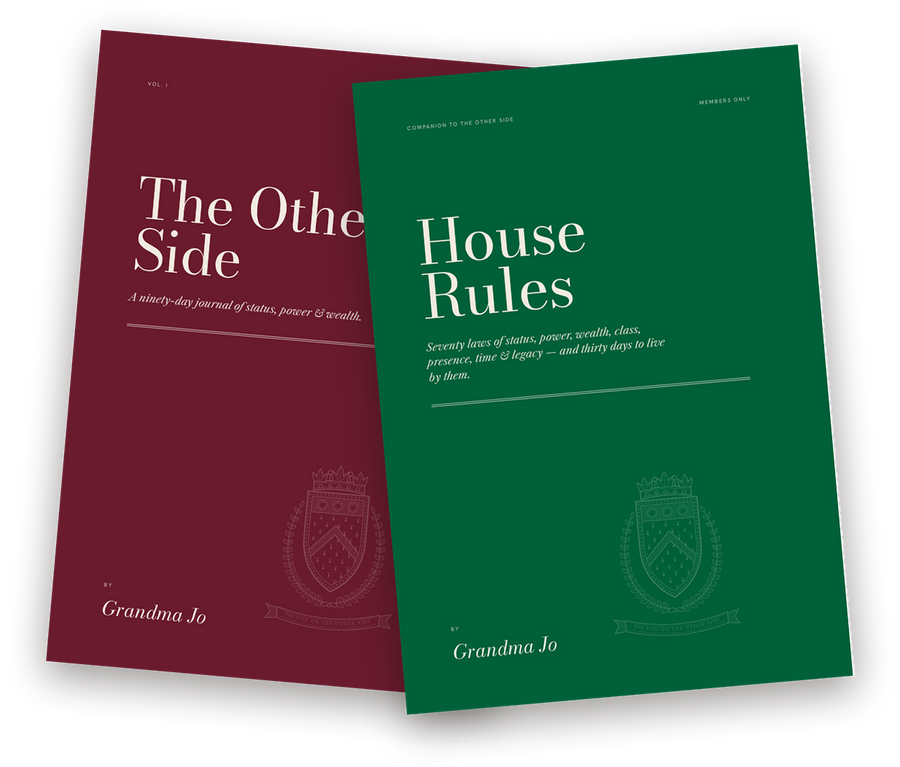
Rule 03 is a good one to start House Rules with, because its receipts come quickly. The book's practice takes five minutes at lunch and finishes with a receipt, a line for what actually happened, and with this rule what happens is usually that you bite back a correction and then hear the most useful sentence of the week.
Those receipts need somewhere to live, and in The Other Side they go on the Evidence line at night. I can think of few entries more satisfying than "Asked to take the notes. Took them. Heard about the year-end."
Both come in The Full House, which costs less than one good dinner out. Think about what a dinner leaves you with a week later: a pleasant blur and, if you're lucky, the name of the pudding. A rule you actually keep is still paying out when the restaurant has changed hands twice.
Now go and buy the cards. Cream, heavy, plain. The next time someone asks you to take the notes, you'll know exactly what one of them is for.