She held her glass in both hands, just below her chin, the way you'd hold a cup of tea on a cold platform. It was a gallery opening on a Thursday in November, a long white room full of paintings nobody was looking at, and she laughed about half a second before everyone else did, as though she'd rather be early to a joke than risk missing it.
I'm writing this to her, and to you, if you recognised her before I'd finished the paragraph. I was her, for years, and what I know about how to stop seeking approval I learnt the slow way, by doing the opposite first.
So here is what I wish someone had told me, and it's simpler than you'd think and harder than it sounds: stop pointing your attention at yourself. Decide what you're glad about before you walk in, give your attention outward once you're there, and let one silence go unfilled. That's most of it. House rule 45 says it better:
"Walk in hungry for approval and everyone can smell it. Walk in glad to be there and they can't look away."
You laugh half a second early
At the gallery, each time the man at the centre of her group spoke, her eyes went to his face and then round the circle, checking the weather on each one. You know the signs better than I do, but let me name the rest so you know I see you.
You agree before the other person has finished their sentence. You thank people three times for things they didn't do. You apologise when someone bumps into you. You end perfectly clear statements with "Does that make sense?" You write an email, reread it, add a softening line, reread it, add a smiley face, delete the smiley face and put it back. After a dinner, you lie in bed replaying one remark you made at nine o'clock and wondering whether the woman opposite thought it was odd.
She didn't. She was replaying her own.
That need for validation isn't vanity, whatever you've been told. It's vigilance. Somewhere along the way you learnt that reading the room kept you safe, and you got very, very good at it. The trouble is that you never stopped. You're still reading the room when nobody in it means you any harm, and the effort shows on your face in a way you can't see and everybody else can.
Where I learnt it, and what it cost me
In my twenties the face I read was a man's. He kept the chequebook in his jacket and let me know, in small ways every day, that nothing in that flat was mine. I won't say more about him than that, except that I became an expert in his moods. I could tell from the way he put his keys down on the hall table, the exact sound of them, what the evening was going to be like. That skill kept things calm. It also meant that for four years I didn't have a single opinion I hadn't checked against his face first.
When I finally went, the habit came too, folded in somewhere between my two good blouses. (If someone in your life is like that now, a local support service or a counsellor can help you think it through. You don't have to do it alone.)
Years later, at my first proper board dinner, I sat between two men who disagreed about a new building in town. Within one hour I had agreed with the first man that it was a triumph, with the second that it was a disgrace, and with the woman opposite that it was far too early to say. Driving home, I realised I had no idea what I thought of the building. I'd been too busy approving of everyone else's approval.
That's the real cost. People see through it, of course, but worse than that, you disappear. You spend the whole evening being agreeable and go home with nothing of your own.
How to stop seeking approval before you even walk in
The work starts on the doorstep, not in the room. By the time you're inside, you're reacting. Outside, you still get to choose.
Before you ring the bell or push the door, name one thing you're glad about. Not a thing you hope will happen. A thing that's already true. "I'm glad I got out of the house." "I'm glad I'll see Maria." "I'm glad there'll be food I didn't cook." It sounds too small to matter. It isn't. You are changing what you walk in carrying, from a question (will they like me?) to a statement (I'm glad to be here). People feel the difference within seconds, even if they couldn't tell you what they felt.
Then pause in the doorway. Two seconds. Let the room see you before you start looking for somewhere to put yourself. Doorways have their own small choreography, and I'll only say here that nobody who is glad to be somewhere rushes through one.
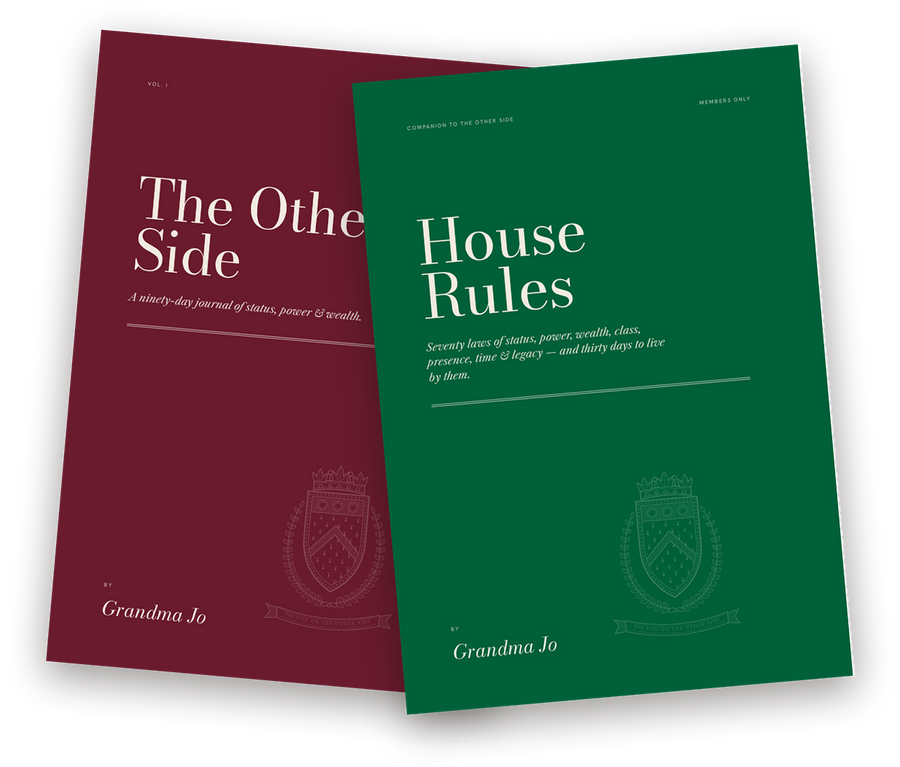
There's a line in the mornings of The Other Side that begins "I am". People who seek approval tend to write something grand there and feel like frauds by lunchtime. For you, I'd suggest something much plainer and entirely checkable: "I am glad to be where I am tonight." At bedtime there's Carriage, where you mark how you held yourself. Keep it a few weeks and you'll notice your best marks land on the evenings you cared least what anyone thought.
Once you're inside, turn the attention round
Approval-seeking is attention pointed at yourself. Turn it round and the room turns with it.
Choose one person and give them the whole of you. People forget almost everything said to them at a party; they remember for years the person who was actually listening. Ask them a real question, something you actually want to know, and then listen to the answer rather than rehearsing your next line. Listening properly is a skill with parts, not a personality trait, and you can learn it. You'll find it hard at first. Your mind will keep sliding back to your own face, your own hands, whether you said "fascinating" too often. Bring it back to them. Every time.
Something odd happens when you do this. You become interesting, precisely because you've stopped trying to be. The person talking to you feels heard, which is rarer at parties than good wine, and they'll leave with a feeling about you they can't quite explain.
And let one silence go unfilled. When the conversation pauses, don't rush in with a joke or a compliment. Let it sit for a breath. Somebody else will fill it, and nothing bad will have happened. Your part is to find out, one pause at a time, that silence is not a verdict on you.
What to say instead of yes
People pleasing lives in the mouth. So give your mouth some new sentences to practise. These are the ones I wish I'd had at that board dinner.
When you disagree: "I see it a little differently, actually." Then say how, once, and stop.
When you're not sure yet: "I hadn't thought of it that way. I'm not sure I agree, but I'll think about it."
When someone compliments you: "Thank you." That's the entire sentence. No "oh, this old thing", no "you're too kind", no returning the compliment with interest as if it were a debt.
When someone asks for something you don't want to give: "I won't be able to, but I hope it goes well." Not "I'm so sorry, I would, it's just that this week…" The more reasons you offer, the more you invite negotiation.
And a few to retire. "Does that make sense?" at the end of every point. "Sorry, can I just…" before every question. "I'm probably wrong, but…" before saying something you've thought about for a week. Each of these is a small request for permission to exist in the conversation. You have it already. You had it when you walked in.
The email you rewrite eleven times
Rooms aren't the only place this happens. For a great many people the hunger for approval does its worst work at a desk, at ten at night, over a message to someone more senior.
Find the last email you sent to someone whose opinion you care about. Read it again now and count the softeners. "Just." "Sorry to bother you." "I was wondering if maybe." "No worries at all if not." "Hope that's okay." I once counted nine in a four-line message of my own, written to a man who, I later discovered, read his post standing up in a lift and would have preferred one sentence.
Here's the kind of thing I mean. Before: "Hi, so sorry to bother you, I was just wondering if maybe you'd had a chance to look at the proposal? No worries at all if not, I know you're incredibly busy!" After: "Hello Tom, have you had a chance to look at the proposal? I'd like to confirm by Friday."
The second version is clear, and clarity is a courtesy to a busy person. Nobody reading it would call it rude. It also stops asking to be forgiven for existing, which is what all those softeners were quietly doing. Ask once. Then wait, and a drink helps. Send it, close the laptop, and don't follow up the same evening to check it didn't sound too abrupt. It didn't. And if it did, Tom will survive.
When they don't approve anyway
Some people won't like you. That's not a failure of technique. It's arithmetic. There are people who dislike anyone bright and well turned out on principle, and there are people who have decided not to understand you before you've opened your mouth. Don't spend a single explanation on that second group. They've already filed their verdict, and your paragraph won't reach the clerk.
The first few times you hold your ground and someone looks unimpressed, you'll feel it in your stomach. That feeling is unfamiliarity, nothing worse. Stay where you are, keep your voice where it was, and let them be unimpressed. You'll notice, perhaps the next morning, that you're completely fine, and that you remember what you actually said.
I still get it, at my age. At a lunch in March a man I'd only just met told me my views on handwritten letters were hopelessly old-fashioned, in the tone people use when they expect you to recant. The girl I used to be would have laughed early and agreed that yes, gosh, she was a dinosaur. I said, "They may well be. I still hold them," and passed him the bread. He sat talking to me through the cheese as well, and I think he was a little annoyed at how much he enjoyed it.
You didn't come to be graded. You came to be there.
The morning and evening lines I mentioned live in The Full House, with a lock screen for your phone, which is handy, since that's where you go to check whether anyone has approved of you yet. Start whenever you like.
You'll want to know what happened to the woman with the glass. I went over before I left, and she asked me what I'd thought of the paintings. I said I hadn't liked a single one and had come for the wine. She laughed, for the first time all night, exactly on time.