Mrs D. came for her fitting a quarter of an hour before her time and sat by the window with her gloves in her lap. I have made her six coats and not seen her hurry. Nor late, not once. I think the two are the same thing.
My grandmother wrote that on a page near the front of her diary, and it took me about fifteen years to understand it. The whole of how to stop rushing is in her last line. Hurry and lateness are one habit wearing two coats. You stop rushing by leaving earlier than you need to, arriving before you're due, and sitting down when you get there. The hurry is almost never in the clock. It's in the margin you didn't leave yourself.
House Rule 55 puts it the way she would have, had she been a little more cheeky:
"The good things always arrive seated and on time."
Rushing is a signal, and everyone in the room can read it
You know the person I mean, because at some point we have all been them. They come through the door with their coat half off, apologising before they're inside. They put three things down on the table (phone, keys, a takeaway coffee sweating through its sleeve) and then look for somewhere to put the fourth. They're still catching their breath when they start to speak, and the first thing they say is about the traffic.
Nothing terrible has happened. They're perhaps four minutes late. And yet everybody at that table has just learned something about them: their day is running them, and not the other way round.
That is what rushing tells people. It isn't a crime and it isn't rude, exactly. It's information. The hurried person has announced, without meaning to, that they took on more than they could carry, and that they're carrying it into this room as well. If lateness is theft wearing perfume, rushing is its louder younger sister, the one who arrives on time but sweating.
Hurry is how a crowded diary shows on a person's face. You can dress beautifully and still give yourself away with the way you come through a door.
What I believed about hurry, and what it cost me
I should confess that for years I thought rushing was proof that I mattered.
When the business was young I booked my days the way some people pack for a weekend: everything in, sit on the lid, force the zip. Meetings back to back across town. Lunch eaten standing at the counter of whatever was nearest. I was quietly proud of it. Busy people were important people, and I wanted very badly to be important, having spent my twenties being told I wasn't.
There was an afternoon, a Thursday in November, when I came into the third meeting of the day at twelve minutes past three. The clock over the door said so and I have never forgotten its face. I'd walked fast from the second meeting in the rain. My hair was damp at the ends and I had buttoned my good camel coat one hole out, so the whole front sat crooked, and I didn't notice until I saw my own reflection, lopsided, in the glazed door of his bookcase.
He was older, very still, with his hands folded on a single sheet of paper. He watched me take the coat off and fold it and fail to fold it, and he said: "Sit down, Josephine. Take a moment. We'll wait."
He meant it kindly, and it was kind. It was also the moment I lost that meeting. Not the business (I think we did some work together in the end) but the room. For the first five minutes he was looking after me, and a person you're looking after is not a person you're negotiating with.
That evening I went home and read the page about Mrs D. again. Then I looked at the following week, crossed out two things and moved a third. It felt reckless. It was the wisest thing I'd done with a pencil in years.
How to stop rushing without becoming slow
People hear "never rush" and imagine a woman drifting through her life at the pace of a wedding procession. I move quickly. I always have. The difference is that I'm fast at the things that should be fast (decisions, replies, getting up in the morning) and slow at the things that show.
Here is how I'd go about it, from the practical to the subtle.
Begin by putting a margin on both sides of everything. Most rushing is caused by the seam between two commitments: the meeting that runs over, the lift that doesn't come, the taxi that does something unexpected with the one-way system. You can't control any of that. You can control how much room you left. Treat the fifteen minutes before an appointment as part of the appointment. Write them in if you have to, and guard them from the extra call you'll be tempted to squeeze in; those minutes are what make you look unhurried when you arrive.
Then arrive, and sit. Getting there early is only half of it. The other half is what you do with the ten minutes. If you spend them answering emails in the lobby, you'll walk in with the same frantic face as if you'd been late. Sit down. Put the phone away. Look at the room. By the time the other person comes, your breathing has slowed and your mind has caught up with your body. That's all poise is, most days.
Carry less. Physically, I mean. The hurried person always seems to be juggling. One bag, and the things in it have places. You'd be amazed what a free hand does for a person's composure.
Slow three small things on purpose: speech, meals and entrances. Speak a beat slower than feels natural, and let the full stop land before you start the next sentence. Eat sitting down, with a knife and fork, even if it's a sandwich. Pause for one breath inside the door of any room before you go looking for anyone. None of this costs you more than a minute a day. All of it changes what people see.
And refuse the run. Rule 13 is one of my favourites: "I have never run after a bus, a lover or an opportunity. Another one always comes." I've kept that rule literally, for decades, and I can tell you the next bus has come every single time. Letting one go is the fastest cure for hurry I know, because it teaches your body that missing something is survivable.
Slow living is mostly a question of the calendar
I'm aware that there is a whole world online devoted to slow living, and I've looked at it with interest. It's very pretty. There is a great deal of oatmeal-coloured linen and bread being torn by hand, and I have nothing against either.
But you can bake sourdough in a frenzy. I've watched people do it. An unhurried life has very little to do with how your kitchen looks and a great deal to do with how many things you've promised to be at in a week. If your diary is full to the edges, no amount of candlelight will stop you rushing between the entries.
The women my grandmother dressed were not idle. Several of them ran households the size of small hotels, sat on committees, raised children and buried husbands. Their days were full. There was simply room in them. They said yes to fewer things than they could have, and then they gave each thing its full time. It looked like leisure from the outside. It was discipline, done so quietly you'd miss it.
Leaving room looks, to an anxious eye, like laziness, and that is what makes it hard. You will feel, the first few weeks, that you should be doing more. You'll see someone at work cramming their days and wonder if they're getting ahead of you. They may be. They're also walking into rooms with their coats buttoned wrong.
Why the good things arrive seated
Rule 55 isn't only about punctuality. It's about how good things find you.
A hurried person grabs. They grab the first offer, the first chair, the first explanation, because stopping to consider feels like falling behind. And the people with good things to give (the introductions, the work, the invitations) are very often looking, without quite knowing it, for the one person at the table who doesn't need them urgently. Watch the people everyone calls effortlessly elegant and you'll see they're offered things rather than chasing them. Calm reads as having options. Having options makes you worth offering to.
I once had lunch with a woman who owned rather more than she ever let on. We arrived at the restaurant together and she took, I timed it later in my head, the best part of four minutes to decide where to sit. She looked at the light. She asked the waiter which table was quietest at one o'clock. She moved her chair twice. Nobody minded, including the waiter; if anything he stood a little straighter. By the time she sat down, the whole room had rearranged itself around her, and she'd never once got louder than the cutlery.
I would have taken the first table offered and apologised for the fuss. That's the difference, in one lunch.
The first hour decides how the rest goes
If you only change one thing, change the morning. Rule 52: "The first hour sets the price of the whole day." Start by grabbing your phone in bed and reading your emails before your feet touch the floor, and you have handed the day to other people before you've had a cup of tea. You'll spend the next fourteen hours catching up with them.
My own morning isn't elaborate, and the longer account of it sits with how quietly successful people spend their first hour. For our purposes, only one part matters: the first hour should contain one thing that isn't urgent and is entirely yours. Coffee at the window. Ten minutes with a pen. A walk to buy the paper. Something that proves to your nervous system that the day can begin without an emergency. When I finally built that hour, I stopped rushing in the afternoons, and I still don't entirely understand why it works. It does.
When somebody does try to hurry you (and they will), you're allowed to decline. I say: "Give me a moment. I'd rather get this right than get it fast." Then I take the moment, without an apology. People who rush you are usually rushing themselves, and they tend to settle when they see that one person in the room has declined to join in.
Anyone still reading has already begun
I mean this quite literally. Hurried people skim. They read the headline and the first line and go back to whatever was chasing them. You've given a long piece about slowness the time it asked for, several minutes of it, without anybody making you. That is the habit itself, practised on me. Whoever reaches this paragraph is already halfway to being the woman who arrives early and sits by the window with her gloves in her lap, or the man who lets the bus go.
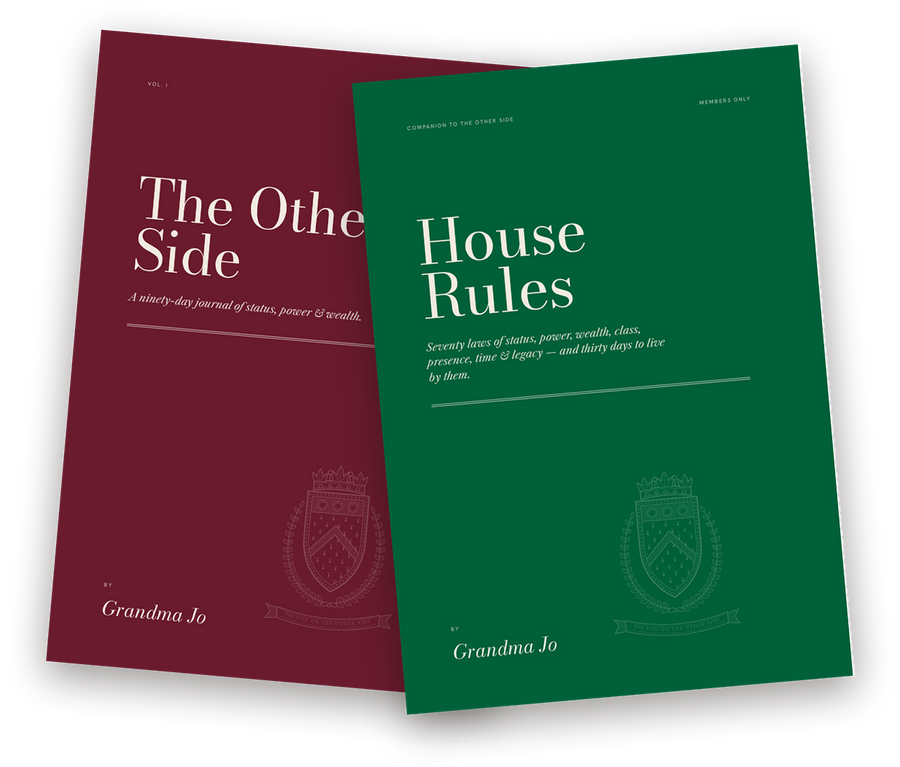
The other half is practice, and practice is easier with a page in front of you. In The Other Side, Time has a week of its own, and each morning there's a line headed I am, which you finish in the present tense, as if it were already so. For that week, mine read "I am the one who is already sitting down." Write something like it until it stops being an intention and starts being a description. If you'd like to become that person on purpose, the pages for it are in The Full House.
These days the only thing I rush is the bill at a bad restaurant.