Years ago, at a hotel bar, the woman on the next stool but one turned to me and asked, "What's keeping you busy these days that you actually enjoy?"
She was in her seventies, with the crossword, a small sherry and reading glasses pushed up into white hair, and she'd watched me check my watch once too often while a client ran forty minutes late. That one question held the whole of how to make small talk, though I was slow to see it. I answered her for twenty minutes. When my client finally arrived and I got up to go, I realised I knew nothing about her at all, not even her name, and I liked her enormously.
So here it is, the diplomat's way. Be curious, not interesting. Ask about what people have chosen or enjoyed rather than what they are, ask a second question about their answer before you offer anything of your own, and have one opener, one bridge and one exit ready before you walk in. Below are those three, word for word, and the lines I'd never let out of my mouth.
Notice what her question did. It skipped the job, which I might not have wanted to talk about, and asked for pleasure, which almost everyone does. The word "actually" gave me permission to leave out the dull parts. And it was open enough that I could take it anywhere. I took it to the garden I'd just started, eleven feet of clay and optimism. She asked about the soil.
How to make small talk without performing
For years I did it the wrong way. Before a party I'd prepare three anecdotes, like a comedian with a set list: the one about the hotel guest and the parrot, the one about my first car, the one about the wedding where the cake fell. I'd wait for a gap and deliver one. People laughed. I thought I was good at this.
Then one evening a man I'd met twice before listened to the parrot story all the way through, smiled kindly and said, "You told me that one at the Hendersons'." He wasn't being unkind. But I went home and understood that I'd been performing at people, and a performance leaves nobody any room. He'd heard my story twice and I didn't know a single thing about him.
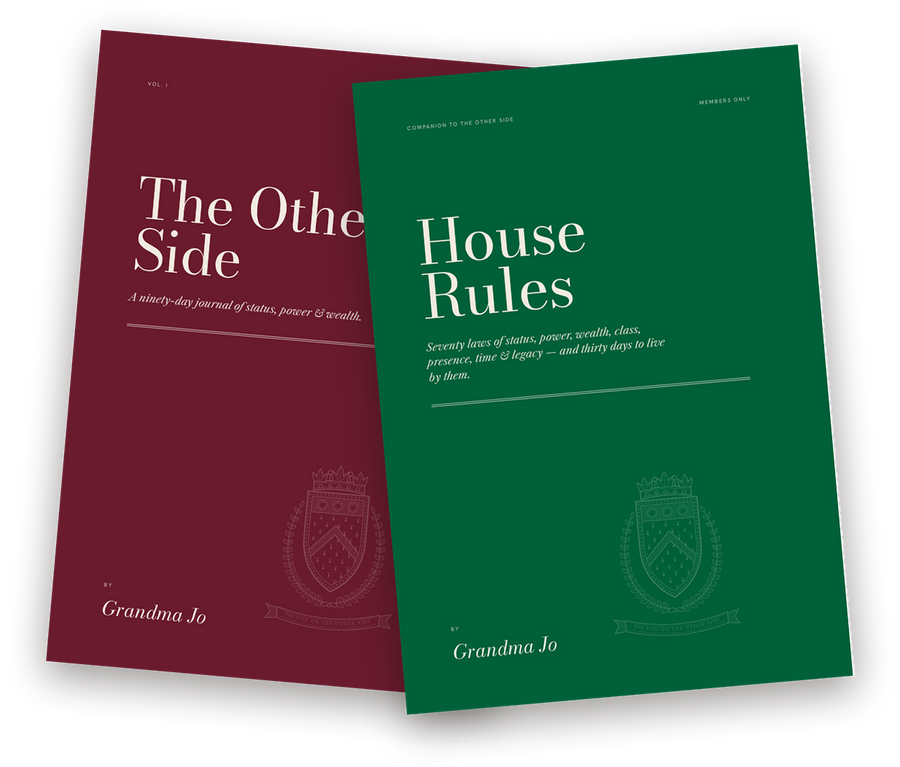
Interesting people are exhausting by nine o'clock. Curious people get invited back. Rule 44 in House Rules says it more gently: "Give someone your whole attention and they'll remember you for years." Small talk is the smallest version of that, and the easiest place to practise.
Openers for the rooms you'll actually be in
You need one good first line per situation. Not ten. One you trust, said in a warm, unhurried voice.
At a party where you know the host
Say: "How do you know Clare?" (using the host's name). It is the oldest line in the book because it works. Everyone has a story about how they met the host, and the story tells you where to go next: school, work, a neighbour's fence, a bad first marriage they now laugh about.
At a work event
Say: "What are you working on at the moment that you're enjoying?" or "What brought you out tonight?"
Don't say, as your first line, "So, what do you do?" It isn't forbidden, but it asks people to hand over a label, and a label is a dead end. The accountant says "accountant", and now you both have to climb over that word to get anywhere. Ask what they're enjoying and they'll tell you the job anyway, along with the part of it they like, which is where the conversation lives.
At a wedding
Say: "Which side are you, and what's the best story you know about them?" You'll get laughter, a bit of family history and usually one piece of gossip you shouldn't repeat. Don't repeat it.
Seated next to a stranger at dinner
Say: "I don't think we've met. I'm Jo; I've known Clare since we were both too young to be trusted with a dinner party." A small, self-deprecating detail gives them something to hold, and it tells them you aren't going to be grand. Then hand it straight over and let them tell you theirs.
In a queue, a lift or a doorway in the rain
Pair an observation with a light question. "That's the third time this lift has stopped at four for nobody. Do you think there's a ghost with a meeting?" Or, in the rain under an awning: "I've decided to wait until it stops or until I'm sixty-eight, whichever is first." Keep these short. Strangers in lifts like small talk that knows it's small.
Lines never to open with
- "You look tired." They know. Now they also know you noticed.
- "Are you two together?" Let them tell you.
- "Do you have children?" as a first question. For some people it's a lovely subject. For others it's the most painful sentence at the party.
- Anything about what their house, car, ring or holiday cost.
- "I'm terrible at these things." It asks the other person to comfort you before they've even had a drink.
Four bridges that keep small talk going
An opener gets you ten seconds. A bridge gets you ten minutes. The good news is that you only need four.
The first is the echo. Repeat the last few important words with a slight lift, and wait. "We've just come back from six months in Lisbon." "Six months in Lisbon." That's all. They'll hear it as an invitation, and they'll go on. It feels far too simple the first time you do it. It is the most reliable tool I own.
The second is the "what was that like". Facts go nowhere; experiences go everywhere. "I restore clocks." "What's it like, the moment one starts ticking again?" You're asking for a scene, and people love to describe scenes.
The third is the small share, handed straight back. After their second or third answer, offer one sentence of your own that matches theirs, then return the conversation. "My grandfather had a carriage clock that ran twenty minutes fast for forty years; nobody dared fix it. Tell me the oddest one you've had." One sentence, not a story. You're adding a log to their fire, not lighting your own.
The fourth is the third person. When a conversation has run its course, bring someone in with a hook. "Tom, come here, you'll like this. Clara restores clocks, and she's just told me about one that belonged to a sea captain." You've given Tom a way in, given Clara an audience, and freed yourself, all in one sentence. Diplomats do this all evening without anybody noticing.
Underneath all four is listening, because you can't bridge from something you didn't hear. For years my version of listening was nodding while I rehearsed my next line, and curing that took longer than anything else here; the cure has its own page in my notes on becoming a better listener.
Small talk tips for people who dread it
Some of you read the word "mingling" on an invitation and feel your stomach drop. I understand. I was that person for a long time, and I still have evenings where I'd rather be at home with a book and a boiled egg.
At a family wedding last summer, my grandson, who was then at the age where adults are mysterious and faintly embarrassing, sat beside me at the long table looking stricken. "I don't know what to say to any of them," he told me. "They all just ask what I want to do."
I gave him one line to use, and I'll give it to you. "Tell them one thing you've liked lately, and then ask them the same." So when a great-uncle leaned across and asked the inevitable question about his future, my grandson said, "I don't know yet. I've been really into old maps lately. What were you into at my age?" The great-uncle, who had not been asked a question about himself at a family wedding in perhaps thirty years, talked about the railway for the whole of the main course, and my grandson learned something about his family he'd never have found out otherwise.
That's the trick for anyone who dreads small talk. You don't have to be witty or brave. You need one true thing about yourself, small and cheerful, and one question to hand back. Quiet people are often the best at this, once they realise nobody is grading the answers.
When the conversation dies in your hands
It will. Two people, two drinks, and a silence arrives like an uninvited cousin. Don't panic and don't reach for the weather. Reach for something forward-looking:
"What are you looking forward to this month?"
"Tell me something you've read or watched lately that you'd recommend."
"What's the best thing you've eaten this week?" (A surprisingly good one. Everybody has an answer and nobody's answer is dull.)
And if none of those catches, there's no shame in an honest exit. Some conversations are only meant to be three minutes long. That's not failure. That's small talk working as designed.
Small talk at parties: what stays off the table
My grandmother's rule, which is rule 33, still holds: "Money, health and other people's marriages. Everything else is fair game." I'd add anything that asks someone to justify how they live: why they aren't married, why they moved, why they didn't go to university, why they don't drink. You don't know the answer, and the answer may be a long and painful one they didn't come to a party to tell.
Politics with strangers I leave to people braver or less observant than I am. My grandmother's three forbidden subjects get a full evening's argument of their own; for small talk, a simpler test will get you through most parties. Stay with what people have chosen, enjoyed or are looking forward to. Avoid what happened to them.
Exits, with the exact words
Most people are bad at small talk because they're bad at leaving it. They stay too long in one conversation, because they don't know how to get out, and both people end up hostage to politeness.
An exit needs a warm reason and a detail that proves you listened. Try:
"I must go and say hello to our host before she thinks I've been kidnapped, but I'm so glad I heard about the clocks."
"I've kept you long enough, and I'm going to steal that restaurant recommendation."
Or, best of all, introduce them to someone and step away once it takes: "Clara, this is Helen. Helen's grandfather was a watchmaker."
What you don't say is "I'm just going to get a drink" unless you mean to come back with one. People wait. I've seen them wait. And don't say "Anyway..." and trail off, which sounds like you've just remembered something more important, and nobody wants to be less important than a remembered something.
Slipping out of one conversation is a rehearsal for leaving the whole party while they still want you. And the handover to Helen only works if you can say Helen's name, so a small, dull system for remembering names earns its keep here. An introduction without a name is an exit with a limp.
One rule, seven nights
You don't need to learn all of this at once. You need one habit, practised until it's automatic. So here's a challenge.
From tonight until this time next week, or across your next seven conversations if your social calendar is saner than that, keep a single rule: ask a second question about their answer before you offer one fact about yourself. Not three questions, not an interrogation. Just a second one. The woman at the bar asked about my soil, and that second question is the reason I remember her. Keep a note of each night in two words if you like ("clocks, Lisbon"; "great-uncle, railway") and on the seventh, look at what you learned and how people looked at you when you left.
Seven nights of one rule is a fair trial. If you come out of it with a handful of conversations you enjoyed more than usual, there are sixty-nine more rules where that one came from, collected in The Full House. Night eight can start with any of them.
I never saw the woman with the crossword again. I've borrowed her question so often since that I think of it as a coat she lent me. And in the taxi home after any party, I ask myself one small question, and I ask it of nobody else: did anyone go home tonight knowing more about me than I'd learned about them?