Yes, you should buy back your time, but only the hours you've already decided what to do with. An hour you pay for and don't name is money spent twice: once on the help, and once on the evening that drifts away anyway.
That's my answer, and I'll stand by it. But it's not quite the answer you'll find elsewhere, so let me explain what I disagree with and why.
The House Rule on the subject reads, "Spend money to buy back time. Never spend time to save pennies." I believe every word of it. I've also watched people take the first half of that sentence and run somewhere I'd never send them, so the rest of this is about where they go wrong, where I went wrong in the other direction, and what I do now.
The popular advice, and why it sounds so clever
You've heard it. Work out what an hour of your time is worth. Then pay someone else to do anything that costs less than that. The ironing, the errands, the queueing, the waiting in for the boiler man. Buy the hours back, spend them on whatever earns the most, and repeat until you're rich and rested.
It has the appeal of all tidy arithmetic. It's easy to explain at dinner, it makes the person explaining it sound rather decisive, and it contains a real truth: most people undervalue their time badly and overvalue small sums of money. That part is right, and I'll come back to it.
But I've been watching people apply this rule for a long time now, and I've come to think that as usually told, it gets three things wrong.
Where the hourly-rate arithmetic goes wrong
First, it assumes the hour becomes something. The whole calculation depends on the bought-back hour being spent on something better. In my experience it very often isn't. A woman I know paid for help with her house on Saturdays so she could "have her weekends back". She told me, laughing, some months later, that she now spent Saturday mornings on the sofa with her phone, feeling vaguely guilty, while someone else cleaned round her feet. She'd bought the hours and had nowhere to put them.
There's no moral failing in it. Any hour that arrives without a name goes the same way. Unassigned time fills with whatever is nearest and loudest, and nothing is nearer or louder than the thing in your pocket.
Second, it treats every task as a cost. Some tasks are not costs. They're the life. Writing to a friend whose mother has died is not a task you delegate because your hourly rate is high. Neither is cooking for people you love, if cooking is how you love them. Run the arithmetic on those and you'll conclude that you ought to pay someone else to live your life while you go and earn the money to pay them.
Third, and this is the one that worries me most, it spreads. Once you've learned to put a price on your hour, the price starts to follow you around. You find yourself calculating whether a friend's birthday lunch is "worth it", or whether an afternoon with your grandmother is a good use of the rate. I've met people at the top of their professions who could no longer spend a slow afternoon with anybody, because every slow afternoon had become a line on an invoice they would never send.
Value your time, by all means. But the moment you start valuing people by the hour, you've made a very poor trade.
My mistake at the returns counter
Now let me be fair to the arithmetic, because I spent years getting it wrong in the other direction, and so, I suspect, have you.
When my firm was new and every coin felt like an argument, I bought a kettle that stopped working after a week. It was an unconsidered kettle, and I should have known better. Rather than accept my losses, I decided on principle to take it back. That meant a bus across town on a Saturday afternoon, a queue at a returns counter that curled past the lamps and into the bedding, a young man in a paper name badge who needed to call his supervisor, and a supervisor who needed to find a form.
I got my money back. It was less than a taxi fare. It had taken three hours and forty minutes, door to door.
And while I was standing in that queue with the kettle in its box under my arm, a very dear friend of mine was having her leaving drinks in a pub near my flat. She was moving to the far side of the world the following week. I'd said I'd be there by six. I arrived at twenty past eight, still slightly pleased with myself about the refund, and she'd already gone home to finish packing.
I didn't see her again for nine years.
I've never forgotten that kettle. I think of it every time I'm tempted to spend an afternoon to save a small sum, and it's why I say, with feeling, that the second half of the House Rule matters just as much as the first. Pennies are real. So are Saturdays. One of them comes back.
What you should never pay someone else to do
Before I give you the better version, here's the short list of things I keep for myself however busy I am. The principle is simple: if it has your name on it, you do it.
- Thank-you notes, by hand. They cost almost nothing, and they are worth nothing at all in anyone else's handwriting.
- Looking at my own money once a week. I don't mean managing it; I mean looking. Money nobody looks at has a way of wandering off, and I'd rather mine didn't wander while someone else was minding it.
- Any telephone call to someone who is ill, grieving or frightened.
- Anything my grandchildren will remember me doing. Toast cut into soldiers is not an efficient use of anybody's hourly rate. I've never once regretted the time.
Everything else is fair game. The ironing, the gutters, the paperwork that makes you weep, the forty minutes on hold to the bank. If you can pay someone fairly to take those away, and you know what you'll do with the hours instead, pay them promptly and thank them properly. The woman who does my ironing gets paid on the Friday, in an envelope with her name on it, and has never once had to ask.
When to buy back your time: the named hour
So here is the better version, and it's only one sentence longer than the original.
Before you pay for any hour, name it.
Not in your head, vaguely. On paper. "The Saturday morning I'd have spent at the launderette is now: two hours at the swimming pool, then lunch with my sister." "The evening I'd have spent on the invoices is now: the chapter I keep not writing." If you can't name the hour, don't buy it yet. Do the task yourself, do it well, and do it without resentment, because resenting a task you've chosen is the worst of both worlds.
When you can name it, buy it without guilt. Spending money to buy back time, done this way, is about the most honest thing money can do for you.
The first hour I ever bought on purpose was a Thursday evening. I paid a student from the flat downstairs to sort a month of receipts into folders, and I had written in my diary, in ink, what the evening was for: the first draft of a proposal I'd been avoiding for three weeks. I sat at the kitchen table with the door shut while she worked in the next room, humming something from the radio. The draft was finished by ten. I won't pretend every named hour turns into money; most shouldn't. But I've never forgotten that humming through the door. It was the sound of an hour going exactly where I'd sent it.
A few things that count as a perfectly good name, in case you're unsure:
- Rest, planned in advance and taken on purpose. Rest that waits to be earned never quite arrives, and I've a rule about that too. Rest is allowed to be the reason.
- A particular person, by name, and what you'll do together.
- Work you'd do for nothing, which in my experience is usually the work that ends up paying.
- Thinking. A walk with no phone and a question in your head. Some of the best decisions of my life were made on walks I'd have told you I didn't have time for.
If you like, try it tonight. Take a sheet of paper, write down one task you've been meaning to hand over, and underneath it write exactly what the freed hour will become. If the second line is blank after five minutes, you have your answer, and it's a useful one. If it isn't blank, you've already done the hard part.
The named hour is the bridge between a calendar you fill yourself, before anyone else can and a day that doesn't feel like a sprint. It's how bought time gets onto the calendar instead of slipping off it.
The words to use when help is offered
One more thing, because it's where the penny-saving habit hides best. Many of us refuse help that's freely offered, out of pride or a vague sense that we ought to manage. A neighbour offers to collect the children. A colleague offers to take the minutes. We say, "Oh no, don't worry, I'll manage," and then we manage, badly, at eleven at night.
Try this instead: "Yes, please. That's very kind, and I'll return the favour." Then return it, soon and specifically. And retire "Oh, you really shouldn't have," which tells a person who has just given you an afternoon that they made a mistake.
And when you're tempted by a small saving that would eat an afternoon, try this, said to yourself or to anyone who asks: "It isn't worth my Saturday." You'll be surprised how often that settles it. Underneath all of this sits the question my grandmother finally asked about her borrowed sewing machine, "How could I?", and it works on hours as well as it works on money.
A diary for your hours
My grandmother sewed from first light until the light went, and time was the only thing she ever had less of than money. Her diary lives in the drawer of my writing desk now, the end of its ribbon worn down to a few threads, and it is full of what she noticed about the women she sewed for. One of those things, and wrote down in a sentence I still know by heart, was that those women "never did their own errands, and never missed their own children's birthdays." They bought back their time, and they knew exactly whose it was.
She couldn't afford to live that way. She could afford to write it down, and I could afford, eventually, to live by it.
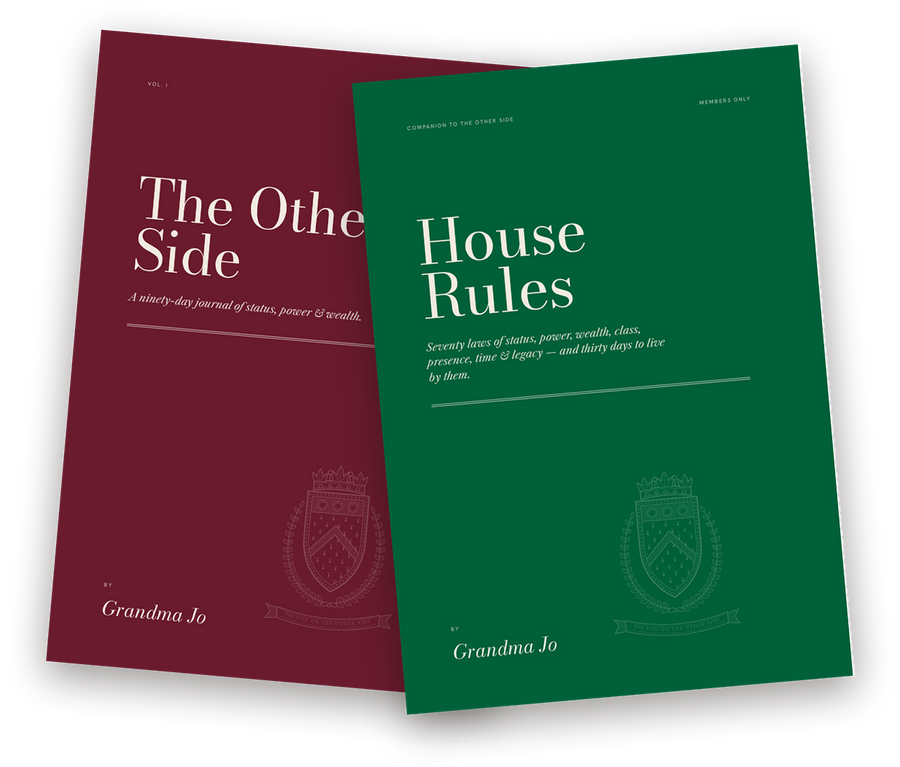
I've tried to leave something of the same kind. The Other Side opens every morning with three targets and one move, written down before the day gets its hands on you, which is the named hour in ten minutes flat. She left me her diary. I've written you one, and it's waiting in The Full House.
Pay for the hour only when you can say whose it is. Never trade a whole afternoon for a sum you'll have forgotten by Sunday.