It's twenty to seven. The kettle has just clicked off in the kitchen, the radiator is making the noise it makes every October, and my grandmother's diary is open on my desk at the page with the tacking thread in it: a length of pale blue cotton she must have used as a bookmark, still there after all these years. I haven't moved it. I'm not sure I ever will.
I'm often asked how to be more patient, as though patience were a mood you could summon, like calm before an interview. It isn't a mood. It's a handful of small refusals, repeated: you refuse to check before the time you set, you refuse to restart when progress is slow, you refuse to pay tomorrow's price for today's relief. My grandmother knew this long before I did, because she worked with silk, and silk does not care how badly you want to be finished.
So this morning I thought I'd read you some of what she wrote, and tell you what I've made of it since.
"Patience compounds. So does panic. Choose which one you'd like more of." (House rule 59)
The Saturday after
Page 17. A wet autumn. Mrs. D. wants her gown for Saturday and it cannot be done for Saturday. Silk will not be hurried. If I rush the hem it will show at the first dance and she will blame the silk, and then me. I told her the Saturday after. She was cross for a day. She will be grateful for twenty years.
The woman who wrote that sewed for a living, for clients who could have bought her whole workroom with the change in their evening bags, and she was in no position to be difficult with any of them. Yet she said no to a rushed hem. She understood that the small relief of saying yes would cost her far more later, when the hem puckered under the chandeliers and everybody in the room saw it.
That's the first thing impatience does. It borrows from the future at a terrible rate. You rush the report and spend the following week correcting it. You buy the thing today and find the better one on Thursday. You say the sharp sentence now and spend a month repairing the friendship.
The practice here is what I call the true date. When someone presses you for something that can't be done well in time, don't promise the impossible and then scramble. Give them the real answer, pleasantly and once: "I can't do it properly by Friday. I can do it properly by the Wednesday after. Which would you prefer?" Most people choose properly. The ones who don't would have blamed you anyway.
You cannot watch a thing into growing
Page 44. The bread would not rise in the cold kitchen. I put it by the range and went to bed. You cannot watch dough into rising. I have tried, and it only makes the dough nervous and me tired.
I laughed out loud the first time I read that, on a bus, and the woman next to me moved her shopping bag.
And then I went home and did the opposite. I was renting a single room at the time, with one window that looked onto a brick wall, and I'd planted tulip bulbs in a window box on its sill to give the wall something to look at. Red ones, I'd been told. After two weeks nothing had happened, so I dug one up to see whether it had rooted. It had, a little. I put it back. A week later I dug up another. By the spring I had exactly one tulip, leaning at an angle, and four little brown lumps that had given up on me.
I was twenty-five and I thought checking was a kind of care. Checking is anxiety wearing an apron. Every time you pull something up to look at it, whether it's a bulb, a plan, a new friendship or your own progress on the bathroom scales, you disturb the roots and learn almost nothing.
Now I give things a date. When I send an important letter, I write in my diary when I'll next think about it, usually a week or a fortnight later, and I don't think about it before then. When I start a new habit, I decide at the start that I'll judge it after ninety days, not after nine. You'll be amazed how much quieter your head gets when every worry has an appointment.
How to be more patient with yourself while you're still bad at it
Page 61. The winter the river froze. The new girl wants to cut before she can pin. I let her cut a remnant. She wept over it. This week she pinned without being told, and pinned well.
This one is about the hardest patience of all, which is patience with your own slowness.
Nobody likes being a beginner. The first weeks of anything (a language, a business, a new way of carrying yourself into rooms) are a sort of public embarrassment, even when there's no one watching but you. So people skip ahead. They try to cut before they can pin. And when the result is a ragged remnant, they decide they have no talent and give up.
My grandmother's cure was clever. She let the girl fail cheaply, on a scrap, so that she'd understand in her own hands why pinning mattered. Then she stopped talking and let the lesson settle.
Do that for yourself. When you're learning something, give yourself a remnant: a low-stakes version where failing costs nothing. Practise the difficult conversation on a friend. Draft the business plan for an imaginary company first. Wear the new jacket to the supermarket before the interview. And when you get it wrong, which you will, weep over it if you like, and then pin the next one.
Long term thinking is mostly this: accepting that the dull, clumsy middle is where the skill is actually made, and staying in it longer than feels comfortable. I don't think anyone who has done something worthwhile skipped that part. They simply stopped expecting to.
Panic compounds too
Page 88. Mr. R. has not paid for the coats. I have written once. I shall not write again until the month is out. A second letter in a week tells a man you are frightened, and frightened people are paid last.
I've always loved the steel in that one. She needed the money, I'm sure of it. She had a family and a shop and very little room for error. But she could see that panic has its own interest rate. One anxious letter leads to a second. The second makes the man uneasy, so he delays. The delay makes you frantic, so you write a third, and by then you've taught him that your deadlines are negotiable and your nerves are his to play with.
The same arithmetic applies to almost everything. Panic buying, panic texting, panic resigning, the email sent at midnight that begins "Just following up again". Each one makes the next one more likely. Calm works the same way, in the other direction: every time you hold your nerve, it becomes a little easier to hold it next time. That's what the house rule means by compounding. You are, whether you like it or not, making deposits into one account or the other, all day long.
Money is where most people feel this first, which is why the cat that only comes to the calm ones needed a whole essay to herself; the racing pulse and the dry mouth belong to keeping your head while the room loses its own. The practice from page 88 is simple. Before you send the second message, the second request or the second anything, ask whether the first has had a fair amount of time. If it hasn't, put your hands in your lap and wait. If it has, send the second one exactly as calmly as the first.
Patience and success, and the dull middle
There's a lot of talk about overnight success. I've met a few people who were supposed to have had it. Every one of them, when you got them alone with a drink, told the same story: ten or fifteen years of unglamorous work that nobody photographed, and then one Tuesday somebody noticed.
That's the real relationship between patience and success. Patience doesn't make you talented, and it doesn't guarantee anything. What it does is keep you in the game long enough for your talent and your effort to add up. Impatient people are often perfectly capable. They simply leave too early, pull the bulb up, restart on Monday, and never get to find out what would have happened in month seven. The daily version of this, the gulped coffee and the jumped queue, is what refusing to rush is about. The diary is about the yearly one.
"But will I actually stick with it?"
This is the question people ask me about the journal, and I'd rather answer it straight than pretend it doesn't come up.
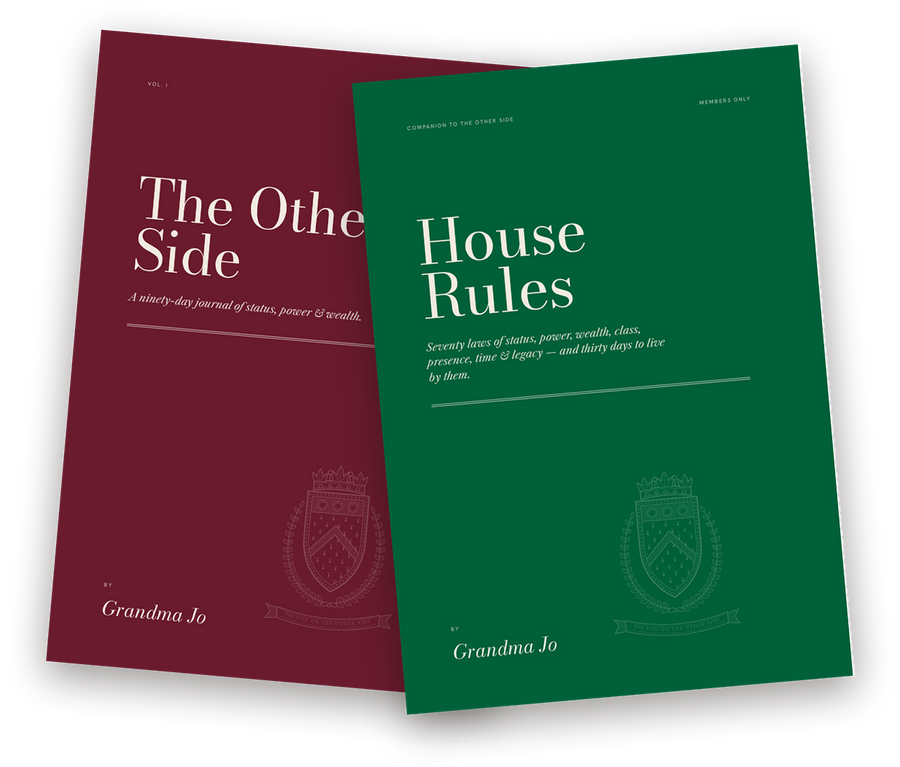
You might not, the first time. I won't promise you'll open The Other Side every morning for ninety days without a gap, because I don't know you and I don't make promises I can't keep. What I can say is that the journal was written by someone who has abandoned a good many notebooks, for people who have done the same. It goes through seven pillars, one a week, and then goes through them all again, and the second time round you'll have evidence of your own to read back.
And there's a page for precisely the morning you're dreading: the one after the gap, when the last entry is dated eight days ago and the pen feels like an accusation. It tells you not to go back to page one, not to write the book an apology, and to open today's page and fill it in as if the gap were a weekend away. That is the whole instruction. My grandmother would have recognised it. You don't unpick an entire dress because you skipped a Tuesday; you pick up the hem where you left it.
If the worry is time rather than stamina, the sums are kinder than you'd think. It asks for about a quarter of an hour a day, most of it while the kettle boils and the rest just before the light goes off. That is less time than most of us spend each day checking on things that aren't ready.
That's patience built into the practice itself. You don't have to feel patient to use it. You only have to come back. The journal travels inside The Full House, and rule 59 rides along with it in the Time chapter, where it belongs.
The page with the thread
The page where the blue tacking thread sits is near the end of the diary. The handwriting is shakier by then. There's only one line on it:
Everything good I ever made took longer than I wanted and less long than I feared.
I read it this morning with the kettle cooling and the radiator knocking, and I thought about the tulip, and the years it took to build my own business, and every good thing in my life that arrived later than I'd asked for and in better shape than I'd have made it.
Tonight, choose one thing you'll stop checking, write the date you'll look at it again, and close the book.