The short answer first. Money anxiety eases when you stop looking at money out of the corner of your eye. Look at it straight, at the same time every week, sitting down, with a pen. The number may not change for a while. You will. Calm with money comes before more money, not after it, and in forty years I haven't watched it happen the other way round.
Now the long one.
House rule 26 is the one people smile at: "Money is like a cat. It comes to the calm ones." It sounds like something embroidered on a cushion. I learnt it in a rented room with a single bed, a candlewick bedspread the colour of weak tea and a biscuit tin with a faded tartan lid, and it was not a cushion sort of lesson.
The tin on the bedspread
You need to know where I'd come from to understand the tin. For four years in my twenties every penny in the house answered to a man who liked me to know it. He knew the figures. I didn't. That was the arrangement, and he made sure I understood that I had nothing of my own and no say in any of it. What I didn't see at the time was how much of my fear came from not knowing. When you can't see the numbers, every number is a monster.
When I left, I found a room and a job at the front desk of a hotel that had been grand once and still had the carpets to prove it. I was paid weekly, in a small brown envelope with my name typed on a slip in the window. And for the first two months I did something I'm not proud of. I didn't look.
I kept the envelopes, and the letters that came to the room, in the drawer of the bedside table. I told myself I was being careful. What I was actually doing was hiding from the numbers the way I'd hidden from him, as if not seeing them would keep them from being true. I'd lie awake until after the last bus had rattled past the window, doing sums in my head that never came out the same way twice. That was my financial anxiety at its purest: not a problem I could name, just a weight on my chest at night.
It was my grandmother's diary that got me out of the drawer. I kept it on the windowsill of that room, propped against the glass, and read a page most nights. She had pinned hems for women with accounts at every good shop in town, and she'd noticed how they handled a bill. One evening I found this:
"The ladies who had it never looked in their purses in the shop. They'd looked at home, the night before, with the lamp on."
So on the following Sunday, at seven o'clock, I sat on the bed and tipped everything out. Every coin from the tin, every note from every envelope, every letter from the drawer. I sorted the coins into piles on the bedspread. I wrote the figures in pencil down the blank side of a spare hotel menu card: what had come in, what had gone out, what was due. It took forty minutes, and my hands shook for the first ten of them.
The number was small. It was also, for the first time, just a number. Not a monster. I could see all of it at once, lying on a bedspread, and none of it was going to leap at me.
I did the same the next Sunday, and the one after. Seven o'clock, the tin, the pencil, the menu card. By the second month I was asleep before the last bus.
The Friday the heel came off
I'd love to tell you that fixed it. It didn't, entirely, because the calm I'd built on Sundays hadn't yet reached the rest of the week. That took a pair of shoes.
It was a Friday in March. I was running up the hotel's back staircase at twenty to nine, and the heel of my only good pair caught on a brass stair rod and came clean off. I spent the morning shift at the front desk in a pair of black court shoes from lost property, two sizes too big, with tissue stuffed in the toes, walking like a woman on a ship.
At lunch I went to the shoe shop on the corner. I was upset and embarrassed and I felt the way I'd felt in the old life, which is to say small, found out, one mistake from the edge. The assistant brought me the first pair she thought might suit, oxblood patent with a little buckle, and I said yes before she'd finished pulling the tissue paper out of them. I paid with money from the tin. Money that was the rent.
I never wore them again after that spring. I didn't even like the colour.
On Sunday, at seven, the piles on the bedspread were short. Rent was due on Monday. My landlady, Mrs Adair, a widow with reading glasses on a chain and a radio permanently on in her kitchen, did not seem like a woman who gave weeks' grace.
I went down on Monday morning before work and stood in her kitchen doorway and said it plainly, because I'd decided on Sunday night what I would say: "I'm short this week. I'll have the rest to you on Friday."
She looked at me over the glasses for rather a long time. Then she said, "Thank you for telling me before I had to ask." That was all. On Friday I paid her the rest, out of a week of sandwiches from home and a walk instead of the bus.
That was the moment I understood what my grandmother's line was really about. The ladies who looked at home, with the lamp on, weren't just better informed than the ones who looked in the shop. They were calmer. And because they were calmer, they didn't buy oxblood shoes at lunchtime with the rent.
Why money anxiety makes the worst decisions for you
Panic always shops in a hurry, and it never once bought me anything I kept.
Here is what fear does to a mind, as far as I've ever been able to tell from my own. It shrinks the world to the next five minutes. In the next five minutes, the snapped heel is a catastrophe and the oxblood shoes are a rescue. In the next five weeks, the heel was a cobbler's job and the shoes were a mistake with a buckle on. Emotional spending is simply what happens when the next five minutes are allowed to make decisions for the next five weeks.
It isn't only shopping. Panic signs the first contract it's offered. It accepts the job it doesn't want because the silence after an interview feels unbearable. It avoids the envelope, which, as I learnt, is its own very expensive decision. There's a rule in the Wealth chapter that calls vagueness the costliest habit a person can keep, and it was written with that bedside drawer in mind. Knowing your number is the cure for the drawer, and the audit in that piece takes about twenty minutes.
And this is why the cat line isn't a cushion. A cat doesn't come to the person who lunges at it. It watches the room from the top of a bookcase and chooses the lap that isn't twitching. Opportunities are much the same. So are good decisions, good terms, good people to do business with. They go where things are steady. When you are frantic about money, you can't see the long view, and the long view is where nearly every sensible choice lives.
I saw the same thing from the other side of the front desk, many times. The guest whose card was declined at checkout and who went scarlet and began to argue always ended up in a worse spot than the one who said, "How odd. Would you mind trying it again, and if it won't go, I'll ring my bank from that chair." The second guest was no richer than the first. She simply hadn't let the next five minutes take the wheel. The general case is in composure when the pressure's on; money is only the place where the pressure is most private.
Calm, I should say, isn't the absence of worry. I worried plenty in that room. Calm is what you do while you're worried: you sit down, you look, you write it down, you decide on Sunday what you'll say on Monday. It's a habit, not a temperament, and I was not born with it. I built it out of forty-minute Sundays and one pair of bad shoes.
If what's frightening you is debt you can't see a way through, please don't carry it alone in a drawer the way I did with far less. Speak to a qualified adviser or a free debt advice service where you live. What I can offer is a habit of mind. They can offer a plan.
How to be calm with money, starting this week
None of what follows is financial advice. It's conduct, which is the only thing I've ever been qualified to talk about.
Choose your hour. Mine was Sunday at seven in those days. It's Sunday after lunch now, in a chair by the window, and the tin long ago became a folder and the menu cards became plain white ones. Money you don't look at has a way of wandering off, like anything left unwatched. Sit down for it. Have a pen. Look at what came in, what went out and what's due. Write the figures by hand; a number you've written yourself is harder to be frightened of than one glowing on a screen.
Put a night between the feeling and the purchase. When you want something with a pounding heart, that's panic or its cousin, relief, doing the shopping. Say to yourself, out loud if you have to, "I'm not deciding anything tonight." If you still want it tomorrow, calmly, you can decide then.
Have one sentence ready for other people. "Let me look at the numbers and come back to you on Thursday." It works on salesmen, on relatives, on your own worst instincts. It buys you the time in which calm does its work.
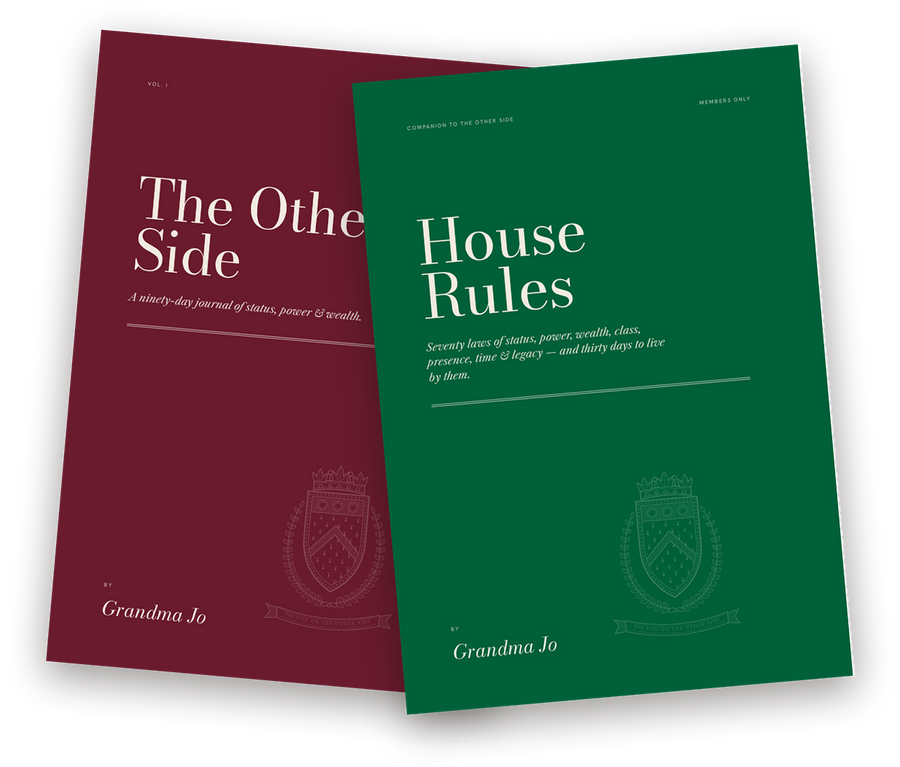
And when the fear arrives at eleven at night, as it will, write it down rather than turning it over. In my journal, The Other Side, there's a practice for exactly this, plainly named "Old story, new truth". First you write the old story ("I'll never have enough, I always make a mess of it"). Then the new truth, which has to be something you can actually check ("I looked at every figure on Sunday. I know where I stand"). It's the same muscle, pointed forwards, that swaps "I can't afford it" for "How could I?"
Ninety nights from now, if you keep the pages, here is the room I'd like you to be in. It's a Sunday evening. Your kitchen, or wherever your lamp is. A pen, a cup of something, the figures in front of you. Your shoulders are where shoulders should be. You look at the numbers once, write them down and close the book, and you realise halfway through that your breath hasn't caught once. I can't promise you what the numbers will say. Nobody honest can. I would bet on the woman at that table making better decisions on Monday than the one lying awake listening for the last bus, because I've been both of them.
The practice for that Sunday table is in The Full House. I'd particularly like you to have the lock screen with rule 26 on it, so the cat is sitting on your phone at the precise moment you open it to buy something at lunchtime with your heart going.
Tonight, sit down with a pen and look, once, at the number you've been avoiding.