There's a small brass egg timer on the corner of my desk. It holds ten minutes of fine grey sand, and it has been there for longer than some of the people I've taught have been alive. It isn't for eggs. It's there to stop me talking.
People ask me how to mentor someone as though it required a title, a programme and a great deal of time. It doesn't. You need something you learned the hard way, someone a few steps behind you on the same road, and the discipline to hand it over in about ten minutes. The rest is listening. The house rule for it is number sixty-nine:
"What took you ten years, teach in ten minutes. That's generosity with interest."
The egg timer arrived because I once got this badly wrong. I'll tell you how in the answers below, which are the questions people actually ask me, more or less in the words they use.
How do I mentor someone if I'm not especially successful yet?
You're more qualified than you think. Mentorship isn't reserved for people with corner offices. It belongs to anyone who has walked a stretch of road someone else is just starting on.
In my second year at the hotel, when I still had to stand on a telephone directory to reach the top row of key hooks, a girl of about nineteen started on the morning shift. I knew almost nothing about anything, but I knew which guests liked their newspaper folded, which manager to ask for a day off and on which day of the week, and how to say "I'll find out for you" instead of "I don't know." I told her those three things over a cup of tea in the linen room. It took about ten minutes. She stayed at that hotel for eleven years and ran the front desk for most of them.
You don't have to be at the top of the staircase. You only have to be one flight up and willing to turn round.
How do I find the right person to teach?
Usually they've already found you. Look at who asks you questions. The junior who lingers after the meeting. Your niece who keeps bringing up her job at Sunday lunch. The new person on the team who laughs a beat too late at the in-jokes because nobody has explained them.
I also watch who arrives early and who says thank you to the person clearing the plates. Those are the people who'll use what you give them. Somebody is standing outside a door you've already walked through, which was my argument in the piece on holding doors open behind you. You'll recognise them, because they look a little like you did.
What should I actually teach them?
The things that took you longest. Not the things in books. Anyone can read a manual; what they can't read is the unwritten part. The sentence you should say when the client is furious. The meeting you should never skip. The person in accounts who is secretly the most important person in the building.
A good test is to ask yourself, "What do I wish someone had told me in my first year?" Then tell them that, and tell them how you learned it, especially if you learned it by making a fool of yourself. Stories carry lessons far better than instructions do. Nobody remembers "manage your client's expectations." Everybody remembers the story of the time you promised a client Tuesday and delivered on Friday, and what her face looked like.
And teach the mistakes. When you're further along, it's tempting to present a tidy version of how you got there. Please don't. The tidy version is useless to someone who's still up to their knees in it.
How long should a mentoring conversation be?
Here's where the egg timer comes in.
Years ago, after I'd started my own small firm, a young man I'd once worked alongside rang and asked if he could buy me a coffee and "pick my brain." I was flattered. We met in a café with a green awning, and I talked for three hours. I told him everything: my whole story, every lesson, every principle, most of what my grandmother wrote in her diary, and a good deal about the weather. He nodded politely through all of it. When he left, he looked like a man who'd been made to carry furniture.
He never used a single piece of it, and I don't blame him. He'd come with one question, about whether to leave his job, and I'd buried it under a mountain of my own opinions.
The next week I bought the timer. Now, when someone sits across my desk, I turn it over and I give myself until the sand runs out. Whatever I have to say that matters, I say inside those ten minutes. The rest of the time is theirs. It's astonishing how much fits into ten minutes when you know you don't have eleven.
How do I teach without sounding like a know-it-all?
Ask before you tell. My opening question is nearly always the same: "What have you tried so far?" It shows respect for their thinking, it saves you from explaining what they already know, and it tells you exactly where they're stuck.
Then, when you do offer advice, offer it as your experience and not as law. "When I was in that position, I did this, and here's what happened" lands very differently from "What you need to do is..." The first gives them information. The second gives them an order, and nobody likes orders from people they came to for help.
Listening, properly, is most of mentorship. If I could set one piece of homework for anyone about to start teaching, it would be learning to listen better, long before learning to explain.
What if they don't take my advice?
Then they don't. It's their life.
This took me a long time to accept. When you've given someone the benefit of your hardest lessons, it stings to watch them walk straight into the wall you warned them about. But advice is a gift, and a gift with conditions attached isn't a gift. Say what you think once, clearly. After that, the decision belongs to them.
What you mustn't do is sulk, or say "I told you so" when it goes wrong. If they come back bruised, the only right sentence is: "That happens. What did you learn?" Some of the best people I've taught ignored me the first time and came back the second. They came back precisely because I hadn't made them feel foolish for leaving.
Should I teach someone who might one day compete with me?
I used to think not. When my firm was young, I kept certain things very close. How I priced, who I called, the one question I always asked a new client. I thought that knowledge was my advantage, and that sharing it would water it down.
I was wrong, and it cost me. People can tell when you're holding back, and they stop bringing you their best questions. Worse, I became a woman who counted what she'd given. I don't like that woman much, looking back.
What changed my mind was a rule from the Status pillar: "Competition is for people who haven't chosen their lane." The people I taught didn't take my lane. They found their own, usually one I'd never have thought of, and several of them sent work my way for years afterwards. Sharing knowledge made my world larger, not more crowded. That's the "interest" in generosity with interest.
What if someone asks me to be their mentor, formally?
It can feel like being proposed to by someone you've only met twice. You're touched, and slightly alarmed.
I don't do anything formal, and I'm honest about it. What I say is: "I don't take on anything official. But bring me your hardest question once a month, and I'll give you ten minutes and my full attention." Most people are delighted with that. It's clear, it's generous, and it's something I can keep, which matters more than any title. A promise you can't keep isn't mentorship. It's the first lesson in disappointment.
How do I know when it's over?
It ends when they need you less, and that's the whole point. The questions get smaller, then less frequent, then they start telling you about people they're helping. That's the sign you've done it properly.
Don't cling. Mark it, if you like: a note, a lunch, a sentence such as "You don't need me for this anymore, you know. I'm very proud of you." Then let them go. The good ones come back anyway, years later, with news. And one day, if you're lucky, they'll ask you who you think they should be teaching.
Can I mentor my own family?
You can, but it's the hardest room to teach in, because they've heard your voice every day of their lives and have learned, quite sensibly, to let most of it wash past.
When my granddaughter started her first proper job, she rang me on the second evening sounding flat. Her manager had corrected her in front of the whole team. Every grandmotherly bone in me wanted to deliver a lecture on dignity, office politics and the character of people who humiliate juniors in public. Instead I asked what she'd said back. "Nothing," she said. "I just went red." I told her one thing: that tomorrow, she could go and find the manager alone and say, "I'd find it easier to take notes if we went through corrections one to one, if that suits you." Then I stopped talking.
She said it the following morning. It worked, more or less, which is as well as anything works. Family will take one sentence from you far more readily than a speech, and they'll take it from you as a person who's been there, not as a grandmother who knows best. The egg timer helps here too. I've been known to turn it over at Sunday lunch.
What's in it for me?
More than you'd think, though I won't pretend it's the reason to do it.
Teaching makes you find out what you actually know. You can't hand a lesson to someone in ten minutes if you've never put it into words, which is why I've always written things down. Half of what I've taught came straight out of notebooks I wrote for myself first.
And it puts you in good company. The leaders I admired most, the ones who took the blame in private and gave the credit in public, were almost always teaching someone. It's part of how you know what kind of person someone is.
Where to start, if you'd like the practice
I've tried to make the habit easy to keep, and it lives in three places, because a rule you've read once is gone by Thursday.
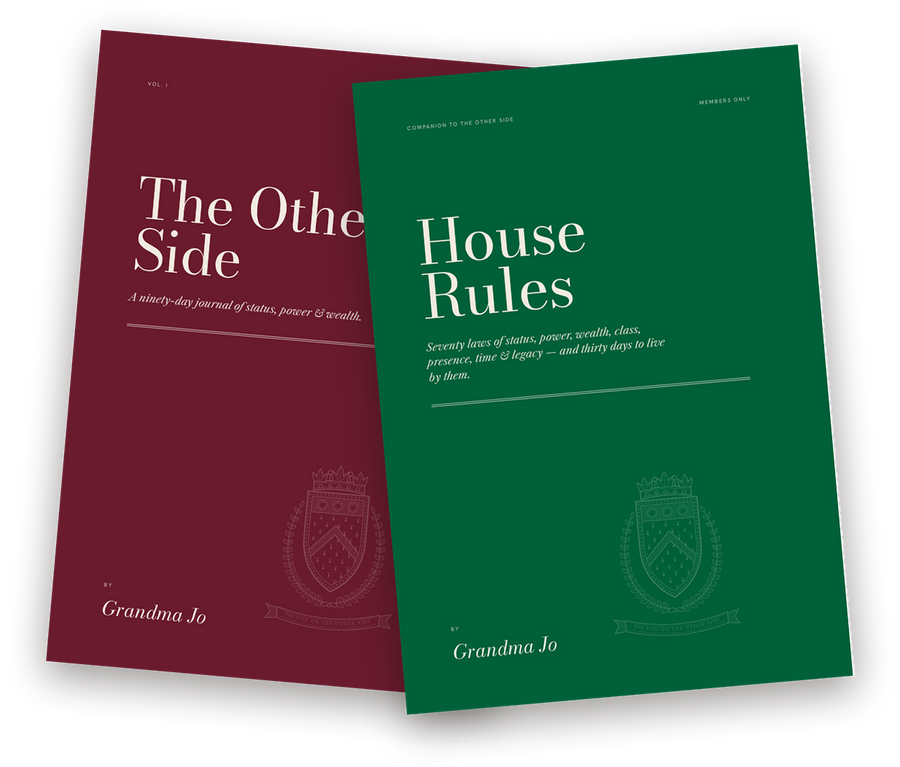
The first is House Rules. Rule sixty-nine sits in the Legacy chapter among nine others about what you leave behind, and the book's thirty-day practice fits inside a lunch break: the rule, your own sentence for it, one small move, and a note of what came back. The second is The Other Side. Each morning page has a line called The move, the one thing you'll do that day; on a Legacy morning, let it be ten minutes for someone a flight behind you, and that night write down what you taught and what they said. The third is the smallest of the three and the one people underestimate. Twelve lock screens, one of them carrying rule sixty-nine, on the glass you glance at all day long for the time, the weather and nothing in particular.
Read it once, practise it daily, catch sight of it when you've forgotten. That is the whole reason I sell them as one set rather than three, and it's the same logic behind every good lesson I was ever given: once to hear it, every day to do it, and something small to remind you when you slip.
The sand in the timer on my desk has run out while I've been writing this, which means I've gone on too long. I'll turn it over now. The next ten minutes are yours, and I suspect somebody is already waiting to be given them.