The first time a client turned me down, I did everything you shouldn't when you're working out how to handle rejection professionally. I wrote him a letter. It ran to three pages, on the new letterhead I'd had printed for my firm: thick cream stock, my name in small capitals, and a watermark I'd paid extra for that you could only see by holding the sheet up to a window. I took his reasons one by one and explained, courteously and at considerable length, why each of them was mistaken. I posted it on a Friday and felt marvellous all weekend.
He never replied. Some years later I was seated beside him at a dinner, and he looked at my place card, looked at me, and said, "You're the woman who sent the essay." Then, kindly enough: "We'd have come back to you, you know. The budget moved that spring."
So here is the answer I wish I'd had before I bought the stamp. Hear the no as "not yet, not on those terms." Find out what the terms were. Thank them, ask one useful question, and then stop talking, leaving the door exactly as you found it. That's House Rule 14, and I learned it by breaking it on my best stationery:
"Hear 'no' as 'not yet — not on those terms.'"
Six beliefs about refusal make most of us handle it worse than we need to. Here they are, one at a time.
No rarely means never
The first myth is that no means never. Almost nobody who says it means forever. They mean not now, not at that price, not with that proof, not through that person, not while the boss is on holiday, not until they've seen what the other lot are offering. A no is usually the other person telling you the price of their yes. You may not want to pay it, and that's your decision. But it's a price, and prices move.
The practical job is to find out which terms you're dealing with. There are only a handful: timing, money, proof, scope, and occasionally you. Most refusals are one of the first four, and all four change. Budgets move in the spring. The person who signs things leaves. Your work improves and there's more of it to show. The door you're standing outside this year may well swing open by itself next year, provided you haven't nailed it shut on the way out.
A decade after the letter, when I'd learned a little, the woman who ran a far larger company than mine told me no across her desk. "You're too small for us. Come back when you've got a second office." I said, "That's very clear. Thank you. May I send you a card when we do?" She laughed and said I could. It took us the better part of two years. When the second office opened I sent her the card and only the card: a photograph of the new front door, a green one with a brass letterbox, and two words in my handwriting, "As promised." No brochure, no pitch, no reminder of the meeting. She rang within the week. She'd named her terms, I'd met them, and the meeting of them did all the talking.
Rejection at work is seldom a verdict on you
The second is that a refusal is a judgement on you. Think of the last five things you turned down. An invitation, a sales call, a friend's idea for a holiday, a candidate who was perfectly good. How many of those were about the person? One, perhaps. The rest were about your week, your budget, your mood, or what you'd already promised someone else.
Other people refuse for the same reasons. Rejection at work, in business, even in love, is far more often about the refuser's situation than the asker's worth. When I was running my firm, I once said no to a very capable woman because I'd hired her near-twin a month earlier. She sent me a gracious note on a plain postcard. I hired her two years later, and she stayed eleven.
Sometimes, of course, it is personal. They didn't like you, or your work wasn't good enough yet. That stings. It's also the most useful kind, because it's the only kind you can do anything about. Treat it as information you can use, and resist treating it as a verdict you have to appeal. Appealing is how I ended up with three pages and a watermark.
You can handle rejection professionally and still mind
The third myth says a professional doesn't mind. You're allowed to mind. What you mustn't do is make your minding the other person's problem.
People confuse composure with coldness. They think the professional response is a bright "No problem at all!" delivered through their teeth, followed by a week of quiet resentment. Nobody believes the bright voice, and the resentment leaks out in the next meeting. Far better to name it once and move on: "I'm disappointed, I won't pretend otherwise. Thank you for telling me directly."
It's honest, so nobody has to wonder what you really think. It thanks them, which quietly makes you the most gracious person in the conversation. And it's over in two breaths, which tells them the disappointment is yours to carry and you've already picked it up. A refusal is pressure in a very pure form, and nearly everything in keeping calm when the room tightens applies to the minute after you hear one. The calm I mean has feeling in it. It's the feeling with its coat on.
The hardest version is the promotion that goes to someone else, because you'll be sitting near that decision every day afterwards. Everyone in the office will glance at your face that first morning, whether they mean to or not. Get there before they do. Walk over to the person who got it, before lunch, where others can see, and say, "Congratulations. You'll be very good at it." Then, separately and privately, take the one useful question to your manager. The order matters. Public grace first, private questions second. Reverse them and it looks like a complaint wearing a smile.
Why "why?" is the wrong question after a no
The received wisdom says find out why, straight away and in detail. I followed it to the letter, literally. I wanted the reasons, and then I wanted to argue with them, and those two wishes tend to arrive together.
Ask one question, once. Make it the useful one, which is almost never "Why?", because that invites a defence, and people defending a decision dig in. Ask about the future instead:
- "What would need to be different for this to be a yes?"
- "Is this a no for now, or a no to the idea?"
- "What would you need to see from me next time?"
Then listen, write down what they say, and don't rebut a word of it. If the answer is vague, let it be vague. If it's plainly an excuse, let it be an excuse; you've learned how they deliver bad news, which is worth knowing too. The urge to set them straight is strongest in the half-hour after a refusal, and it's the same urge I took apart in the habit of over-explaining. Someone who has already decided will not be converted by your second paragraph. They'll only have more to disagree with.
Chasing and persistence are different animals
The fifth myth is that persistence means asking until they give in. People who handle no well are praised for persistence, and people who handle it badly hear that word and start ringing every Tuesday.
The two are different animals. Chasing is coming back because you can't bear the silence. Persistence is coming back because the terms have changed. The first is about your nerves, the second about their situation, and you can feel which one it is in your stomach before you pick up the phone. So can they, when they answer it. House Rule 13 covers it:
"I have never run after a bus, a lover or an opportunity. Another one always comes."
Anyone who read why I stopped chasing people will recognise the principle. It applies to clients and promotions exactly as much as it applies to men who don't ring back.
So when do you go back? When you can honestly open with something new. Roughly like this:
"When we spoke in the spring you said the timing wasn't right, and that you'd want to see it working somewhere first. It's now working in two places. I thought you'd want to know. Shall we find half an hour?"
No recap of how hurt you were. No "just checking in." A change in the terms, stated plainly, and one clear ask. If they say no again, you've lost nothing, and you've shown them exactly who they'd be dealing with: someone who listens, returns when it's useful and doesn't make a fuss. People remember that when the budget moves.
Not every no deserves a post-mortem
The last myth is the one I held longest: that every refusal deserves an inquest. I used to lie awake over them. I'd replay the conversation, hunt for the sentence that lost it, and rewrite my side in the dark. I was sure this was diligence. It was mostly pain with a notebook.
Some refusals have a lesson in them. Most don't. The client had a cousin in the trade. The committee was always going to pick the internal candidate. The shop was closing that month anyway. Picking over each of those teaches you only to flinch before the next ask, and a flinch costs far more over a career than any single no.
What helps is writing the no down, briefly, with its terms, and closing the book on it for the night. The Other Side has an evening line called Evidence, meant for proof that the day moved you forward, and I've often put a refusal there beside the day's small wins. A no you asked for is evidence too. It proves you were in the room making an offer, which is where every yes eventually comes from. People who never hear no aren't lucky; they simply aren't asking.
A seven-night trial of Rule 14
I won't promise that one rule changes the way you take a refusal. It changed mine, eventually, but it took a letterhead's worth of mistakes. What I'll suggest is a test.
For the next seven nights, before you turn the light off, write down every no you heard that day: from a client, a manager, a shop, a child, a date, even from yourself. Next to each one write "not yet", and then the terms, as best you can guess them. Timing, money, proof, scope, person. Leave out how you felt. Write only what would need to change.
By the fourth or fifth night you may notice the list of terms is short and repetitive, and that nearly all of them are things that do, in fact, shift with time. The word itself starts to sound different. Less like a door slamming, more like somebody quoting you a price.
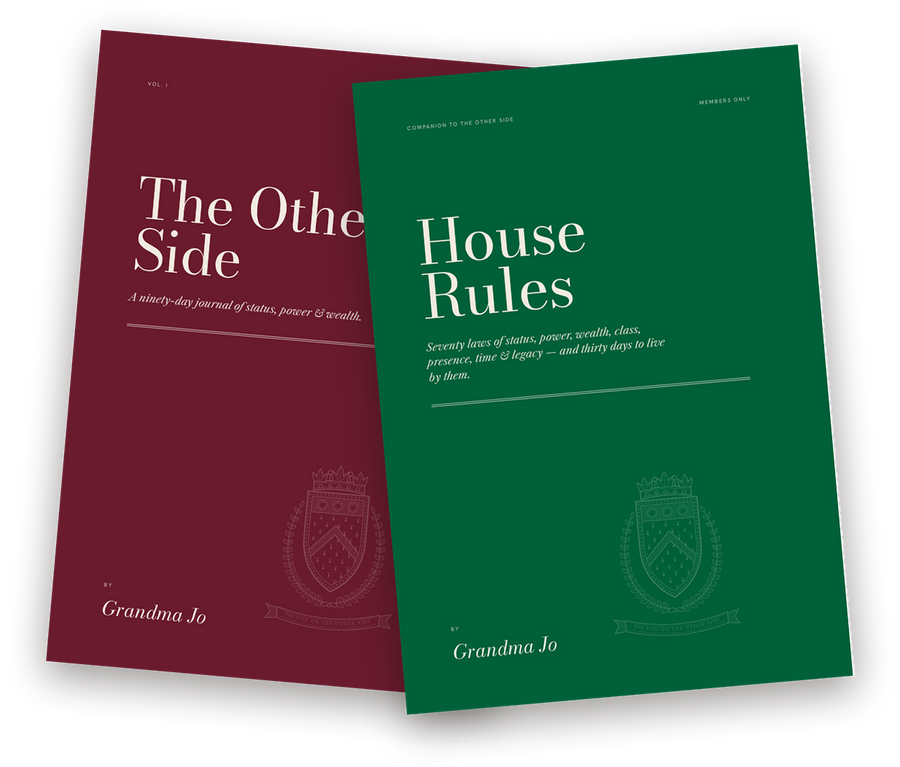
If that happens for you, Rule 14 has sixty-nine companions in House Rules, each small enough to try over a sandwich, and the journal is where you keep the score. I put the two together as The Full House for readers who finish a week like this one and want the next.
Here's the rule once more, the way I'd say it to you across a table now. A refusal tells you what their yes would cost. Listen to the figure, decide whether you'll pay it, and leave quietly, because one day you'll want to walk back in.